Q5HZK1
Gene name |
Cep44 (Kiaa1712) |
Protein name |
Centrosomal protein of 44 kDa |
Names |
Cep44 |
Species |
Mus musculus (Mouse) |
KEGG Pathway |
mmu:382010 |
EC number |
|
Protein Class |
|
Descriptions
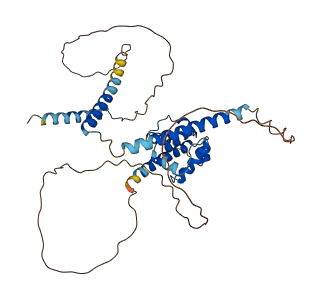
The autoinhibited protein was predicted that may have potential autoinhibitory elements via cis-regPred.
Autoinhibitory domains (AIDs)
Target domain |
|
Relief mechanism |
|
Assay |
cis-regPred |
Accessory elements
No accessory elements
Autoinhibited structure

Activated structure
1 structures for Q5HZK1
| Entry ID | Method | Resolution | Chain | Position | Source |
|---|---|---|---|---|---|
| AF-Q5HZK1-F1 | Predicted | AlphaFoldDB |
20 variants for Q5HZK1
| Variant ID(s) | Position | Change | Description | Diseaes Association | Provenance |
|---|---|---|---|---|---|
| rs3388981371 | 30 | G>S | No | EVA | |
| rs3388970594 | 42 | I>F | No | EVA | |
| rs3388983568 | 48 | T>N | No | EVA | |
| rs38545817 | 55 | A>V | No | EVA | |
| rs3388988576 | 65 | L>H | No | EVA | |
| rs3388981324 | 74 | T>I | No | EVA | |
| rs3399088262 | 101 | F>Y | No | EVA | |
| rs239773772 | 106 | I>V | No | EVA | |
| rs245585625 | 165 | M>L | No | EVA | |
| rs3388981347 | 179 | Y>* | No | EVA | |
| rs36783882 | 191 | V>G | No | EVA | |
| rs232747835 | 210 | I>V | No | EVA | |
| rs263164399 | 217 | D>A | No | EVA | |
| rs37074455 | 218 | P>A | No | EVA | |
| rs3388935246 | 260 | L>M | No | EVA | |
| rs33607336 | 312 | D>E | No | EVA | |
| rs32867624 | 341 | S>A | No | EVA | |
| rs3388970604 | 343 | T>I | No | EVA | |
| rs3388964935 | 346 | G>A | No | EVA | |
| rs3388985366 | 346 | G>R | No | EVA |
No associated diseases with Q5HZK1
1 regional properties for Q5HZK1
| Type | Name | Position | InterPro Accession |
|---|---|---|---|
| domain | Centrosomal CEP44 domain | 5 - 126 | IPR029157 |
Functions
5 GO annotations of cellular component
| Name | Definition |
|---|---|
| centriole | A cellular organelle, found close to the nucleus in many eukaryotic cells, consisting of a small cylinder with microtubular walls, 300-500 nm long and 150-250 nm in diameter. It contains nine short, parallel, peripheral microtubular fibrils, each fibril consisting of one complete microtubule fused to two incomplete microtubules. Cells usually have two centrioles, lying at right angles to each other. At division, each pair of centrioles generates another pair and the twin pairs form the pole of the mitotic spindle. |
| centrosome | A structure comprised of a core structure (in most organisms, a pair of centrioles) and peripheral material from which a microtubule-based structure, such as a spindle apparatus, is organized. Centrosomes occur close to the nucleus during interphase in many eukaryotic cells, though in animal cells it changes continually during the cell-division cycle. |
| cytoplasm | The contents of a cell excluding the plasma membrane and nucleus, but including other subcellular structures. |
| midbody | A thin cytoplasmic bridge formed between daughter cells at the end of cytokinesis. The midbody forms where the contractile ring constricts, and may persist for some time before finally breaking to complete cytokinesis. |
| spindle pole | Either of the ends of a spindle, where spindle microtubules are organized; usually contains a microtubule organizing center and accessory molecules, spindle microtubules and astral microtubules. |
1 GO annotations of molecular function
| Name | Definition |
|---|---|
| microtubule binding | Binding to a microtubule, a filament composed of tubulin monomers. |
3 GO annotations of biological process
| Name | Definition |
|---|---|
| centriole replication | The cell cycle process in which a daughter centriole is formed perpendicular to an existing centriole. An immature centriole contains a ninefold radially symmetric array of single microtubules; mature centrioles consist of a radial array of nine microtubule triplets, doublets, or singlets depending upon the species and cell type. Duplicated centrioles also become the ciliary basal body in cells that form cilia during G0. |
| centriole-centriole cohesion | The cell cycle process in which the two centrioles within a centrosome remain tightly paired. |
| centrosome cycle | The cell cycle process in which centrosome duplication and separation takes place. The centrosome cycle can operate with a considerable degree of independence from other processes of the cell cycle. |
| 10 | 20 | 30 | 40 | 50 | 60 |
| MATGDLKRSL | RKLEQVLRSL | NYPNEVDYVG | LIKGDTAASL | PIISYSLTSY | SPYVAELLME |
| 70 | 80 | 90 | 100 | 110 | 120 |
| SSIELIAKND | VRFTDTVYKL | LRDQFDYKPI | LTKKQFIQSG | FAEWKIEIVC | DILNCVMKKH |
| 130 | 140 | 150 | 160 | 170 | 180 |
| KELIGLDKNS | SCQRKKNVSE | KPEPCSNSEK | RPAEAVGIDI | TGRFMTSGKK | KAVVIRHLYT |
| 190 | 200 | 210 | 220 | 230 | 240 |
| DEKVGVPEGT | VTLADISQGC | SESAEQSSDI | RIPEAQDPEV | KAELQDICDH | PEITALQIAL |
| 250 | 260 | 270 | 280 | 290 | 300 |
| AECQEKLKQL | TWIEKRLERL | EAATHGKVMV | DEKAWNNLLS | RVTLLETEML | LSKKSESVER |
| 310 | 320 | 330 | 340 | 350 | 360 |
| NVASQDCESI | SDVDFVPYDK | NYSVGGAAGN | YRSSGCSAVS | SETAPGSSIV | NYCVLREFSE |
| 370 | 380 | ||||
| ETTIQKMERM | KKMFEETAEL | LKCSSR |