Q5FVJ6
Gene name |
Bscl2 |
Protein name |
Seipin |
Names |
Bernardinelli-Seip congenital lipodystrophy type 2 protein homolog |
Species |
Rattus norvegicus (Rat) |
KEGG Pathway |
rno:361722 |
EC number |
|
Protein Class |
|
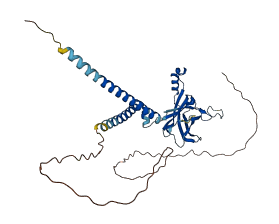
Descriptions
The autoinhibited protein was predicted that may have potential autoinhibitory elements via cis-regPred.
Autoinhibitory domains (AIDs)
Target domain |
|
Relief mechanism |
|
Assay |
cis-regPred |
Accessory elements
No accessory elements
Autoinhibited structure

Activated structure
1 structures for Q5FVJ6
| Entry ID | Method | Resolution | Chain | Position | Source |
|---|---|---|---|---|---|
| AF-Q5FVJ6-F1 | Predicted | AlphaFoldDB |
No variants for Q5FVJ6
| Variant ID(s) | Position | Change | Description | Diseaes Association | Provenance |
|---|---|---|---|---|---|
| No variants for Q5FVJ6 | |||||
No associated diseases with Q5FVJ6
Functions
5 GO annotations of cellular component
| Name | Definition |
|---|---|
| cytosol | The part of the cytoplasm that does not contain organelles but which does contain other particulate matter, such as protein complexes. |
| endoplasmic reticulum | The irregular network of unit membranes, visible only by electron microscopy, that occurs in the cytoplasm of many eukaryotic cells. The membranes form a complex meshwork of tubular channels, which are often expanded into slitlike cavities called cisternae. The ER takes two forms, rough (or granular), with ribosomes adhering to the outer surface, and smooth (with no ribosomes attached). |
| endoplasmic reticulum membrane | The lipid bilayer surrounding the endoplasmic reticulum. |
| integral component of endoplasmic reticulum membrane | The component of the endoplasmic reticulum membrane consisting of the gene products and protein complexes having at least some part of their peptide sequence embedded in the hydrophobic region of the membrane. |
| lipid droplet | An intracellular non-membrane-bounded organelle comprising a matrix of coalesced lipids surrounded by a phospholipid monolayer. May include associated proteins. |
1 GO annotations of molecular function
| Name | Definition |
|---|---|
| phospholipid binding | Binding to a phospholipid, a class of lipids containing phosphoric acid as a mono- or diester. |
13 GO annotations of biological process
| Name | Definition |
|---|---|
| adipose tissue development | The process whose specific outcome is the progression of adipose tissue over time, from its formation to the mature structure. Adipose tissue is specialized tissue that is used to store fat. |
| cytosolic lipolysis | The chemical reactions and pathways resulting in the breakdown of lipid droplets and hydrolysis of stored triglycerides occurring through the orchestrated activation of cytosolic lipases. |
| fat cell differentiation | The process in which a relatively unspecialized cell acquires specialized features of an adipocyte, an animal connective tissue cell specialized for the synthesis and storage of fat. |
| lipid droplet formation | A process that results in the assembly, arrangement of constituent parts of a lipid droplet. |
| lipid droplet organization | A process that is carried out at the cellular level which results in the assembly, arrangement of constituent parts, or disassembly of a lipid particle. |
| lipid storage | The accumulation and maintenance in cells or tissues of lipids, compounds soluble in organic solvents but insoluble or sparingly soluble in aqueous solvents. Lipid reserves can be accumulated during early developmental stages for mobilization and utilization at later stages of development. |
| maintenance of location in cell | Any process in which a substance or cellular entity, such as a protein complex or organelle, is maintained in a specific location within, or in the membrane of, a cell, and is prevented from moving elsewhere. |
| negative regulation of catalytic activity | Any process that stops or reduces the activity of an enzyme. |
| negative regulation of lipid catabolic process | Any process that stops, prevents, or reduces the frequency, rate or extent of the chemical reactions and pathways resulting in the breakdown of lipids. |
| positive regulation of cold-induced thermogenesis | Any process that activates or increases the frequency, rate or extent of cold-induced thermogenesis. |
| regulation of excitatory postsynaptic membrane potential involved in skeletal muscle contraction | Any process, involved in skeletal muscle contraction, that modulates the establishment or extent of the excitatory postsynaptic potential (EPSP). Excitatory postsynaptic potential (EPSP) is a temporay increase in postsynaptic potential due to the flow of positively charged ions into the postsynaptic cell. The flow of ions that causes an EPSP is an excitatory postsynaptic current (EPSC) and makes it easier for the neuron to fire an action potential. |
| regulation of phosphatidic acid biosynthetic process | Any process that modulates the frequency, rate or extent of phosphatidic acid biosynthetic process. |
| spermatid differentiation | The process whose specific outcome is the progression of a spermatid over time, from initial commitment of the cell to a specific fate, to the fully functional differentiated cell. |
| 10 | 20 | 30 | 40 | 50 | 60 |
| MVNDPPVPAL | LWAQEVGHVL | AGRARRLMLQ | FGVLFCTILL | LLWVSVFLYG | SFYYSYMPTV |
| 70 | 80 | 90 | 100 | 110 | 120 |
| SHLSPVHFYY | RTDCDSSTAS | LCSFPVANVS | LTKSGRDRVL | MYGQPYRVTL | ELELPESPVN |
| 130 | 140 | 150 | 160 | 170 | 180 |
| QDLGMFLVTV | SCYTRGGRII | STSSRSVMLH | YRSQLLQMLD | TLVFSSLLLF | GFAEQKQLLE |
| 190 | 200 | 210 | 220 | 230 | 240 |
| VELYSDYREN | SYVPTTGAII | EVHSKRVQMY | GAYLRIHAHF | TGLRYLLYNF | PMTCAFVGVA |
| 250 | 260 | 270 | 280 | 290 | 300 |
| SNFTFLSVIA | LFSYMQWVWG | AVWPRHRFSL | QVNIRQRDNS | GHGAQRRISR | HQPGQASTQQ |
| 310 | 320 | 330 | 340 | 350 | 360 |
| SDVTEDGESP | EDPSGTEGQL | SEEEKPEKQP | LNGEGEQEPE | ASDGSWEDAA | LLTEASTSAL |
| 370 | |||||
| APETLGSLRQ | RQTCSSS |