Q5EB32
Gene name |
mtm1 |
Protein name |
Myotubularin |
Names |
Phosphatidylinositol-3,5-bisphosphate 3-phosphatase, Phosphatidylinositol-3-phosphate phosphatase |
Species |
Xenopus tropicalis (Western clawed frog) (Silurana tropicalis) |
KEGG Pathway |
xtr:548545 |
EC number |
3.1.3.64: Phosphoric monoester hydrolases |
Protein Class |
|
Descriptions
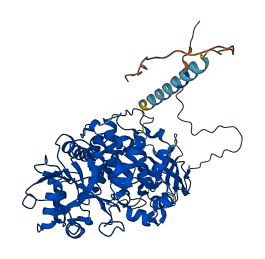
The autoinhibited protein was predicted that may have potential autoinhibitory elements via cis-regPred.
Autoinhibitory domains (AIDs)
Target domain |
|
Relief mechanism |
|
Assay |
cis-regPred |
Accessory elements
No accessory elements
Autoinhibited structure

Activated structure
1 structures for Q5EB32
| Entry ID | Method | Resolution | Chain | Position | Source |
|---|---|---|---|---|---|
| AF-Q5EB32-F1 | Predicted | AlphaFoldDB |
No variants for Q5EB32
| Variant ID(s) | Position | Change | Description | Diseaes Association | Provenance |
|---|---|---|---|---|---|
| No variants for Q5EB32 | |||||
No associated diseases with Q5EB32
5 regional properties for Q5EB32
| Type | Name | Position | InterPro Accession |
|---|---|---|---|
| domain | Tyrosine-specific protein phosphatases domain | 343 - 390 | IPR000387 |
| domain | Protein-tyrosine phosphatase, catalytic | 319 - 470 | IPR003595 |
| domain | GRAM domain | 29 - 142 | IPR004182 |
| domain | Myotubularin-like, phosphatase domain | 150 - 537 | IPR010569 |
| active_site | Protein-tyrosine phosphatase, active site | 372 - 382 | IPR016130 |
Functions
| Description | ||
|---|---|---|
| EC Number | 3.1.3.64 | Phosphoric monoester hydrolases |
| Subcellular Localization |
|
|
| PANTHER Family | ||
| PANTHER Subfamily | ||
| PANTHER Protein Class | ||
| PANTHER Pathway Category | No pathway information available | |
5 GO annotations of cellular component
| Name | Definition |
|---|---|
| filopodium | Thin, stiff, actin-based protrusion extended by the leading edge of a motile cell such as a crawling fibroblast or amoeba, or an axonal or dendritic growth cone, or a dendritic shaft. |
| late endosome | A prelysosomal endocytic organelle differentiated from early endosomes by lower lumenal pH and different protein composition. Late endosomes are more spherical than early endosomes and are mostly juxtanuclear, being concentrated near the microtubule organizing center. |
| plasma membrane | The membrane surrounding a cell that separates the cell from its external environment. It consists of a phospholipid bilayer and associated proteins. |
| ruffle | Projection at the leading edge of a crawling cell; the protrusions are supported by a microfilament meshwork. |
| sarcomere | The repeating unit of a myofibril in a muscle cell, composed of an array of overlapping thick and thin filaments between two adjacent Z discs. |
3 GO annotations of molecular function
| Name | Definition |
|---|---|
| phosphatidylinositol-3,5-bisphosphate 3-phosphatase activity | Catalysis of the reaction: 1-phosphatidyl-1D-myo-inositol 3,5-bisphosphate + H2O = a 1-phosphatidyl-1D-myo-inositol 5-phosphate + phosphate + 2 H+. |
| phosphatidylinositol-3-phosphatase activity | Catalysis of the reaction: 1-phosphatidyl-1D-myo-inositol 3-phosphate + H2O = 1-phosphatidyl-1D-myo-inositol + phosphate. |
| phosphoprotein phosphatase activity | Catalysis of the reaction: a phosphoprotein + H2O = a protein + phosphate. Together with protein kinases, these enzymes control the state of phosphorylation of cellular proteins and thereby provide an important mechanism for regulating cellular activity. |
6 GO annotations of biological process
| Name | Definition |
|---|---|
| endosome to lysosome transport | The directed movement of substances from endosomes to lysosomes. |
| intermediate filament organization | Control of the spatial distribution of intermediate filaments; includes organizing filaments into meshworks, bundles, or other structures, as by cross-linking. |
| mitochondrion distribution | Any process that establishes the spatial arrangement of mitochondria between and within cells. |
| muscle cell cellular homeostasis | The cellular homeostatic process that preserves a muscle cell in a stable functional or structural state. |
| phosphatidylinositol dephosphorylation | The process of removing one or more phosphate groups from a phosphatidylinositol. |
| regulation of vacuole organization | Any process that modulates the frequency, rate or extent of a process involved in the formation, arrangement of constituent parts, or disassembly of a vacuole. |
| 10 | 20 | 30 | 40 | 50 | 60 |
| MASNSTPKYN | SNSLENSLRR | SPGDGMNHEQ | NDEIPCLPGE | ALITDKDVIY | MCPFYGPVKG |
| 70 | 80 | 90 | 100 | 110 | 120 |
| RIHVTNYKLY | FKGEEMEPLI | SFSVPLGVIA | RIEKMGGASS | RGENSYGLDI | TCKDMRNLRF |
| 130 | 140 | 150 | 160 | 170 | 180 |
| ALKQEVHSRK | QIFEDLTKYA | FPLSHGLLLF | AFQNEEKFPE | NGWAVYDAMT | EFRRQGLPNG |
| 190 | 200 | 210 | 220 | 230 | 240 |
| QWRITFINKN | YELCDTYPPL | LVVPYSASEE | DLKKVAAFRS | RNRIPVLSWL | HPENQSAIMR |
| 250 | 260 | 270 | 280 | 290 | 300 |
| CSQPLVGMSG | KRNKDDERYL | DIIRDTNGQT | SKLTIYDARP | NVNAVANKAT | GGGYESEDAY |
| 310 | 320 | 330 | 340 | 350 | 360 |
| PNAELVFLDI | HNIHVMRESL | KKLKDIVYPN | VEESHWLSSL | ESTHWLEHIK | LVLTGAIQVA |
| 370 | 380 | 390 | 400 | 410 | 420 |
| DKVASGKSSV | VVHCSDGWDR | TAQLTSLAML | MLDSYYRTIV | GFEVLVQKEW | ISFGHKFSSR |
| 430 | 440 | 450 | 460 | 470 | 480 |
| IGHGDKNHAD | ADRSPIFLQF | IDCVWQMSKQ | FPTAFEFNEH | FLITVLDHLY | SCRFGTFLYN |
| 490 | 500 | 510 | 520 | 530 | 540 |
| CENIRDKEKV | REKTQSLWSL | ISSEKSKYTN | PFYTKELNRV | LYPVASMRHL | ELWVNYYIRW |
| 550 | 560 | 570 | 580 | 590 | 600 |
| NPRIRQQQPN | PVEQRYMELL | ALRDDYVRRL | EELQITNSPK | MNSSTTSPSS | PSQIMPQVHT |
| PF |