Q5E9Q1
Gene name |
POGLUT1 (CLP46, KTELC1) |
Protein name |
Protein O-glucosyltransferase 1 |
Names |
CAP10-like 46 kDa protein, KTEL motif-containing protein 1, O-glucosyltransferase Rumi homolog, Rumi, Protein O-xylosyltransferase |
Species |
Bos taurus (Bovine) |
KEGG Pathway |
bta:511862 |
EC number |
2.4.1.376: Hexosyltransferases |
Protein Class |
|
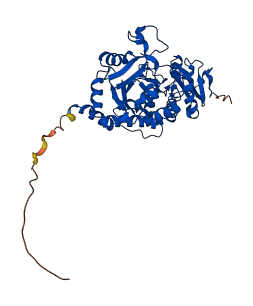
Descriptions
The autoinhibited protein was predicted that may have potential autoinhibitory elements via cis-regPred.
Autoinhibitory domains (AIDs)
Target domain |
|
Relief mechanism |
|
Assay |
cis-regPred |
Accessory elements
No accessory elements
Autoinhibited structure

Activated structure
1 structures for Q5E9Q1
| Entry ID | Method | Resolution | Chain | Position | Source |
|---|---|---|---|---|---|
| AF-Q5E9Q1-F1 | Predicted | AlphaFoldDB |
22 variants for Q5E9Q1
| Variant ID(s) | Position | Change | Description | Diseaes Association | Provenance |
|---|---|---|---|---|---|
| rs463545117 | 5 | V>G | No | EVA | |
| rs443433481 | 5 | V>M | No | EVA | |
| rs477602261 | 8 | Q>R | No | EVA | |
| rs459748217 | 19 | P>T | No | EVA | |
| rs479761322 | 21 | V>G | No | EVA | |
| rs461023173 | 51 | S>R | No | EVA | |
| rs434941498 | 61 | I>M | No | EVA | |
| rs455111825 | 62 | E>K | No | EVA | |
| rs1116318608 | 80 | V>A | No | EVA | |
| rs716879447 | 121 | R>H | No | EVA | |
| rs1117324367 | 127 | M>I | No | EVA | |
| rs470718475 | 152 | K>* | No | EVA | |
| rs798318918 | 196 | A>T | No | EVA | |
| rs451782073 | 200 | W>C | No | EVA | |
| rs437262963 | 214 | T>K | No | EVA | |
| rs450771984 | 273 | G>A | No | EVA | |
| rs482123376 | 273 | G>C | No | EVA | |
| rs464379593 | 309 | V>G | No | EVA | |
| rs478019530 | 316 | T>K | No | EVA | |
| rs446618680 | 317 | D>A | No | EVA | |
| rs467085113 | 320 | N>H | No | EVA | |
| rs435675910 | 321 | V>L | No | EVA |
No associated diseases with Q5E9Q1
1 regional properties for Q5E9Q1
| Type | Name | Position | InterPro Accession |
|---|---|---|---|
| domain | Glycosyl transferase CAP10 domain | 50 - 388 | IPR006598 |
Functions
| Description | ||
|---|---|---|
| EC Number | 2.4.1.376 | Hexosyltransferases |
| Subcellular Localization |
|
|
| PANTHER Family | ||
| PANTHER Subfamily | ||
| PANTHER Protein Class | ||
| PANTHER Pathway Category | No pathway information available | |
2 GO annotations of cellular component
| Name | Definition |
|---|---|
| endomembrane system | A collection of membranous structures involved in transport within the cell. The main components of the endomembrane system are endoplasmic reticulum, Golgi bodies, vesicles, cell membrane and nuclear envelope. Members of the endomembrane system pass materials through each other or though the use of vesicles. |
| endoplasmic reticulum lumen | The volume enclosed by the membranes of the endoplasmic reticulum. |
5 GO annotations of molecular function
| Name | Definition |
|---|---|
| EGF-domain serine glucosyltransferase activity | Catalysis of the reaction: UDP-alpha-D-glucose + -3-O-(beta-D-glucosyl)-L-serine. |
| EGF-domain serine xylosyltransferase activity | Catalyses the reaction: UDP-alpha-D-xylose + -3-O-(beta-D-xylosyl)-L-serine. |
| glucosyltransferase activity | Catalysis of the transfer of a glucosyl group to an acceptor molecule, typically another carbohydrate or a lipid. |
| UDP-glucosyltransferase activity | Catalysis of the transfer of a glucosyl group from UDP-glucose to an acceptor molecule. |
| UDP-xylosyltransferase activity | Catalysis of the transfer of a xylosyl group from UDP-xylose to an acceptor molecule. |
10 GO annotations of biological process
| Name | Definition |
|---|---|
| axial mesoderm development | The process whose specific outcome is the progression of the axial mesoderm over time, from its formation to the mature structure. The axial mesoderm includes the prechordal mesoderm and the chordamesoderm. It gives rise to the prechordal plate and to the notochord. |
| circulatory system development | The process whose specific outcome is the progression of the circulatory system over time, from its formation to the mature structure. The circulatory system is the organ system that passes nutrients (such as amino acids and electrolytes), gases, hormones, blood cells, etc. to and from cells in the body to help fight diseases and help stabilize body temperature and pH to maintain homeostasis. |
| gastrulation | A complex and coordinated series of cellular movements that occurs at the end of cleavage during embryonic development of most animals. The details of gastrulation vary from species to species, but usually result in the formation of the three primary germ layers, ectoderm, mesoderm and endoderm. |
| muscle tissue development | The progression of muscle tissue over time, from its initial formation to its mature state. Muscle tissue is a contractile tissue made up of actin and myosin fibers. |
| paraxial mesoderm development | The process whose specific outcome is the progression of the paraxial mesoderm over time, from its formation to the mature structure. The paraxial mesoderm is the mesoderm located bilaterally adjacent to the notochord and neural tube. |
| positive regulation of Notch signaling pathway | Any process that activates or increases the frequency, rate or extent of the Notch signaling pathway. |
| protein O-linked glycosylation | A protein glycosylation process in which a carbohydrate or carbohydrate derivative unit is added to a protein via the hydroxyl group of peptidyl-serine, peptidyl-threonine, peptidyl-hydroxylysine, or peptidyl-hydroxyproline, or via the phenol group of peptidyl-tyrosine, forming an O-glycan. |
| protein O-linked glycosylation via serine | The glycosylation of protein via the O3 atom of peptidyl-serine, forming O3-glycosyl-L-serine; the most common forms are N-acetylgalactosaminyl, mannosyl, galactosyl, and xylosyl serine. |
| regulation of gastrulation | Any process that modulates the rate or extent of gastrulation. Gastrulation is the complex and coordinated series of cellular movements that occurs at the end of cleavage during embryonic development of most animals. |
| somitogenesis | The formation of mesodermal clusters that are arranged segmentally along the anterior posterior axis of an embryo. |
| 10 | 20 | 30 | 40 | 50 | 60 |
| MELGVSSQLW | LWLLLLLLPP | VPGREKESGS | KWKVFIDQIN | RALENYEPCS | SPNCSCYHGV |
| 70 | 80 | 90 | 100 | 110 | 120 |
| IEEDLTPFRG | GISRKMMAEV | VRRKLGTHYQ | IIKNRLYRES | DCMFPSRCSG | VEHFILEVIG |
| 130 | 140 | 150 | 160 | 170 | 180 |
| RLPDMEMVIN | VRDYPQVPKW | MEPAIPIFSF | SKTLEYHDIM | YPAWTFWEGG | PAVWPIYPMG |
| 190 | 200 | 210 | 220 | 230 | 240 |
| LGRWDLFRED | LVRSAAQWPW | KKKNSTAYFR | GSRTSPERDP | LILLSRKNPK | LVDAEYTKNQ |
| 250 | 260 | 270 | 280 | 290 | 300 |
| AWKSMKDTLG | KPAAKDVHLV | DHCKYKYLFN | FRGVAASFRF | KHLFLCGSLV | FHVGDEWLEF |
| 310 | 320 | 330 | 340 | 350 | 360 |
| FYPQLKPWVH | YIPVKTDLSN | VQELLQFVKA | NDDVAQEIAE | RGSQFILNHL | KMDDITCYWE |
| 370 | 380 | 390 | |||
| NLLTEYSKFL | SYNVTRRKGY | DQIVPKILKI | EL |