Q56A18
Gene name |
Smarce1 (Baf57) |
Protein name |
SWI/SNF-related matrix-associated actin-dependent regulator of chromatin subfamily E member 1 |
Names |
BRG1-associated factor 57, BAF57 |
Species |
Rattus norvegicus (Rat) |
KEGG Pathway |
rno:303518 |
EC number |
|
Protein Class |
|
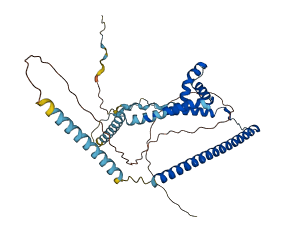
Descriptions
The autoinhibited protein was predicted that may have potential autoinhibitory elements via cis-regPred.
Autoinhibitory domains (AIDs)
Target domain |
|
Relief mechanism |
|
Assay |
cis-regPred |
Accessory elements
No accessory elements
Autoinhibited structure

Activated structure
1 structures for Q56A18
| Entry ID | Method | Resolution | Chain | Position | Source |
|---|---|---|---|---|---|
| AF-Q56A18-F1 | Predicted | AlphaFoldDB |
1 variants for Q56A18
| Variant ID(s) | Position | Change | Description | Diseaes Association | Provenance |
|---|---|---|---|---|---|
| rs3321914165 | 372 | D>A | No | EVA |
No associated diseases with Q56A18
1 regional properties for Q56A18
| Type | Name | Position | InterPro Accession |
|---|---|---|---|
| domain | High mobility group box domain | 30 - 100 | IPR009071 |
4 GO annotations of cellular component
| Name | Definition |
|---|---|
| nBAF complex | A SWI/SNF-type complex that is found in post-mitotic neurons, and in human contains actin and proteins encoded by the ARID1A/BAF250A or ARID1B/BAF250B, SMARCD1/BAF60A, SMARCD3/BAF60C, SMARCA2/BRM/BAF190B, SMARCA4/BRG1/BAF190A, SMARCB1/BAF47, SMARCC1/BAF155, SMARCE1/BAF57, SMARCC2/BAF170, DPF1/BAF45B, DPF3/BAF45C, ACTL6B/BAF53B genes. The nBAF complex along with CREST plays a role regulating the activity of genes essential for dendrite growth. |
| npBAF complex | A SWI/SNF-type complex that is found in neural stem or progenitor cells, and in human contains actin and proteins encoded by the ARID1A/BAF250A or ARID1B/BAF250B, SMARCD1/BAF60A, SMARCD3/BAF60C, SMARCA2/BRM/BAF190B, SMARCA4/BRG1/BAF190A, SMARCB1/BAF47, SMARCC1/BAF155, SMARCE1/BAF57, SMARCC2/BAF170, PHF10/BAF45A, ACTL6A/BAF53A genes. The npBAF complex is essential for the self-renewal/proliferative capacity of the multipotent neural stem cells. |
| nucleus | A membrane-bounded organelle of eukaryotic cells in which chromosomes are housed and replicated. In most cells, the nucleus contains all of the cell's chromosomes except the organellar chromosomes, and is the site of RNA synthesis and processing. In some species, or in specialized cell types, RNA metabolism or DNA replication may be absent. |
| SWI/SNF complex | A SWI/SNF-type complex that contains 8 to 14 proteins, including both conserved (core) and nonconserved components; contains the ATPase product of the yeast SNF2 or mammalian SMARCA4/BAF190A/BRG1 gene, or an ortholog thereof. |
5 GO annotations of molecular function
| Name | Definition |
|---|---|
| DNA binding | Any molecular function by which a gene product interacts selectively and non-covalently with DNA (deoxyribonucleic acid). |
| N-acetyltransferase activity | Catalysis of the transfer of an acetyl group to a nitrogen atom on the acceptor molecule. |
| nuclear receptor binding | Binding to a nuclear receptor protein. Nuclear receptor proteins are DNA-binding transcription factors which are regulated by binding to a ligand. |
| protein N-terminus binding | Binding to a protein N-terminus, the end of any peptide chain at which the 2-amino (or 2-imino) function of a constituent amino acid is not attached in peptide linkage to another amino-acid residue. |
| RNA binding | Binding to an RNA molecule or a portion thereof. |
6 GO annotations of biological process
| Name | Definition |
|---|---|
| brain development | The process whose specific outcome is the progression of the brain over time, from its formation to the mature structure. Brain development begins with patterning events in the neural tube and ends with the mature structure that is the center of thought and emotion. The brain is responsible for the coordination and control of bodily activities and the interpretation of information from the senses (sight, hearing, smell, etc.). |
| chromatin remodeling | A dynamic process of chromatin reorganization resulting in changes to chromatin structure. These changes allow DNA metabolic processes such as transcriptional regulation, DNA recombination, DNA repair, and DNA replication. |
| negative regulation of DNA-templated transcription | Any process that stops, prevents, or reduces the frequency, rate or extent of cellular DNA-templated transcription. |
| neurogenesis | Generation of cells within the nervous system. |
| nucleosome disassembly | The controlled breakdown of nucleosomes, the beadlike structural units of eukaryotic chromatin composed of histones and DNA. |
| spermatid development | The process whose specific outcome is the progression of a spermatid over time, from its formation to the mature structure. |
2 homologous proteins in AiPD
| UniProt AC | Gene Name | Protein Name | Species | Evidence Code |
|---|---|---|---|---|
| Q969G3 | SMARCE1 | SWI/SNF-related matrix-associated actin-dependent regulator of chromatin subfamily E member 1 | Homo sapiens (Human) | PR |
| O54941 | Smarce1 | SWI/SNF-related matrix-associated actin-dependent regulator of chromatin subfamily E member 1 | Mus musculus (Mouse) | PR |
| 10 | 20 | 30 | 40 | 50 | 60 |
| MSKRPSYAPP | PTPAPATASS | GITIPKPPKP | PDKPLMPYMR | YSRKVWDQVK | ASNPDLKLWE |
| 70 | 80 | 90 | 100 | 110 | 120 |
| IGKIIGGMWR | DLTDEEKQEY | LNEYEAEKIE | YNESMKAYHN | SPAYLAYINA | KSRAEAALEE |
| 130 | 140 | 150 | 160 | 170 | 180 |
| ESRQRQSRME | KGEPYMSIQP | AEDPDDYDDG | FSMKHTATAR | FQRNHRLISE | ILSESVVPDV |
| 190 | 200 | 210 | 220 | 230 | 240 |
| RSVVTTARMQ | VLKRQVQSLM | VHQRKLEAEL | LQIEERHQEK | KRKFLESTDS | FNNELKRLCG |
| 250 | 260 | 270 | 280 | 290 | 300 |
| LKVEVDMEKI | AAEIAQAEEQ | ARKRQEEREK | EAAEQAERSQ | GSIAPEEEQV | ANKAEEKKDE |
| 310 | 320 | 330 | 340 | 350 | 360 |
| ENIPMETEET | HLEDTAENQQ | NGEEGTSTPE | DKESGQEGVD | SMEVEGTSDS | NTGSESNSAT |
| 370 | |||||
| VEEPPTDPVP | EDEKKE |