Q4V8B0
Gene name |
Oxr1 (C7) |
Protein name |
Oxidation resistance protein 1 |
Names |
Protein C7 |
Species |
Rattus norvegicus (Rat) |
KEGG Pathway |
rno:117520 |
EC number |
|
Protein Class |
|
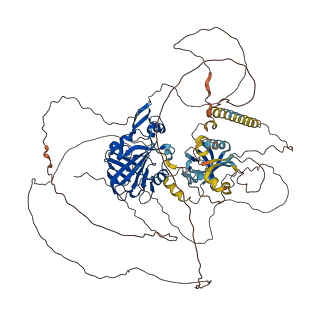
Descriptions
The autoinhibited protein was predicted that may have potential autoinhibitory elements via cis-regPred.
Autoinhibitory domains (AIDs)
Target domain |
|
Relief mechanism |
|
Assay |
cis-regPred |
Accessory elements
No accessory elements
Autoinhibited structure

Activated structure
1 structures for Q4V8B0
| Entry ID | Method | Resolution | Chain | Position | Source |
|---|---|---|---|---|---|
| AF-Q4V8B0-F1 | Predicted | AlphaFoldDB |
No variants for Q4V8B0
| Variant ID(s) | Position | Change | Description | Diseaes Association | Provenance |
|---|---|---|---|---|---|
| No variants for Q4V8B0 | |||||
No associated diseases with Q4V8B0
3 GO annotations of cellular component
| Name | Definition |
|---|---|
| mitochondrion | A semiautonomous, self replicating organelle that occurs in varying numbers, shapes, and sizes in the cytoplasm of virtually all eukaryotic cells. It is notably the site of tissue respiration. |
| nucleolus | A small, dense body one or more of which are present in the nucleus of eukaryotic cells. It is rich in RNA and protein, is not bounded by a limiting membrane, and is not seen during mitosis. Its prime function is the transcription of the nucleolar DNA into 45S ribosomal-precursor RNA, the processing of this RNA into 5.8S, 18S, and 28S components of ribosomal RNA, and the association of these components with 5S RNA and proteins synthesized outside the nucleolus. This association results in the formation of ribonucleoprotein precursors; these pass into the cytoplasm and mature into the 40S and 60S subunits of the ribosome. |
| nucleus | A membrane-bounded organelle of eukaryotic cells in which chromosomes are housed and replicated. In most cells, the nucleus contains all of the cell's chromosomes except the organellar chromosomes, and is the site of RNA synthesis and processing. In some species, or in specialized cell types, RNA metabolism or DNA replication may be absent. |
1 GO annotations of molecular function
| Name | Definition |
|---|---|
| oxidoreductase activity | Catalysis of an oxidation-reduction (redox) reaction, a reversible chemical reaction in which the oxidation state of an atom or atoms within a molecule is altered. One substrate acts as a hydrogen or electron donor and becomes oxidized, while the other acts as hydrogen or electron acceptor and becomes reduced. |
8 GO annotations of biological process
| Name | Definition |
|---|---|
| adult walking behavior | The behavior of an adult relating to the progression of that organism along the ground by the process of lifting and setting down each leg. |
| cellular response to hydroperoxide | Any process that results in a change in state or activity of a cell (in terms of movement, secretion, enzyme production, gene expression, etc.) as a result of a hydroperoxide stimulus. Hydroperoxides are monosubstitution products of hydrogen peroxide, HOOH. |
| negative regulation of cellular response to oxidative stress | Any process that stops, prevents or reduces the frequency, rate or extent of cellular response to oxidative stress. |
| negative regulation of neuron apoptotic process | Any process that stops, prevents, or reduces the frequency, rate or extent of cell death by apoptotic process in neurons. |
| negative regulation of oxidative stress-induced neuron death | Any process that stops, prevents or reduces the frequency, rate or extent of oxidative stress-induced neuron death. |
| negative regulation of peptidyl-cysteine S-nitrosylation | Any process that stops, prevents or reduces the frequency, rate or extent of peptidyl-cysteine S-nitrosylation. |
| neuron apoptotic process | Any apoptotic process in a neuron, the basic cellular unit of nervous tissue. Each neuron consists of a body, an axon, and dendrites. Their purpose is to receive, conduct, and transmit impulses in the nervous system. |
| response to oxidative stress | Any process that results in a change in state or activity of a cell or an organism (in terms of movement, secretion, enzyme production, gene expression, etc.) as a result of oxidative stress, a state often resulting from exposure to high levels of reactive oxygen species, e.g. superoxide anions, hydrogen peroxide (H2O2), and hydroxyl radicals. |
| 10 | 20 | 30 | 40 | 50 | 60 |
| MDYLTTFTGK | SGRLLRGTAS | RLWGLGGGGE | ARQVRFEDYL | REPAPGDPGC | GPGELRPPSP |
| 70 | 80 | 90 | 100 | 110 | 120 |
| TSPEGPDTGQ | KKTLDKKDGR | RMSFQKPKGT | IEYTVESRDS | LNSIALKFDT | TPNELVQLNK |
| 130 | 140 | 150 | 160 | 170 | 180 |
| LFSRAVVTGQ | VLYVPDPEYV | SSVESSPSLS | PVSPLSPTSS | EAEFDKTTTP | DVVHPKEAPP |
| 190 | 200 | 210 | 220 | 230 | 240 |
| SSTESSIRPA | RVVSSTSEEE | EAFTEKFLKI | NCKYITNGKG | TVSGVLLVTP | NNIMFDPHKT |
| 250 | 260 | 270 | 280 | 290 | 300 |
| DPLVQENGCE | EYGIMCPMEE | VMSAAMYKEI | LDSKLKESLP | IEVDQLSGRG | FCHSKKMTGV |
| 310 | 320 | 330 | 340 | 350 | 360 |
| PAEETDSRSR | DQGNDSVSTA | PRSTEESLSE | DVFTESELSP | IREELPSSEL | RQEKSSDASS |
| 370 | 380 | 390 | 400 | 410 | 420 |
| ESVQTVSQIE | VESLTAASES | ADVPDHTNAN | SGRSSSEVGA | LSHETGLSSL | EIATKEGDKA |
| 430 | 440 | 450 | 460 | 470 | 480 |
| TGNLQEVSGP | KEQSTDIKGQ | DNQDSFHHEN | SLQQEAGEDS | LSSGETVELT | EKPTVLKDQQ |
| 490 | 500 | 510 | 520 | 530 | 540 |
| GKELKRDSET | EVEELRKLWK | THSMQQAKQQ | RDTIQQVAQR | ESKHRGAPAD | AHGEGSSLLK |
| 550 | 560 | 570 | 580 | 590 | 600 |
| EKRRHRLHKF | LCLRVGKPMR | KTFVSQASAT | MQQYAQRDKK | HEYWFAVPQE | RTDHLYAFFI |
| 610 | 620 | 630 | 640 | 650 | 660 |
| QWSPEIYAED | TGEYTREPGF | IVVKKMAESG | PDEAPAGEAA | AREWEITTRE | DINSKQAAPA |
| 670 | 680 | 690 | 700 | 710 | 720 |
| KADLEPESFR | PNLSDPSELL | LPDQIEKLTK | HLPPRTIGYP | WTLVYGTGKH | GTSLKTLYRT |
| 730 | 740 | 750 | 760 | 770 | 780 |
| MTGLDTPVLM | VIKDSDGQVF | GALASEPFKV | SDGFYGTGET | FVFTFCPEFE | VFKWTGDNMF |
| 790 | 800 | 810 | 820 | 830 | |
| FIKGDMDSLA | FGGGGGEFAL | WLDGDLYHGR | SHSCKTFGNH | TLSKKEDFFI | QDIEIWAFE |