Q4QR75
Gene name |
Exosc9 |
Protein name |
Exosome complex component RRP45 |
Names |
Exosome component 9 |
Species |
Rattus norvegicus (Rat) |
KEGG Pathway |
rno:294975 |
EC number |
|
Protein Class |
|
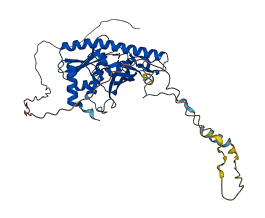
Descriptions
The autoinhibited protein was predicted that may have potential autoinhibitory elements via cis-regPred.
Autoinhibitory domains (AIDs)
Target domain |
|
Relief mechanism |
|
Assay |
cis-regPred |
Accessory elements
No accessory elements
Autoinhibited structure

Activated structure
1 structures for Q4QR75
| Entry ID | Method | Resolution | Chain | Position | Source |
|---|---|---|---|---|---|
| AF-Q4QR75-F1 | Predicted | AlphaFoldDB |
No variants for Q4QR75
| Variant ID(s) | Position | Change | Description | Diseaes Association | Provenance |
|---|---|---|---|---|---|
| No variants for Q4QR75 | |||||
No associated diseases with Q4QR75
1 regional properties for Q4QR75
| Type | Name | Position | InterPro Accession |
|---|---|---|---|
| domain | B0AT3, solute-binding domain | 16 - 591 | IPR042701 |
Functions
9 GO annotations of cellular component
| Name | Definition |
|---|---|
| cytoplasm | The contents of a cell excluding the plasma membrane and nucleus, but including other subcellular structures. |
| cytoplasmic exosome (RNase complex) | A ribonuclease complex that has 3-prime to 5-prime processive hydrolytic exoribonuclease activity producing 5-prime-phosphomonoesters. Participates in a multitude of cellular RNA processing and degradation events preventing nuclear export and/or translation of aberrant RNAs. Restricted to processing linear and circular single-stranded RNAs (ssRNA) only. RNAs with complex secondary structures may have to be unwound or pre-processed by co-factors prior to entering the complex, esp if the 3-prime end is structured. |
| cytosol | The part of the cytoplasm that does not contain organelles but which does contain other particulate matter, such as protein complexes. |
| exosome (RNase complex) | A ribonuclease complex that has 3-prime to 5-prime exoribonuclease activity and possibly endoribonuclease activity, producing 5-prime-phosphomonoesters. Participates in a multitude of cellular RNA processing and degradation events preventing nuclear export and/or translation of aberrant RNAs. Restricted to processing linear and circular single-stranded RNAs (ssRNA) only. RNAs with complex secondary structures may have to be unwound or pre-processed by co-factors prior to entering the complex, esp if the 3-prime end is structured. |
| nuclear chromosome | A chromosome that encodes the nuclear genome and is found in the nucleus of a eukaryotic cell during the cell cycle phases when the nucleus is intact. |
| nuclear exosome (RNase complex) | A ribonuclease complex that has 3-prime to 5-prime processive and distributive hydrolytic exoribonuclease activity and endoribonuclease activity, producing 5-prime-phosphomonoesters. Participates in a multitude of cellular RNA processing and degradation events preventing nuclear export and/or translation of aberrant RNAs. Restricted to processing linear and circular single-stranded RNAs (ssRNA) only. RNAs with complex secondary structures may have to be unwound or pre-processed by co-factors prior to entering the complex, esp if the 3-prime end is structured. |
| nucleolus | A small, dense body one or more of which are present in the nucleus of eukaryotic cells. It is rich in RNA and protein, is not bounded by a limiting membrane, and is not seen during mitosis. Its prime function is the transcription of the nucleolar DNA into 45S ribosomal-precursor RNA, the processing of this RNA into 5.8S, 18S, and 28S components of ribosomal RNA, and the association of these components with 5S RNA and proteins synthesized outside the nucleolus. This association results in the formation of ribonucleoprotein precursors; these pass into the cytoplasm and mature into the 40S and 60S subunits of the ribosome. |
| nucleoplasm | That part of the nuclear content other than the chromosomes or the nucleolus. |
| nucleus | A membrane-bounded organelle of eukaryotic cells in which chromosomes are housed and replicated. In most cells, the nucleus contains all of the cell's chromosomes except the organellar chromosomes, and is the site of RNA synthesis and processing. In some species, or in specialized cell types, RNA metabolism or DNA replication may be absent. |
2 GO annotations of molecular function
| Name | Definition |
|---|---|
| mRNA 3'-UTR AU-rich region binding | Binding to a region containing frequent adenine and uridine bases within the 3' untranslated region of a mRNA molecule or in pre-mRNA intron. The ARE-binding element consensus is UUAUUUAUU. ARE-binding proteins control the stability and/or translation of mRNAs. |
| RNA polymerase II-specific DNA-binding transcription factor binding | Binding to a sequence-specific DNA binding RNA polymerase II transcription factor, any of the factors that interact selectively and non-covalently with a specific DNA sequence in order to modulate transcription. |
16 GO annotations of biological process
| Name | Definition |
|---|---|
| exonucleolytic catabolism of deadenylated mRNA | The chemical reactions and pathways resulting in the breakdown of the transcript body of a nuclear-transcribed mRNA that occurs when the ends are not protected by the 3'-poly(A) tail. |
| exonucleolytic trimming to generate mature 3'-end of 5.8S rRNA from tricistronic rRNA transcript (SSU-rRNA, 5.8S rRNA, LSU-rRNA) | Exonucleolytic digestion of a pre-rRNA molecule to generate the mature 3'-end of a 5.8S rRNA molecule derived from an originally tricistronic pre-rRNA transcript that contained the Small Subunit (SSU) rRNA, the 5.8S rRNA, and the Large Subunit (LSU) rRNA in that order from 5' to 3' along the primary transcript. |
| nuclear mRNA surveillance | A process that identifies and degrades defective or aberrant mRNAs within the nucleus. |
| nuclear polyadenylation-dependent mRNA catabolic process | The chemical reactions and pathways occurring in the nucleus and resulting in the breakdown of a messenger RNA (mRNA) molecule, initiated by the enzymatic addition of a sequence of adenylyl residues (polyadenylation) at the 3' end the target mRNA. |
| nuclear polyadenylation-dependent rRNA catabolic process | The chemical reactions and pathways occurring in the nucleus and resulting in the breakdown of a ribosomal RNA (rRNA) molecule, including RNA fragments released as part of processing the primary transcript into multiple mature rRNA species, initiated by the enzymatic addition of a sequence of adenylyl residues (polyadenylation) at the 3' end the target rRNA. |
| nuclear polyadenylation-dependent tRNA catabolic process | The chemical reactions and pathways occurring in the nucleus and resulting in the breakdown of an aberrant or incorrectly modified transfer RNA (tRNA) molecule, initiated by the enzymatic addition of a sequence of adenylyl residues (polyadenylation) at the 3' end the target tRNA. |
| nuclear-transcribed mRNA catabolic process | The chemical reactions and pathways resulting in the breakdown of nuclear-transcribed mRNAs in eukaryotic cells. |
| nuclear-transcribed mRNA catabolic process, exonucleolytic, 3'-5' | The chemical reactions and pathways resulting in the breakdown of the mRNA transcript body that occurs when the 3' end is not protected by a 3'-poly(A) tail; degradation proceeds in the 3' to 5' direction. |
| positive regulation of cell growth | Any process that activates or increases the frequency, rate, extent or direction of cell growth. |
| positive regulation of transcription by RNA polymerase II | Any process that activates or increases the frequency, rate or extent of transcription from an RNA polymerase II promoter. |
| RNA catabolic process | The chemical reactions and pathways resulting in the breakdown of RNA, ribonucleic acid, one of the two main type of nucleic acid, consisting of a long, unbranched macromolecule formed from ribonucleotides joined in 3',5'-phosphodiester linkage. |
| RNA processing | Any process involved in the conversion of one or more primary RNA transcripts into one or more mature RNA molecules. |
| rRNA catabolic process | The chemical reactions and pathways resulting in the breakdown of rRNA, ribosomal RNA, a structural constituent of ribosomes. |
| U1 snRNA 3'-end processing | Any process involved in forming the mature 3' end of a U1 snRNA molecule. |
| U4 snRNA 3'-end processing | Any process involved in forming the mature 3' end of a U4 snRNA molecule. |
| U5 snRNA 3'-end processing | Any process involved in forming the mature 3' end of a U5 snRNA molecule. |
| 10 | 20 | 30 | 40 | 50 | 60 |
| MKETPLSNCE | RRFLLRAIEE | KKRLDGRQTY | DYRNIRISFG | TDYGCCIVEL | GKTRVLGQVS |
| 70 | 80 | 90 | 100 | 110 | 120 |
| CELVSPKLNR | ATEGILFFNL | ELSQMAAPAF | EPGRQSDLLV | KLNRLLERCL | RNSKCIDTES |
| 130 | 140 | 150 | 160 | 170 | 180 |
| LCVVAGEKVW | QIRVDLHLLN | HDGNIIDAAS | IAAIVALCHF | RRPDVSVQGE | EVTLYTPEER |
| 190 | 200 | 210 | 220 | 230 | 240 |
| DPVPLSIHHM | PICVSFAFFQ | QGTYLLVDPN | EREERVMDGL | LVIAMNKHRE | ICTIQSSGGI |
| 250 | 260 | 270 | 280 | 290 | 300 |
| MLLKDQVFRC | SKIAGVKVAE | ITELIQKALE | NDQRVRKEGG | KFGFAESIAN | QRITAFKMEK |
| 310 | 320 | 330 | 340 | 350 | 360 |
| APIDTSNIEE | KAEEIIAEAE | PPPEVVSKPV | LWTPGTAQIG | EGIENSWGDL | EDSEKEEEEE |
| 370 | 380 | 390 | 400 | 410 | 420 |
| GGIDETVILD | DTKMDTGEVS | DIGSQGAPIV | LSDSEEEEMI | ILEPEKSPKK | IRAQTSANQK |
| 430 | |||||
| APSKSQGKRR | KKKRTAN |