Q4KLM6
Gene name |
P3h2 |
Protein name |
Prolyl 3-hydroxylase 2 |
Names |
Leprecan-like protein 1 |
Species |
Rattus norvegicus (Rat) |
KEGG Pathway |
rno:288016 |
EC number |
1.14.11.7: With 2-oxoglutarate as one donor, and incorporation of one atom each of oxygen into both donors |
Protein Class |
|
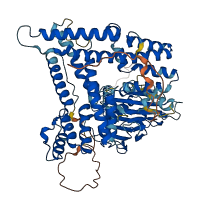
Descriptions
The autoinhibited protein was predicted that may have potential autoinhibitory elements via cis-regPred.
Autoinhibitory domains (AIDs)
Target domain |
|
Relief mechanism |
|
Assay |
cis-regPred |
Accessory elements
No accessory elements
Autoinhibited structure

Activated structure
1 structures for Q4KLM6
| Entry ID | Method | Resolution | Chain | Position | Source |
|---|---|---|---|---|---|
| AF-Q4KLM6-F1 | Predicted | AlphaFoldDB |
2 variants for Q4KLM6
| Variant ID(s) | Position | Change | Description | Diseaes Association | Provenance |
|---|---|---|---|---|---|
| rs3322053531 | 218 | A>V | No | EVA | |
| rs107119616 | 352 | T>S | No | EVA |
No associated diseases with Q4KLM6
Functions
| Description | ||
|---|---|---|
| EC Number | 1.14.11.7 | With 2-oxoglutarate as one donor, and incorporation of one atom each of oxygen into both donors |
| Subcellular Localization |
|
|
| PANTHER Family | ||
| PANTHER Subfamily | ||
| PANTHER Protein Class | ||
| PANTHER Pathway Category | No pathway information available | |
6 GO annotations of cellular component
| Name | Definition |
|---|---|
| basement membrane | A collagen-containing extracellular matrix consisting of a thin layer of dense material found in various animal tissues interposed between the cells and the adjacent connective tissue. It consists of the basal lamina plus an associated layer of reticulin fibers. |
| cytosol | The part of the cytoplasm that does not contain organelles but which does contain other particulate matter, such as protein complexes. |
| endoplasmic reticulum | The irregular network of unit membranes, visible only by electron microscopy, that occurs in the cytoplasm of many eukaryotic cells. The membranes form a complex meshwork of tubular channels, which are often expanded into slitlike cavities called cisternae. The ER takes two forms, rough (or granular), with ribosomes adhering to the outer surface, and smooth (with no ribosomes attached). |
| Golgi apparatus | A membrane-bound cytoplasmic organelle of the endomembrane system that further processes the core oligosaccharides (e.g. N-glycans) added to proteins in the endoplasmic reticulum and packages them into membrane-bound vesicles. The Golgi apparatus operates at the intersection of the secretory, lysosomal, and endocytic pathways. |
| nucleoplasm | That part of the nuclear content other than the chromosomes or the nucleolus. |
| sarcoplasmic reticulum | A fine reticular network of membrane-limited elements that pervades the sarcoplasm of a muscle cell; continuous over large portions of the cell and with the nuclear envelope; that part of the endoplasmic reticulum specialized for calcium release, uptake and storage. |
3 GO annotations of molecular function
| Name | Definition |
|---|---|
| iron ion binding | Binding to an iron (Fe) ion. |
| L-ascorbic acid binding | Binding to L-ascorbic acid, (2R)-2-[(1S)-1,2-dihydroxyethyl]-4-hydroxy-5-oxo-2,5-dihydrofuran-3-olate; L-ascorbic acid is vitamin C and has co-factor and anti-oxidant activities in many species. |
| procollagen-proline 3-dioxygenase activity | Catalysis of the reaction: procollagen L-proline + 2-oxoglutarate + O2 = procollagen trans-3-hydroxy-L-proline + succinate + CO2. |
3 GO annotations of biological process
| Name | Definition |
|---|---|
| collagen metabolic process | The chemical reactions and pathways involving collagen, any of a group of fibrous proteins of very high tensile strength that form the main component of connective tissue in animals. Collagen is highly enriched in glycine (some regions are 33% glycine) and proline, occurring predominantly as 3-hydroxyproline (about 20%). |
| negative regulation of cell population proliferation | Any process that stops, prevents or reduces the rate or extent of cell proliferation. |
| peptidyl-proline hydroxylation | The hydroxylation of peptidyl-proline to form peptidyl-hydroxyproline. |
| 10 | 20 | 30 | 40 | 50 | 60 |
| MRESTWVSLL | LLLLLPAPQR | GGPQDGRGSP | EPEPERGPLQ | PFDLLYASGV | AAYYSGDYEG |
| 70 | 80 | 90 | 100 | 110 | 120 |
| AVRDLEAALR | SHRRLRDIRT | RCARHCAARR | PLAPPGAGPG | AELPFFRAVL | ERARCSRSCQ |
| 130 | 140 | 150 | 160 | 170 | 180 |
| SQRLGGPASR | HRVSEDVRSD | FQRRVPYNYL | QRAYIKLNQL | DKAMEAAHTF | FMANPEHMEM |
| 190 | 200 | 210 | 220 | 230 | 240 |
| QQNIEDYKAT | ARVEAPLVDR | EAKPHLESYN | AGVKHYEADD | FEAAIKYFEQ | ALREYFNEDM |
| 250 | 260 | 270 | 280 | 290 | 300 |
| VCRALCEGPQ | RFEEYEYLGS | KGSLYEAIAD | HYMQVLVCQH | ECVRELATRP | GRLSPIENFL |
| 310 | 320 | 330 | 340 | 350 | 360 |
| PLHYDYLQFA | YYRVGEYVKA | LECAKAYLMF | HPDDQDVLDN | VDFYESLLDD | STDPASIEAR |
| 370 | 380 | 390 | 400 | 410 | 420 |
| EDLTAFVKRH | KLEAELIKSA | AEGLGFSYSE | PNYWISYGGR | QDENRVPSGV | NMDGAEVHGL |
| 430 | 440 | 450 | 460 | 470 | 480 |
| SMGKKSPPKI | GRDLREGGPL | LYENITFVYN | SEQLNGTQRV | LLDNVLSEEQ | CRELHSVASG |
| 490 | 500 | 510 | 520 | 530 | 540 |
| IMLVGDGYRG | KTSPHTPNEK | FEGATVLKAL | KFGYEGRVPL | KSARLFYDIS | EKARKIVESY |
| 550 | 560 | 570 | 580 | 590 | 600 |
| FMLNSTLYFS | YTHMVCRTAL | SGQQDRRNDL | SHPIHADNCL | LDPEANECWK | EPPAYTFRDY |
| 610 | 620 | 630 | 640 | 650 | 660 |
| SALLYMNDDF | EGGEFIFTEM | DAKTVTASIK | PKCGRMISFS | SGGENPHGVK | AVTRGQRCAV |
| 670 | 680 | 690 | 700 | ||
| ALWFTLDPLY | RELERIQADE | VIAILDQEQH | GKHGLNINPK | DEL |