Q3UJU9
Gene name |
Rmdn3 (Fam82a2, Fam82c) |
Protein name |
Regulator of microtubule dynamics protein 3 |
Names |
RMD-3, mRMD-3, Protein FAM82A2, Protein FAM82C |
Species |
Mus musculus (Mouse) |
KEGG Pathway |
mmu:67809 |
EC number |
|
Protein Class |
|
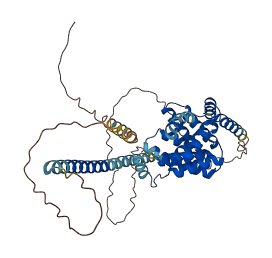
Descriptions
The autoinhibited protein was predicted that may have potential autoinhibitory elements via cis-regPred.
Autoinhibitory domains (AIDs)
Target domain |
|
Relief mechanism |
|
Assay |
cis-regPred |
Accessory elements
No accessory elements
Autoinhibited structure

Activated structure
1 structures for Q3UJU9
| Entry ID | Method | Resolution | Chain | Position | Source |
|---|---|---|---|---|---|
| AF-Q3UJU9-F1 | Predicted | AlphaFoldDB |
24 variants for Q3UJU9
| Variant ID(s) | Position | Change | Description | Diseaes Association | Provenance |
|---|---|---|---|---|---|
| rs248095004 | 78 | I>M | No | EVA | |
| rs263767718 | 102 | M>I | No | EVA | |
| rs3388573730 | 125 | E>D | No | EVA | |
| rs243436653 | 166 | A>T | No | EVA | |
| rs226333946 | 167 | L>F | No | EVA | |
| rs3388568035 | 176 | Y>F | No | EVA | |
| rs3391963792 | 191 | K>Q | No | EVA | |
| rs3388578842 | 195 | D>E | No | EVA | |
| rs3388582492 | 223 | P>T | No | EVA | |
| rs27453648 | 224 | A>S | No | EVA | |
| rs3388578901 | 242 | V>F | No | EVA | |
| rs3388584413 | 249 | L>Q | No | EVA | |
| rs33155988 | 254 | K>E | No | EVA | |
| rs219354258 | 270 | A>V | No | EVA | |
| rs3388574917 | 300 | S>P | No | EVA | |
| rs3388578807 | 333 | L>R | No | EVA | |
| rs3412852127 | 366 | G>S | No | EVA | |
| rs3388580045 | 368 | F>Y | No | EVA | |
| rs3388571732 | 392 | F>I | No | EVA | |
| rs3388584408 | 400 | V>M | No | EVA | |
| rs3388577085 | 418 | S>P | No | EVA | |
| rs3392079806 | 418 | S>P | No | EVA | |
| rs236361983 | 451 | V>I | No | EVA | |
| rs3388582522 | 455 | D>G | No | EVA |
No associated diseases with Q3UJU9
No regional properties for Q3UJU9
| Type | Name | Position | InterPro Accession |
|---|---|---|---|
| No domain, repeats, and functional sites for Q3UJU9 | |||
Functions
9 GO annotations of cellular component
| Name | Definition |
|---|---|
| cytoplasm | The contents of a cell excluding the plasma membrane and nucleus, but including other subcellular structures. |
| integral component of membrane | The component of a membrane consisting of the gene products and protein complexes having at least some part of their peptide sequence embedded in the hydrophobic region of the membrane. |
| intercellular bridge | A direct connection between the cytoplasm of two cells that is formed following the completion of cleavage furrow ingression during cell division. They are usually present only briefly prior to completion of cytokinesis. However, in some cases, such as the bridges between germ cells during their development, they become stabilised. |
| mitochondrial outer membrane | The outer, i.e. cytoplasm-facing, lipid bilayer of the mitochondrial envelope. |
| mitochondrion | A semiautonomous, self replicating organelle that occurs in varying numbers, shapes, and sizes in the cytoplasm of virtually all eukaryotic cells. It is notably the site of tissue respiration. |
| mitotic spindle pole | Either of the ends of a mitotic spindle, a spindle that forms as part of mitosis, where spindle microtubules are organized; usually contains a microtubule organizing center and accessory molecules, spindle microtubules and astral microtubules. |
| nucleus | A membrane-bounded organelle of eukaryotic cells in which chromosomes are housed and replicated. In most cells, the nucleus contains all of the cell's chromosomes except the organellar chromosomes, and is the site of RNA synthesis and processing. In some species, or in specialized cell types, RNA metabolism or DNA replication may be absent. |
| organelle membrane contact site | A zone of apposition between the membranes of an organelle with another membrane, either another membrane of the same organelle, a membrane of another organelle, or the plasma membrane. Membrane contact sites (MCSs) are structured by bridging complexes. They are specialized for communication, including the efficient traffic of small molecules such as Ca2+ ions and lipids, as well as enzyme-substrate interactions. |
| spindle microtubule | Any microtubule that is part of a mitotic or meiotic spindle; anchored at one spindle pole. |
1 GO annotations of molecular function
| Name | Definition |
|---|---|
| microtubule binding | Binding to a microtubule, a filament composed of tubulin monomers. |
3 GO annotations of biological process
| Name | Definition |
|---|---|
| apoptotic process | A programmed cell death process which begins when a cell receives an internal (e.g. DNA damage) or external signal (e.g. an extracellular death ligand), and proceeds through a series of biochemical events (signaling pathway phase) which trigger an execution phase. The execution phase is the last step of an apoptotic process, and is typically characterized by rounding-up of the cell, retraction of pseudopodes, reduction of cellular volume (pyknosis), chromatin condensation, nuclear fragmentation (karyorrhexis), plasma membrane blebbing and fragmentation of the cell into apoptotic bodies. When the execution phase is completed, the cell has died. |
| cell differentiation | The process in which relatively unspecialized cells, e.g. embryonic or regenerative cells, acquire specialized structural and/or functional features that characterize the cells, tissues, or organs of the mature organism or some other relatively stable phase of the organism's life history. Differentiation includes the processes involved in commitment of a cell to a specific fate and its subsequent development to the mature state. |
| cellular calcium ion homeostasis | Any process involved in the maintenance of an internal steady state of calcium ions at the level of a cell. |
5 homologous proteins in AiPD
| UniProt AC | Gene Name | Protein Name | Species | Evidence Code |
|---|---|---|---|---|
| Q1JQC5 | RMDN3 | Regulator of microtubule dynamics protein 3 | Bos taurus (Bovine) | PR |
| Q96DB5 | RMDN1 | Regulator of microtubule dynamics protein 1 | Homo sapiens (Human) | PR |
| Q96TC7 | RMDN3 | Regulator of microtubule dynamics protein 3 | Homo sapiens (Human) | PR |
| Q66H15 | Rmdn3 | Regulator of microtubule dynamics protein 3 | Rattus norvegicus (Rat) | PR |
| P34560 | rmd-1 | Regulator of microtubule dynamics protein 1 | Caenorhabditis elegans | PR |
| 10 | 20 | 30 | 40 | 50 | 60 |
| MSRLGALGGS | RAGLGLLLGT | AAGLGFLCVL | YSQRWKRTQR | HGRSHSLPNS | LDYAQASERG |
| 70 | 80 | 90 | 100 | 110 | 120 |
| RQVTQFRAIP | GEAGDAAILP | SLSQEGQEKV | LDRLDFVLTS | LMALRREVEE | LQRSLQGLAG |
| 130 | 140 | 150 | 160 | 170 | 180 |
| EIVGEVRSHI | EENQRVARRR | RFPFARERSD | STGSSSVYFT | ASSGAALTDA | ESEGGYTTAN |
| 190 | 200 | 210 | 220 | 230 | 240 |
| AESDYERDSD | KESGDAEDEV | SCETVRMGRK | DSLDLDVEAA | SSPAAAALEE | DDSSGREDVQ |
| 250 | 260 | 270 | 280 | 290 | 300 |
| LVLLQADELH | QGSKQDKREG | FQLLLNNKLA | YGSRQDFLWR | LARAYSDMSD | LTEEESGKKS |
| 310 | 320 | 330 | 340 | 350 | 360 |
| YALNGKEEAE | AALKKGDESA | ACHLWYAVLC | GQLAEHEGIS | KRIQSGFSFK | EHVDKAIELQ |
| 370 | 380 | 390 | 400 | 410 | 420 |
| PEDPRGHFLL | GRWCYQVSHL | NWLEKKTATA | LFESPLSATV | QDALQSFLKA | EELQPGFSKA |
| 430 | 440 | 450 | 460 | ||
| GRVYISKCYR | ELGKNSEARK | WMKLAQELPD | VTNEDSAFQK | DLEELEVILG |