Q3U3Q1
Gene name |
Ulk3 |
Protein name |
Serine/threonine-protein kinase ULK3 |
Names |
Unc-51-like kinase 3 |
Species |
Mus musculus (Mouse) |
KEGG Pathway |
mmu:71742 |
EC number |
2.7.11.1: Protein-serine/threonine kinases |
Protein Class |
|
Descriptions
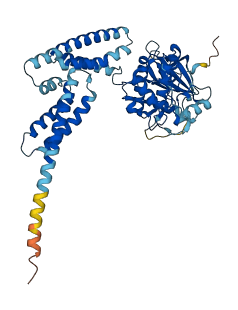
The autoinhibited protein was predicted that may have potential autoinhibitory elements via cis-regPred.
Autoinhibitory domains (AIDs)
Target domain |
|
Relief mechanism |
|
Assay |
cis-regPred |
Accessory elements
156-178 (Activation loop from InterPro)
Target domain |
14-270 (Protein kinase domain) |
Relief mechanism |
|
Assay |
|
Autoinhibited structure

Activated structure
1 structures for Q3U3Q1
| Entry ID | Method | Resolution | Chain | Position | Source |
|---|---|---|---|---|---|
| AF-Q3U3Q1-F1 | Predicted | AlphaFoldDB |
17 variants for Q3U3Q1
| Variant ID(s) | Position | Change | Description | Diseaes Association | Provenance |
|---|---|---|---|---|---|
| rs3389052151 | 44 | K>N | No | EVA | |
| rs3389023250 | 133 | I>T | No | EVA | |
| rs3388996262 | 193 | R>H | No | EVA | |
| rs3389023305 | 243 | C>R | No | EVA | |
| rs3389015063 | 254 | D>V | No | EVA | |
| rs3389051006 | 272 | L>V | No | EVA | |
| rs3389028520 | 393 | A>T | No | EVA | |
| rs3389028590 | 398 | D>E | No | EVA | |
| rs3389046101 | 406 | S>I | No | EVA | |
| rs3389048839 | 408 | G>A | No | EVA | |
| rs3389048839 | 408 | G>E | No | EVA | |
| rs3400179599 | 408 | G>R | No | EVA | |
| rs3389052171 | 410 | L>P | No | EVA | |
| rs3389046152 | 428 | T>N | No | EVA | |
| rs3389015023 | 436 | R>* | No | EVA | |
| rs3400436140 | 471 | L>Q | No | EVA | |
| rs3400273964 | 472 | Q>K | No | EVA |
No associated diseases with Q3U3Q1
5 regional properties for Q3U3Q1
| Type | Name | Position | InterPro Accession |
|---|---|---|---|
| domain | Protein kinase domain | 14 - 270 | IPR000719 |
| domain | MIT domain | 277 - 354 | IPR007330-1 |
| domain | MIT domain | 372 - 450 | IPR007330-2 |
| active_site | Serine/threonine-protein kinase, active site | 133 - 145 | IPR008271 |
| binding_site | Protein kinase, ATP binding site | 20 - 49 | IPR017441 |
Functions
| Description | ||
|---|---|---|
| EC Number | 2.7.11.1 | Protein-serine/threonine kinases |
| Subcellular Localization |
|
|
| PANTHER Family | ||
| PANTHER Subfamily | ||
| PANTHER Protein Class | ||
| PANTHER Pathway Category | No pathway information available | |
3 GO annotations of cellular component
| Name | Definition |
|---|---|
| autophagosome | A double-membrane-bounded compartment that engulfs endogenous cellular material as well as invading microorganisms to target them to the lytic vacuole/lysosome for degradation as part of macroautophagy. |
| cytoplasm | The contents of a cell excluding the plasma membrane and nucleus, but including other subcellular structures. |
| phagophore assembly site | Punctate structures proximal to the endoplasmic reticulum which are the sites where the Atg machinery assembles upon autophagy induction. |
3 GO annotations of molecular function
| Name | Definition |
|---|---|
| ATP binding | Binding to ATP, adenosine 5'-triphosphate, a universally important coenzyme and enzyme regulator. |
| protein serine kinase activity | Catalysis of the reactions: ATP + protein serine = ADP + protein serine phosphate. |
| protein serine/threonine kinase activity | Catalysis of the reactions: ATP + protein serine = ADP + protein serine phosphate, and ATP + protein threonine = ADP + protein threonine phosphate. |
7 GO annotations of biological process
| Name | Definition |
|---|---|
| autophagosome organization | A process that is carried out at the cellular level which results in the assembly, arrangement of constituent parts, or disassembly of an autophagosome. |
| fibroblast activation | A change in the morphology or behavior of a fibroblast resulting from exposure to an activating factor such as a cellular or soluble ligand. |
| negative regulation of smoothened signaling pathway | Any process that stops, prevents, or reduces the frequency, rate or extent of smoothened signaling. |
| peptidyl-serine phosphorylation | The phosphorylation of peptidyl-serine to form peptidyl-O-phospho-L-serine. |
| positive regulation of smoothened signaling pathway | Any process that activates or increases the frequency, rate or extent of smoothened signaling. |
| protein autophosphorylation | The phosphorylation by a protein of one or more of its own amino acid residues (cis-autophosphorylation), or residues on an identical protein (trans-autophosphorylation). |
| smoothened signaling pathway | The series of molecular signals generated as a consequence of activation of the transmembrane protein Smoothened. |
| 10 | 20 | 30 | 40 | 50 | 60 |
| MAGPSWGLPR | LDGFILTERL | GSGTYATVYK | AYAKKDTREV | VAIKCVAKKS | LNKASVENLL |
| 70 | 80 | 90 | 100 | 110 | 120 |
| TEIEILKGIR | HPHIVQLKDF | QWDNDNIYLI | MEFCAGGDLS | RFIHTRRILP | EKVARVFMQQ |
| 130 | 140 | 150 | 160 | 170 | 180 |
| LASALQFLHE | RNISHLDLKP | QNILLSSLEK | PHLKLADFGF | AQHMSPWDEK | HVLRGSPLYM |
| 190 | 200 | 210 | 220 | 230 | 240 |
| APEMVCRRQY | DARVDLWSVG | VILYEALFGQ | PPFASRSFSE | LEEKIRSNRV | IELPLRPQLS |
| 250 | 260 | 270 | 280 | 290 | 300 |
| LDCRDLLQRL | LERDPARRIS | FKDFFAHPWV | DLEHMPSGES | LAQARALVVE | AVKKDQEGDA |
| 310 | 320 | 330 | 340 | 350 | 360 |
| AAALSLYCKA | LDFFVPALHY | EVDAQRKEAI | KAKVGQYVSR | AEELKAIVSS | SNQALLRQGT |
| 370 | 380 | 390 | 400 | 410 | 420 |
| TVQELLREMA | RDKPRLLAAL | EVASAALAKE | EEAGKEQDAL | DLYQHSLGEL | LVLLAAEAPG |
| 430 | 440 | 450 | 460 | 470 | |
| RRRELLHTEV | QNLMARAEYL | KEQIKIRESH | WEAESLDKEG | LSESVRSSCT | LQ |