Q3U2C5
Gene name |
Rnf149 (Greul4) |
Protein name |
E3 ubiquitin-protein ligase RNF149 |
Names |
Goliath-related E3 ubiquitin-protein ligase 4, RING finger protein 149, RING-type E3 ubiquitin transferase RNF149 |
Species |
Mus musculus (Mouse) |
KEGG Pathway |
mmu:67702 |
EC number |
2.3.2.27: Aminoacyltransferases |
Protein Class |
|
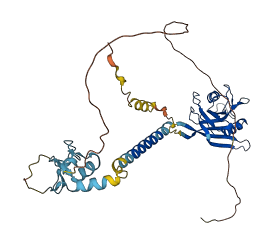
Descriptions
The autoinhibited protein was predicted that may have potential autoinhibitory elements via cis-regPred.
Autoinhibitory domains (AIDs)
Target domain |
|
Relief mechanism |
|
Assay |
cis-regPred |
Accessory elements
No accessory elements
Autoinhibited structure

Activated structure
1 structures for Q3U2C5
| Entry ID | Method | Resolution | Chain | Position | Source |
|---|---|---|---|---|---|
| AF-Q3U2C5-F1 | Predicted | AlphaFoldDB |
18 variants for Q3U2C5
| Variant ID(s) | Position | Change | Description | Diseaes Association | Provenance |
|---|---|---|---|---|---|
| rs217650644 | 26 | T>A | No | EVA | |
| rs254449642 | 65 | E>D | No | EVA | |
| rs226526154 | 113 | G>V | No | EVA | |
| rs13470358 | 115 | T>I | No | EVA | |
| rs240479485 | 149 | A>T | No | EVA | |
| rs3388464772 | 213 | A>T | No | EVA | |
| rs3388464976 | 227 | G>R | No | EVA | |
| rs13470357 | 241 | K>M | No | EVA | |
| rs222793203 | 260 | V>I | No | EVA | |
| rs3388466092 | 271 | N>D | No | EVA | |
| rs3388466544 | 272 | F>Y | No | EVA | |
| rs3388466794 | 320 | E>A | No | EVA | |
| rs3388465486 | 322 | T>A | No | EVA | |
| rs227831910 | 327 | T>I | No | EVA | |
| rs256317247 | 353 | N>D | No | EVA | |
| rs3388465916 | 367 | P>T | No | EVA | |
| rs3388465558 | 393 | I>K | No | EVA | |
| rs237204519 | 395 | C>Q | No | EVA |
No associated diseases with Q3U2C5
1 regional properties for Q3U2C5
| Type | Name | Position | InterPro Accession |
|---|---|---|---|
| domain | Ribosomal protein L18e/L15P | 2 - 188 | IPR021131 |
Functions
| Description | ||
|---|---|---|
| EC Number | 2.3.2.27 | Aminoacyltransferases |
| Subcellular Localization |
|
|
| PANTHER Family | ||
| PANTHER Subfamily | ||
| PANTHER Protein Class | ||
| PANTHER Pathway Category | No pathway information available | |
2 GO annotations of cellular component
| Name | Definition |
|---|---|
| cytoplasm | The contents of a cell excluding the plasma membrane and nucleus, but including other subcellular structures. |
| integral component of membrane | The component of a membrane consisting of the gene products and protein complexes having at least some part of their peptide sequence embedded in the hydrophobic region of the membrane. |
2 GO annotations of molecular function
| Name | Definition |
|---|---|
| metal ion binding | Binding to a metal ion. |
| ubiquitin protein ligase activity | Catalysis of the transfer of ubiquitin to a substrate protein via the reaction X-ubiquitin + S -> X + S-ubiquitin, where X is either an E2 or E3 enzyme, the X-ubiquitin linkage is a thioester bond, and the S-ubiquitin linkage is an amide bond: an isopeptide bond between the C-terminal glycine of ubiquitin and the epsilon-amino group of lysine residues in the substrate or, in the linear extension of ubiquitin chains, a peptide bond the between the C-terminal glycine and N-terminal methionine of ubiquitin residues. |
4 GO annotations of biological process
| Name | Definition |
|---|---|
| cellular response to xenobiotic stimulus | Any process that results in a change in state or activity of a cell (in terms of movement, secretion, enzyme production, gene expression, etc.) as a result of a stimulus from a xenobiotic, a compound foreign to the organism exposed to it. It may be synthesized by another organism (like ampicilin) or it can be a synthetic chemical. |
| negative regulation of MAPK cascade | Any process that stops, prevents, or reduces the frequency, rate or extent of signal transduction mediated by the MAPKKK cascade. |
| regulation of protein stability | Any process that affects the structure and integrity of a protein, altering the likelihood of its degradation or aggregation. |
| ubiquitin-dependent protein catabolic process | The chemical reactions and pathways resulting in the breakdown of a protein or peptide by hydrolysis of its peptide bonds, initiated by the covalent attachment of a ubiquitin group, or multiple ubiquitin groups, to the protein. |
| 10 | 20 | 30 | 40 | 50 | 60 |
| MAARRRPAAG | VGARDALAVL | ALALCTPGVG | GGALEWYSAM | VSIEYVDPQS | NLTVWSVSES |
| 70 | 80 | 90 | 100 | 110 | 120 |
| GRFGESSLRE | ERQGLVGVPR | APAPAEGCAP | DTRFVAPGAL | GNAPWVALVA | RGGCTFKDKV |
| 130 | 140 | 150 | 160 | 170 | 180 |
| LAAARRNASA | VVVYNLESNG | NATEPMSHAG | TGNIVVIMIS | YPKGREIFDL | VQKGIPVKMR |
| 190 | 200 | 210 | 220 | 230 | 240 |
| IEIGTRHMQE | FISGQSVVFV | AIAFITMMII | SLAWLIFYYI | QRFLYTGSQF | GSQNHRKETK |
| 250 | 260 | 270 | 280 | 290 | 300 |
| KVIGQLPLHT | VKHGEKGIDV | DAENCAVCIE | NFKVKDVIRI | LPCKHIFHRI | CIDPWLLDHR |
| 310 | 320 | 330 | 340 | 350 | 360 |
| TCPMCKLDVI | KALGYWGDPE | DTQELPTPEA | APGRVSVGNL | SVTSQDEERS | ESNLPSSSSS |
| 370 | 380 | 390 | |||
| ESGPHRPCLK | EDAGEDTALL | GAGRSEPQHG | GSIC |