O54965
Gene name |
Rnf13 (Rzf) |
Protein name |
E3 ubiquitin-protein ligase RNF13 |
Names |
RING finger protein 13 |
Species |
Mus musculus (Mouse) |
KEGG Pathway |
mmu:24017 |
EC number |
2.3.2.27: Aminoacyltransferases |
Protein Class |
|
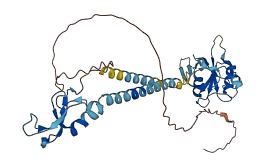
Descriptions
The autoinhibited protein was predicted that may have potential autoinhibitory elements via cis-regPred.
Autoinhibitory domains (AIDs)
Target domain |
|
Relief mechanism |
|
Assay |
cis-regPred |
Accessory elements
No accessory elements
Autoinhibited structure

Activated structure
1 structures for O54965
| Entry ID | Method | Resolution | Chain | Position | Source |
|---|---|---|---|---|---|
| AF-O54965-F1 | Predicted | AlphaFoldDB |
11 variants for O54965
| Variant ID(s) | Position | Change | Description | Diseaes Association | Provenance |
|---|---|---|---|---|---|
| rs3388631360 | 37 | L>F | No | EVA | |
| rs3388629172 | 170 | I>N | No | EVA | |
| rs3388627256 | 177 | S>C | No | EVA | |
| rs3388621322 | 232 | K>* | No | EVA | |
| rs3388633959 | 233 | K>M | No | EVA | |
| rs3388634578 | 234 | G>R | No | EVA | |
| rs3393020160 | 270 | W>C | No | EVA | |
| rs3388613693 | 298 | S>N | No | EVA | |
| rs3388634592 | 330 | H>Q | No | EVA | |
| rs16807645 | 357 | E>K | No | EVA | |
| rs3393181336 | 360 | D>N | No | EVA |
No associated diseases with O54965
Functions
| Description | ||
|---|---|---|
| EC Number | 2.3.2.27 | Aminoacyltransferases |
| Subcellular Localization |
|
|
| PANTHER Family | ||
| PANTHER Subfamily | ||
| PANTHER Protein Class | ||
| PANTHER Pathway Category | No pathway information available | |
10 GO annotations of cellular component
| Name | Definition |
|---|---|
| cytosol | The part of the cytoplasm that does not contain organelles but which does contain other particulate matter, such as protein complexes. |
| endoplasmic reticulum | The irregular network of unit membranes, visible only by electron microscopy, that occurs in the cytoplasm of many eukaryotic cells. The membranes form a complex meshwork of tubular channels, which are often expanded into slitlike cavities called cisternae. The ER takes two forms, rough (or granular), with ribosomes adhering to the outer surface, and smooth (with no ribosomes attached). |
| endoplasmic reticulum membrane | The lipid bilayer surrounding the endoplasmic reticulum. |
| endosome | A vacuole to which materials ingested by endocytosis are delivered. |
| integral component of membrane | The component of a membrane consisting of the gene products and protein complexes having at least some part of their peptide sequence embedded in the hydrophobic region of the membrane. |
| intracellular membrane-bounded organelle | Organized structure of distinctive morphology and function, bounded by a single or double lipid bilayer membrane and occurring within the cell. Includes the nucleus, mitochondria, plastids, vacuoles, and vesicles. Excludes the plasma membrane. |
| late endosome membrane | The lipid bilayer surrounding a late endosome. |
| lysosomal membrane | The lipid bilayer surrounding the lysosome and separating its contents from the cell cytoplasm. |
| nuclear inner membrane | The inner, i.e. lumen-facing, lipid bilayer of the nuclear envelope. |
| nucleoplasm | That part of the nuclear content other than the chromosomes or the nucleolus. |
4 GO annotations of molecular function
| Name | Definition |
|---|---|
| JUN kinase binding | Binding to JUN kinase, an enzyme that catalyzes the phosphorylation and activation of members of the JUN family. |
| metal ion binding | Binding to a metal ion. |
| ubiquitin protein ligase activity | Catalysis of the transfer of ubiquitin to a substrate protein via the reaction X-ubiquitin + S -> X + S-ubiquitin, where X is either an E2 or E3 enzyme, the X-ubiquitin linkage is a thioester bond, and the S-ubiquitin linkage is an amide bond: an isopeptide bond between the C-terminal glycine of ubiquitin and the epsilon-amino group of lysine residues in the substrate or, in the linear extension of ubiquitin chains, a peptide bond the between the C-terminal glycine and N-terminal methionine of ubiquitin residues. |
| ubiquitin-protein transferase activity | Catalysis of the transfer of ubiquitin from one protein to another via the reaction X-Ub + Y --> Y-Ub + X, where both X-Ub and Y-Ub are covalent linkages. |
4 GO annotations of biological process
| Name | Definition |
|---|---|
| organelle localization | Any process in which an organelle is transported to, and/or maintained in, a specific location. |
| positive regulation of stress-activated protein kinase signaling cascade | Any process that activates or increases the frequency, rate or extent of signaling via the stress-activated protein kinase signaling cascade. |
| protein autoubiquitination | The ubiquitination by a protein of one or more of its own amino acid residues, or residues on an identical protein. Ubiquitination occurs on the lysine residue by formation of an isopeptide crosslink. |
| ubiquitin-dependent protein catabolic process | The chemical reactions and pathways resulting in the breakdown of a protein or peptide by hydrolysis of its peptide bonds, initiated by the covalent attachment of a ubiquitin group, or multiple ubiquitin groups, to the protein. |
1 homologous proteins in AiPD
| UniProt AC | Gene Name | Protein Name | Species | Evidence Code |
|---|---|---|---|---|
| Q3U2C5 | Rnf149 | E3 ubiquitin-protein ligase RNF149 | Mus musculus (Mouse) | PR |
| 10 | 20 | 30 | 40 | 50 | 60 |
| MLLSIGMLML | SATQVYTILT | VQLFAFLNLL | PVEADILAYN | FENASQTFED | LPARFGYRLP |
| 70 | 80 | 90 | 100 | 110 | 120 |
| AEGLKGFLIN | SKPENACEPI | VPPPLKDNSS | GTFIVLIRRL | DCNFDIKVLN | AQRAGYKAAI |
| 130 | 140 | 150 | 160 | 170 | 180 |
| VHNVDSDDLI | SMGSNDIDTL | KKIDIPSVFI | GESSANSLKD | EFTYEKGGHI | ILVPELSLPL |
| 190 | 200 | 210 | 220 | 230 | 240 |
| EYYLIPFLII | VGICLILIVI | FMITKFVQDR | HRNRRNRLRK | DQLKKLPVHK | FKKGDEYDVC |
| 250 | 260 | 270 | 280 | 290 | 300 |
| AICLEEYEDG | DKLRILPCSH | AYHCKCVDPW | LTKTKKTCPV | CKQKVVPSQG | DSDSDTDSSQ |
| 310 | 320 | 330 | 340 | 350 | 360 |
| EENQVSEHTP | LLPPSASART | QSFGSLSESH | SHHNMTESSD | YEDDDNEETD | SSDADNEITD |
| 370 | 380 | ||||
| HSVVVQLQPN | GEQDYNIANT | V |