Q3U132
Gene name |
Tespa1 |
Protein name |
Protein TESPA1 |
Names |
Thymocyte-expressed positive selection-associated protein 1 |
Species |
Mus musculus (Mouse) |
KEGG Pathway |
mmu:67596 |
EC number |
|
Protein Class |
|
Descriptions
The autoinhibited protein was predicted that may have potential autoinhibitory elements via cis-regPred.
Autoinhibitory domains (AIDs)
Target domain |
|
Relief mechanism |
|
Assay |
cis-regPred |
Accessory elements
No accessory elements
Autoinhibited structure

Activated structure
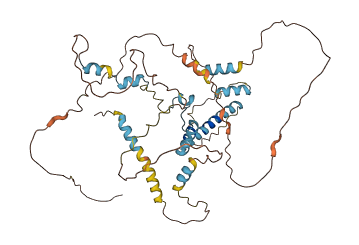
1 structures for Q3U132
| Entry ID | Method | Resolution | Chain | Position | Source |
|---|---|---|---|---|---|
| AF-Q3U132-F1 | Predicted | AlphaFoldDB |
23 variants for Q3U132
| Variant ID(s) | Position | Change | Description | Diseaes Association | Provenance |
|---|---|---|---|---|---|
| rs3401690575 | 24 | W>* | No | EVA | |
| rs3389136372 | 37 | L>H | No | EVA | |
| rs3389134049 | 49 | D>N | No | EVA | |
| rs3389102986 | 63 | D>N | No | EVA | |
| rs3389147261 | 88 | G>E | No | EVA | |
| rs3389110085 | 154 | E>Q | No | EVA | |
| rs3389102955 | 158 | Q>L | No | EVA | |
| rs3389149698 | 159 | V>I | No | EVA | |
| rs3389134078 | 168 | F>V | No | EVA | |
| rs3389136807 | 189 | S>N | No | EVA | |
| rs3389136197 | 358 | P>T | No | EVA | |
| rs254422794 | 361 | S>F | No | EVA | |
| rs45795123 | 373 | H>R | No | EVA | |
| rs3389147253 | 383 | Q>* | No | EVA | |
| rs3389114031 | 400 | D>H | No | EVA | |
| rs3389114031 | 400 | D>Y | No | EVA | |
| rs3401437326 | 401 | I>L | No | EVA | |
| rs214281815 | 406 | R>L | No | EVA | |
| rs214281815 | 406 | R>P | No | EVA | |
| rs3389076690 | 408 | A>V | No | EVA | |
| rs49530144 | 428 | V>I | No | EVA | |
| rs3389149722 | 452 | R>T | No | EVA | |
| rs3401572620 | 457 | N>K | No | EVA |
No associated diseases with Q3U132
1 regional properties for Q3U132
| Type | Name | Position | InterPro Accession |
|---|---|---|---|
| domain | ITPR-interacting domain | 128 - 292 | IPR029325 |
5 GO annotations of cellular component
| Name | Definition |
|---|---|
| COP9 signalosome | A protein complex that catalyzes the deneddylation of proteins, including the cullin component of SCF ubiquitin E3 ligase; deneddylation increases the activity of cullin family ubiquitin ligases. The signalosome is involved in many regulatory process, including some which control development, in many species; also regulates photomorphogenesis in plants; in many species its subunits are highly similar to those of the proteasome. |
| cytoplasm | The contents of a cell excluding the plasma membrane and nucleus, but including other subcellular structures. |
| cytosol | The part of the cytoplasm that does not contain organelles but which does contain other particulate matter, such as protein complexes. |
| endoplasmic reticulum membrane | The lipid bilayer surrounding the endoplasmic reticulum. |
| TCR signalosome | A multi-protein complex containing at least the T-cell receptor complex and the LAT (linker for activation of T cells) scaffold protein. Also contains a variety of signaling proteins including co-receptors, kinases, phosphatases and adaptors such as CD8. Connects events on the plasma membrane to distal signaling cascades to ultimately modulate T cell biology. |
2 GO annotations of molecular function
| Name | Definition |
|---|---|
| phospholipase binding | Binding to a phospholipase. |
| signaling receptor binding | Binding to one or more specific sites on a receptor molecule, a macromolecule that undergoes combination with a hormone, neurotransmitter, drug or intracellular messenger to initiate a change in cell function. |
7 GO annotations of biological process
| Name | Definition |
|---|---|
| COP9 signalosome assembly | The aggregation, arrangement and bonding together of a set of components to form a COP9 signalosome. |
| positive regulation of T cell differentiation in thymus | Any process that activates or increases the frequency, rate or extent of T cell differentiation in the thymus. |
| positive regulation of T cell receptor signaling pathway | Any process that activates or increases the frequency, rate or extent of signaling pathways initiated by the cross-linking of an antigen receptor on a T cell. |
| protein localization | Any process in which a protein is transported to, or maintained in, a specific location. |
| regulation of T cell receptor signaling pathway | Any process that modulates the frequency, rate or extent of signaling pathways initiated by the cross-linking of an antigen receptor on a T cell. |
| T cell differentiation in thymus | The process in which a precursor cell type acquires the specialized features of a T cell via a differentiation pathway dependent upon transit through the thymus. |
| TCR signalosome assembly | The aggregation, arrangement and bonding together of a set of components to form a TCR signalosome. |
1 homologous proteins in AiPD
| UniProt AC | Gene Name | Protein Name | Species | Evidence Code |
|---|---|---|---|---|
| A2RU30 | TESPA1 | Protein TESPA1 | Homo sapiens (Human) | PR |
| 10 | 20 | 30 | 40 | 50 | 60 |
| MEASVLSPTS | WEKRRAWLRQ | SRNWQTQVLE | EEAAAALQDA | LDPEPSSLDD | VFQEGNPINK |
| 70 | 80 | 90 | 100 | 110 | 120 |
| IEDWLQGCGC | RDTEEGLSEE | SGQSNYSGYS | SHGTSFEDDL | SLGAEATLLS | TNGNLFSRNF |
| 130 | 140 | 150 | 160 | 170 | 180 |
| LQTPRLCQLL | DLGSSLASSS | MTGGTNKTSS | SISEILDQVQ | EDAEDILFSL | GFGHENHKDT |
| 190 | 200 | 210 | 220 | 230 | 240 |
| SRIPARFFSN | PSQAKGINFQ | LFLKSQVQRM | EMEDPCLMLA | SRFKQVQTLA | VTADAFFCLY |
| 250 | 260 | 270 | 280 | 290 | 300 |
| SYVSKTPVQK | FTPSNMFWNF | DPTDVPSIRI | LAPEPEPYSP | RERLRRAISK | MCLYTGSRDR |
| 310 | 320 | 330 | 340 | 350 | 360 |
| LSSSYNNPKK | NSLDQIVWEV | MDRVKGEKIQ | QDPEHRQALG | EESVPPIQNT | NPSTSSLPCV |
| 370 | 380 | 390 | 400 | 410 | 420 |
| SYPKEETQGD | MCHAHALARP | GPQYHINSTQ | VRRQLWVLQD | INEKPRSAEN | ESPWERKSKA |
| 430 | 440 | 450 | |||
| RKNLFQRVPV | DKNIKSLNLP | TIQQKQNQGQ | ARHELTNL |