Q3TSG4
Gene name |
Alkbh5 |
Protein name |
RNA demethylase ALKBH5 |
Names |
Alkylated DNA repair protein alkB homolog 5, Alpha-ketoglutarate-dependent dioxygenase alkB homolog 5 |
Species |
Mus musculus (Mouse) |
KEGG Pathway |
mmu:268420 |
EC number |
1.14.11.53: With 2-oxoglutarate as one donor, and incorporation of one atom each of oxygen into both donors |
Protein Class |
|
Descriptions
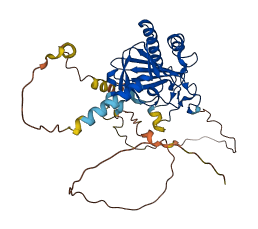
The autoinhibited protein was predicted that may have potential autoinhibitory elements via cis-regPred.
Autoinhibitory domains (AIDs)
Target domain |
|
Relief mechanism |
|
Assay |
cis-regPred |
Accessory elements
No accessory elements
Autoinhibited structure

Activated structure
1 structures for Q3TSG4
| Entry ID | Method | Resolution | Chain | Position | Source |
|---|---|---|---|---|---|
| AF-Q3TSG4-F1 | Predicted | AlphaFoldDB |
10 variants for Q3TSG4
| Variant ID(s) | Position | Change | Description | Diseaes Association | Provenance |
|---|---|---|---|---|---|
| rs3401071648 | 126 | D>H | No | EVA | |
| rs3401704276 | 134 | Y>S | No | EVA | |
| rs3389159732 | 291 | P>S | No | EVA | |
| rs3389161316 | 325 | R>K | No | EVA | |
| rs3389101628 | 325 | R>S | No | EVA | |
| rs3401937407 | 329 | K>R | No | EVA | |
| rs3389151182 | 346 | E>K | No | EVA | |
| rs1132291746 | 357 | H>Q | No | EVA | |
| rs1133173302 | 364 | S>N | No | EVA | |
| rs3389171854 | 385 | S>N | No | EVA |
No associated diseases with Q3TSG4
1 regional properties for Q3TSG4
| Type | Name | Position | InterPro Accession |
|---|---|---|---|
| domain | Alpha-ketoglutarate-dependent dioxygenase AlkB-like | 155 - 276 | IPR027450 |
Functions
| Description | ||
|---|---|---|
| EC Number | 1.14.11.53 | With 2-oxoglutarate as one donor, and incorporation of one atom each of oxygen into both donors |
| Subcellular Localization |
|
|
| PANTHER Family | ||
| PANTHER Subfamily | ||
| PANTHER Protein Class | ||
| PANTHER Pathway Category | No pathway information available | |
5 GO annotations of cellular component
| Name | Definition |
|---|---|
| cytosol | The part of the cytoplasm that does not contain organelles but which does contain other particulate matter, such as protein complexes. |
| Golgi apparatus | A membrane-bound cytoplasmic organelle of the endomembrane system that further processes the core oligosaccharides (e.g. N-glycans) added to proteins in the endoplasmic reticulum and packages them into membrane-bound vesicles. The Golgi apparatus operates at the intersection of the secretory, lysosomal, and endocytic pathways. |
| nuclear speck | A discrete extra-nucleolar subnuclear domain, 20-50 in number, in which splicing factors are seen to be localized by immunofluorescence microscopy. |
| nucleoplasm | That part of the nuclear content other than the chromosomes or the nucleolus. |
| nucleus | A membrane-bounded organelle of eukaryotic cells in which chromosomes are housed and replicated. In most cells, the nucleus contains all of the cell's chromosomes except the organellar chromosomes, and is the site of RNA synthesis and processing. In some species, or in specialized cell types, RNA metabolism or DNA replication may be absent. |
4 GO annotations of molecular function
| Name | Definition |
|---|---|
| 2-oxoglutarate-dependent dioxygenase activity | Catalysis of the reaction: A + 2-oxoglutarate + O2 = B + succinate + CO2. This is an oxidation-reduction (redox) reaction in which hydrogen or electrons are transferred from 2-oxoglutarate and one other donor, and one atom of oxygen is incorporated into each donor. |
| metal ion binding | Binding to a metal ion. |
| mRNA N6-methyladenosine dioxygenase activity | Catalysis of the oxidative demethylation of N6-methyladenosine RNA, with concomitant decarboxylation of 2-oxoglutarate and releases oxidized methyl group on N6-methyladenosine as formaldehyde. |
| oxidative RNA demethylase activity | Catalysis of the removal of a methyl group from one or more nucleosides within a RNA molecule involving the oxidation (i.e. electron loss) of one or more atoms. |
7 GO annotations of biological process
| Name | Definition |
|---|---|
| cell differentiation | The process in which relatively unspecialized cells, e.g. embryonic or regenerative cells, acquire specialized structural and/or functional features that characterize the cells, tissues, or organs of the mature organism or some other relatively stable phase of the organism's life history. Differentiation includes the processes involved in commitment of a cell to a specific fate and its subsequent development to the mature state. |
| mRNA export from nucleus | The directed movement of mRNA from the nucleus to the cytoplasm. |
| mRNA processing | Any process involved in the conversion of a primary mRNA transcript into one or more mature mRNA(s) prior to translation into polypeptide. |
| oxidative single-stranded RNA demethylation | Removal of the methyl group from one or more nucleotides within a single-stranded RNA molecule involving the oxidation (i.e. electron loss) of one or more atoms. |
| regulation of mRNA stability | Any process that modulates the propensity of mRNA molecules to degradation. Includes processes that both stabilize and destabilize mRNAs. |
| response to hypoxia | Any process that results in a change in state or activity of a cell or an organism (in terms of movement, secretion, enzyme production, gene expression, etc.) as a result of a stimulus indicating lowered oxygen tension. Hypoxia, defined as a decline in O2 levels below normoxic levels of 20.8 - 20.95%, results in metabolic adaptation at both the cellular and organismal level. |
| spermatogenesis | The developmental process by which male germ line stem cells self renew or give rise to successive cell types resulting in the development of a spermatozoa. |
3 homologous proteins in AiPD
| 10 | 20 | 30 | 40 | 50 | 60 |
| MAAASGYTDL | REKLKSMTSR | DNYKAGSREA | AAAAAAAVAA | AAAAAAAAEP | YPASGTTKRK |
| 70 | 80 | 90 | 100 | 110 | 120 |
| YQEDSDPERS | DYEEHQLQKE | EEARKVKSGI | RQIRLFSQDE | CSKIEARIDE | VVSRAEKGLY |
| 130 | 140 | 150 | 160 | 170 | 180 |
| NEHTVDRAPL | RNKYFFGEGY | TYGAQLQKRG | PGQERLYPPG | DVDEIPDWVH | QLVIQKLVEH |
| 190 | 200 | 210 | 220 | 230 | 240 |
| RVIPEGFVNS | AVINDYQPGG | CIVSHVDPIH | IFERPIVSVS | FFSDSALCFG | CKFQFKPIRV |
| 250 | 260 | 270 | 280 | 290 | 300 |
| SEPVLSLPVR | RGSVTVLSGY | AADEITHCIR | PQDIKERRAV | IILRKTRLDA | PRLETKSLSS |
| 310 | 320 | 330 | 340 | 350 | 360 |
| STLPPSYASD | RLSGNTRDPA | LKPKRSHRKA | DPDAAHRPRI | LEMDKEENRR | SVLLPTHRRR |
| 370 | 380 | 390 | |||
| GSFSSENYWR | KSYESSEDCP | EAASSPTRKV | KMRRH |