Q3T1H5
Gene name |
Tdp2 (Ttrap) |
Protein name |
Tyrosyl-DNA phosphodiesterase 2 |
Names |
Tyr-DNA phosphodiesterase 2, 5'-tyrosyl-DNA phosphodiesterase, 5'-Tyr-DNA phosphodiesterase, TRAF and TNF receptor-associated protein |
Species |
Rattus norvegicus (Rat) |
KEGG Pathway |
rno:498749 |
EC number |
|
Protein Class |
|
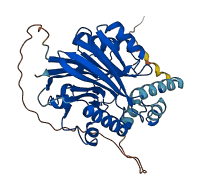
Descriptions
The autoinhibited protein was predicted that may have potential autoinhibitory elements via cis-regPred.
Autoinhibitory domains (AIDs)
Target domain |
|
Relief mechanism |
|
Assay |
cis-regPred |
Accessory elements
No accessory elements
Autoinhibited structure

Activated structure
1 structures for Q3T1H5
| Entry ID | Method | Resolution | Chain | Position | Source |
|---|---|---|---|---|---|
| AF-Q3T1H5-F1 | Predicted | AlphaFoldDB |
No variants for Q3T1H5
| Variant ID(s) | Position | Change | Description | Diseaes Association | Provenance |
|---|---|---|---|---|---|
| No variants for Q3T1H5 | |||||
No associated diseases with Q3T1H5
No regional properties for Q3T1H5
| Type | Name | Position | InterPro Accession |
|---|---|---|---|
| No domain, repeats, and functional sites for Q3T1H5 | |||
Functions
4 GO annotations of cellular component
| Name | Definition |
|---|---|
| cytoplasm | The contents of a cell excluding the plasma membrane and nucleus, but including other subcellular structures. |
| nucleolus | A small, dense body one or more of which are present in the nucleus of eukaryotic cells. It is rich in RNA and protein, is not bounded by a limiting membrane, and is not seen during mitosis. Its prime function is the transcription of the nucleolar DNA into 45S ribosomal-precursor RNA, the processing of this RNA into 5.8S, 18S, and 28S components of ribosomal RNA, and the association of these components with 5S RNA and proteins synthesized outside the nucleolus. This association results in the formation of ribonucleoprotein precursors; these pass into the cytoplasm and mature into the 40S and 60S subunits of the ribosome. |
| nucleus | A membrane-bounded organelle of eukaryotic cells in which chromosomes are housed and replicated. In most cells, the nucleus contains all of the cell's chromosomes except the organellar chromosomes, and is the site of RNA synthesis and processing. In some species, or in specialized cell types, RNA metabolism or DNA replication may be absent. |
| PML body | A class of nuclear body; they react against SP100 auto-antibodies (PML, promyelocytic leukemia); cells typically contain 10-30 PML bodies per nucleus; alterations in the localization of PML bodies occurs after viral infection. |
6 GO annotations of molecular function
| Name | Definition |
|---|---|
| 5'-tyrosyl-DNA phosphodiesterase activity | Catalysis of the hydrolysis of 5'-phosphotyrosyl groups formed as covalent intermediates (in DNA backbone breakage) between DNA topoisomerase II and DNA. |
| magnesium ion binding | Binding to a magnesium (Mg) ion. |
| manganese ion binding | Binding to a manganese ion (Mn). |
| nuclease activity | Catalysis of the hydrolysis of ester linkages within nucleic acids. |
| single-stranded DNA binding | Binding to single-stranded DNA. |
| tyrosyl-RNA phosphodiesterase activity | Catalysis of the hydrolysis of a 5' tyrosyl-RNA phosphodiester bond between a protein and RNA. In picornaviruses, this covalent bond connects VPg, a viral-encoded protein essential for RNA replication, to the 5' end of all nascent picornavirus genomes; it is cleaved from viral RNA prior to its engaging in protein synthesis. |
2 GO annotations of biological process
| Name | Definition |
|---|---|
| double-strand break repair | The repair of double-strand breaks in DNA via homologous and nonhomologous mechanisms to reform a continuous DNA helix. |
| neuron development | The process whose specific outcome is the progression of a neuron over time, from initial commitment of the cell to a specific fate, to the fully functional differentiated cell. |
| 10 | 20 | 30 | 40 | 50 | 60 |
| MASGSSSDAA | ESAEPAAAPA | AAETEEDQVK | RRRLQSLGFA | LVTSCDTTVA | STFLSENNWQ |
| 70 | 80 | 90 | 100 | 110 | 120 |
| TKKALSAFFE | QPENDLARPH | QPPTSSKSED | YVDLTNEDAN | DTTILETSPS | GTPLEDSSTI |
| 130 | 140 | 150 | 160 | 170 | 180 |
| SFITWNIDGL | DGCNLPERAR | GVCSCLALYS | PDVVFLQEVI | PSYCAYLRKR | ARTYNIITGN |
| 190 | 200 | 210 | 220 | 230 | 240 |
| EEGYFTAILL | KKGRVKFKGQ | EIIPFPNTKM | MRNLLCVNVS | LGGNEFCLMT | SHLESTRKHS |
| 250 | 260 | 270 | 280 | 290 | 300 |
| AERINQLKTV | FQKMQEATDS | TTVIFAGDTN | LRDQEVIKCG | GLPDNVFDAW | EFLGKPKHCR |
| 310 | 320 | 330 | 340 | 350 | 360 |
| YTWDTKANDN | LRIPAACKHR | FDRIFFRAEE | GHLIPQSLDL | IGLERLDCGR | FPSDHWGLLC |
| TLNVVL |