Q3SZ54
Gene name |
EIF4A1 |
Protein name |
Eukaryotic initiation factor 4A-I |
Names |
eIF-4A-I, eIF4A-I, ATP-dependent RNA helicase eIF4A-1 |
Species |
Bos taurus (Bovine) |
KEGG Pathway |
bta:504958 |
EC number |
3.6.4.13: Acting on ATP; involved in cellular and subcellular movement |
Protein Class |
|
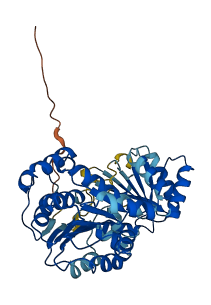
Descriptions
The autoinhibited protein was predicted that may have potential autoinhibitory elements via cis-regPred.
Autoinhibitory domains (AIDs)
Target domain |
|
Relief mechanism |
|
Assay |
cis-regPred |
Accessory elements
No accessory elements
Autoinhibited structure

Activated structure
1 structures for Q3SZ54
| Entry ID | Method | Resolution | Chain | Position | Source |
|---|---|---|---|---|---|
| AF-Q3SZ54-F1 | Predicted | AlphaFoldDB |
31 variants for Q3SZ54
| Variant ID(s) | Position | Change | Description | Diseaes Association | Provenance |
|---|---|---|---|---|---|
| rs469235814 | 59 | Q>K | No | EVA | |
| rs479749746 | 63 | I>F | No | EVA | |
| rs465439241 | 64 | L>H | No | EVA | |
| rs445325023 | 64 | L>V | No | EVA | |
| rs437189649 | 65 | P>R | No | EVA | |
| rs457044257 | 73 | I>L | No | EVA | |
| rs467262082 | 79 | G>A | No | EVA | |
| rs441935224 | 219 | D>G | No | EVA | |
| rs462293617 | 226 | K>N | No | EVA | |
| rs472658134 | 228 | M>V | No | EVA | |
| rs441412833 | 229 | R>S | No | EVA | |
| rs458262028 | 230 | D>V | No | EVA | |
| rs439263052 | 238 | K>E | No | EVA | |
| rs462622797 | 243 | L>P | No | EVA | |
| rs482628810 | 244 | E>* | No | EVA | |
| rs448044577 | 246 | I>L | No | EVA | |
| rs472746406 | 261 | D>G | No | EVA | |
| rs441473309 | 262 | T>S | No | EVA | |
| rs472083595 | 343 | L>F | No | EVA | |
| rs443796161 | 346 | N>T | No | EVA | |
| rs457519904 | 348 | D>G | No | EVA | |
| rs466068476 | 365 | R>H | No | EVA | |
| rs445180497 | 366 | F>L | No | EVA | |
| rs437477449 | 369 | K>T | No | EVA | |
| rs474420310 | 371 | V>G | No | EVA | |
| rs436551764 | 379 | E>G | No | EVA | |
| rs455439910 | 382 | R>T | No | EVA | |
| rs440842892 | 389 | T>S | No | EVA | |
| rs457729272 | 400 | L>H | No | EVA | |
| rs443464032 | 404 | D>G | No | EVA | |
| rs463454515 | 407 | I>R | No | EVA |
2 associated diseases with Q3SZ54
[MIM: 613237]: Focal segmental glomerulosclerosis 5 (FSGS5)
A renal pathology defined by the presence of segmental sclerosis in glomeruli and resulting in proteinuria, reduced glomerular filtration rate and progressive decline in renal function. Renal insufficiency often progresses to end-stage renal disease, a highly morbid state requiring either dialysis therapy or kidney transplantation. {ECO:0000269|PubMed:20023659, ECO:0000269|PubMed:21258034, ECO:0000269|PubMed:21866090, ECO:0000269|PubMed:22971997, ECO:0000269|PubMed:23014460, ECO:0000269|PubMed:25165188}. Note=The disease is caused by variants affecting the gene represented in this entry.
[MIM: 614455]: Charcot-Marie-Tooth disease, dominant, intermediate type, E (CMTDIE)
A form of Charcot-Marie-Tooth disease, a disorder of the peripheral nervous system, characterized by progressive weakness and atrophy, initially of the peroneal muscles and later of the distal muscles of the arms. The dominant intermediate type E is characterized by clinical and pathologic features intermediate between demyelinating and axonal peripheral neuropathies, and motor median nerve conduction velocities ranging from 25 to 45 m/sec. Patients additionally manifest focal segmental glomerulonephritis, proteinuria, progression to end-stage renal disease, and a characteristic histologic pattern on renal biopsy. {ECO:0000269|PubMed:22187985, ECO:0000269|PubMed:24174593, ECO:0000269|PubMed:24750328, ECO:0000269|PubMed:25165188, ECO:0000269|PubMed:25676889}. Note=The disease is caused by variants affecting the gene represented in this entry.
Without disease ID
- A renal pathology defined by the presence of segmental sclerosis in glomeruli and resulting in proteinuria, reduced glomerular filtration rate and progressive decline in renal function. Renal insufficiency often progresses to end-stage renal disease, a highly morbid state requiring either dialysis therapy or kidney transplantation. {ECO:0000269|PubMed:20023659, ECO:0000269|PubMed:21258034, ECO:0000269|PubMed:21866090, ECO:0000269|PubMed:22971997, ECO:0000269|PubMed:23014460, ECO:0000269|PubMed:25165188}. Note=The disease is caused by variants affecting the gene represented in this entry.
- A form of Charcot-Marie-Tooth disease, a disorder of the peripheral nervous system, characterized by progressive weakness and atrophy, initially of the peroneal muscles and later of the distal muscles of the arms. The dominant intermediate type E is characterized by clinical and pathologic features intermediate between demyelinating and axonal peripheral neuropathies, and motor median nerve conduction velocities ranging from 25 to 45 m/sec. Patients additionally manifest focal segmental glomerulonephritis, proteinuria, progression to end-stage renal disease, and a characteristic histologic pattern on renal biopsy. {ECO:0000269|PubMed:22187985, ECO:0000269|PubMed:24174593, ECO:0000269|PubMed:24750328, ECO:0000269|PubMed:25165188, ECO:0000269|PubMed:25676889}. Note=The disease is caused by variants affecting the gene represented in this entry.
6 regional properties for Q3SZ54
| Type | Name | Position | InterPro Accession |
|---|---|---|---|
| domain | SCAN domain | 40 - 148 | IPR003309 |
| domain | Zinc finger C2H2-type | 356 - 383 | IPR013087-1 |
| domain | Zinc finger C2H2-type | 384 - 411 | IPR013087-2 |
| domain | Zinc finger C2H2-type | 412 - 439 | IPR013087-3 |
| domain | Zinc finger C2H2-type | 440 - 467 | IPR013087-4 |
| domain | Zinc finger C2H2-type | 468 - 495 | IPR013087-5 |
Functions
| Description | ||
|---|---|---|
| EC Number | 3.6.4.13 | Acting on ATP; involved in cellular and subcellular movement |
| Subcellular Localization |
|
|
| PANTHER Family | ||
| PANTHER Subfamily | ||
| PANTHER Protein Class | ||
| PANTHER Pathway Category | No pathway information available | |
1 GO annotations of cellular component
| Name | Definition |
|---|---|
| cytoplasm | The contents of a cell excluding the plasma membrane and nucleus, but including other subcellular structures. |
5 GO annotations of molecular function
| Name | Definition |
|---|---|
| ATP binding | Binding to ATP, adenosine 5'-triphosphate, a universally important coenzyme and enzyme regulator. |
| ATP hydrolysis activity | Catalysis of the reaction: ATP + H2O = ADP + H+ phosphate. ATP hydrolysis is used in some reactions as an energy source, for example to catalyze a reaction or drive transport against a concentration gradient. |
| double-stranded RNA binding | Binding to double-stranded RNA. |
| RNA helicase activity | Unwinding of an RNA helix, driven by ATP hydrolysis. |
| translation initiation factor activity | Functions in the initiation of ribosome-mediated translation of mRNA into a polypeptide. |
1 GO annotations of biological process
| Name | Definition |
|---|---|
| cytoplasmic translational initiation | The process preceding formation of the peptide bond between the first two amino acids of a protein in the cytoplasm. This includes the formation of a complex of the ribosome, mRNA or circRNA, and an initiation complex that contains the first aminoacyl-tRNA. |
21 homologous proteins in AiPD
| UniProt AC | Gene Name | Protein Name | Species | Evidence Code |
|---|---|---|---|---|
| P41378 | Eukaryotic initiation factor 4A | Triticum aestivum (Wheat) | PR | |
| P10081 | TIF2 | ATP-dependent RNA helicase eIF4A | Saccharomyces cerevisiae (strain ATCC 204508 / S288c) (Baker's yeast) | PR |
| Q3SZ65 | EIF4A2 | Eukaryotic initiation factor 4A-II | Bos taurus (Bovine) | PR |
| Q29S22 | DDX47 | Probable ATP-dependent RNA helicase DDX47 | Bos taurus (Bovine) | PR |
| Q3SZ40 | DDX56 | Probable ATP-dependent RNA helicase DDX56 | Bos taurus (Bovine) | PR |
| Q2NL08 | DDX55 | ATP-dependent RNA helicase DDX55 | Bos taurus (Bovine) | PR |
| Q8JFP1 | EIF4A2 | Eukaryotic initiation factor 4A-II | Gallus gallus (Chicken) | PR |
| A5A6N4 | EIF4A1 | Eukaryotic initiation factor 4A-I | Pan troglodytes (Chimpanzee) | PR |
| Q14240 | EIF4A2 | Eukaryotic initiation factor 4A-II | Homo sapiens (Human) | PR |
| P60842 | EIF4A1 | Eukaryotic initiation factor 4A-I | Homo sapiens (Human) | PR |
| Q41741 | Eukaryotic initiation factor 4A | Zea mays (Maize) | PR | |
| P10630 | Eif4a2 | Eukaryotic initiation factor 4A-II | Mus musculus (Mouse) | PR |
| P60843 | Eif4a1 | Eukaryotic initiation factor 4A-I | Mus musculus (Mouse) | PR |
| Q5RKI1 | Eif4a2 | Eukaryotic initiation factor 4A-II | Rattus norvegicus (Rat) | PR |
| P35683 | Os06g0701100 | Eukaryotic initiation factor 4A-1 | Oryza sativa subsp japonica (Rice) | PR |
| Q6Z2Z4 | Os02g0146600 | Eukaryotic initiation factor 4A-3 | Oryza sativa subsp japonica (Rice) | PR |
| P27639 | inf-1 | Eukaryotic initiation factor 4A | Caenorhabditis elegans | PR |
| Q3E9C3 | RH58 | DEAD-box ATP-dependent RNA helicase 58, chloroplastic | Arabidopsis thaliana (Mouse-ear cress) | PR |
| Q9CAI7 | TIF4A-3 | Eukaryotic initiation factor 4A-3 | Arabidopsis thaliana (Mouse-ear cress) | PR |
| P41377 | TIF4A-2 | Eukaryotic initiation factor 4A-2 | Arabidopsis thaliana (Mouse-ear cress) | PR |
| P41376 | EIF4A1 | Eukaryotic initiation factor 4A-1 | Arabidopsis thaliana (Mouse-ear cress) | PR |
| 10 | 20 | 30 | 40 | 50 | 60 |
| MSASQDSRSR | DNGPDGMEPE | GVIESNWNEI | VDSFDDMNLS | ESLLRGIYAY | GFEKPSAIQQ |
| 70 | 80 | 90 | 100 | 110 | 120 |
| RAILPCIKGY | DVIAQAQSGT | GKTATFAISI | LQQIELDLKA | TQALVLAPTR | ELAQQIQKVV |
| 130 | 140 | 150 | 160 | 170 | 180 |
| MALGDYMGAS | CHACIGGTNV | RAEVQKLQME | APHIIVGTPG | RVFDMLNRRY | LSPKYIKMFV |
| 190 | 200 | 210 | 220 | 230 | 240 |
| LDEADEMLSR | GFKDQIYDIF | QKLNSNTQVV | LLSATMPSDV | LEVTKKFMRD | PIRILVKKEE |
| 250 | 260 | 270 | 280 | 290 | 300 |
| LTLEGIRQFY | INVEREEWKL | DTLCDLYETL | TITQAVIFIN | TRRKVDWLTE | KMHARDFTVS |
| 310 | 320 | 330 | 340 | 350 | 360 |
| AMHGDMDQKE | RDVIMREFRS | GSSRVLITTD | LLARGIDVQQ | VSLVINYDLP | TNRENYIHRI |
| 370 | 380 | 390 | 400 | ||
| GRGGRFGRKG | VAINMVTEED | KRTLRDIETF | YNTSIEEMPL | NVADLI |