Q3B7L9
Gene name |
KRR1 |
Protein name |
KRR1 small subunit processome component homolog |
Names |
KRR-R motif-containing protein 1 |
Species |
Bos taurus (Bovine) |
KEGG Pathway |
bta:513714 |
EC number |
|
Protein Class |
|
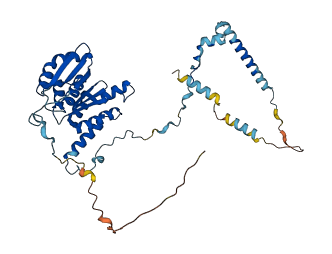
Descriptions
The autoinhibited protein was predicted that may have potential autoinhibitory elements via cis-regPred.
Autoinhibitory domains (AIDs)
Target domain |
|
Relief mechanism |
|
Assay |
cis-regPred |
Accessory elements
No accessory elements
Autoinhibited structure

Activated structure
1 structures for Q3B7L9
| Entry ID | Method | Resolution | Chain | Position | Source |
|---|---|---|---|---|---|
| AF-Q3B7L9-F1 | Predicted | AlphaFoldDB |
40 variants for Q3B7L9
| Variant ID(s) | Position | Change | Description | Diseaes Association | Provenance |
|---|---|---|---|---|---|
| rs475128835 | 2 | A>G | No | EVA | |
| rs460914769 | 3 | S>A | No | EVA | |
| rs440801826 | 4 | S>T | No | EVA | |
| rs715802253 | 9 | P>S | No | EVA | |
| rs472284238 | 10 | T>S | No | EVA | |
| rs452161744 | 15 | K>E | No | EVA | |
| rs432137236 | 15 | K>T | No | EVA | |
| rs456409883 | 16 | S>R | No | EVA | |
| rs436252668 | 19 | R>P | No | EVA | |
| rs722744685 | 21 | P>L | No | EVA | |
| rs434824378 | 24 | T>A | No | EVA | |
| rs466273128 | 24 | T>M | No | EVA | |
| rs477384564 | 25 | S>A | No | EVA | |
| rs477384564 | 25 | S>P | No | EVA | |
| rs470181235 | 26 | E>G | No | EVA | |
| rs481726577 | 27 | N>T | No | EVA | |
| rs461611989 | 28 | R>P | No | EVA | |
| rs468438350 | 47 | K>R | No | EVA | |
| rs448146538 | 73 | K>R | No | EVA | |
| rs479779441 | 79 | V>G | No | EVA | |
| rs448406066 | 79 | V>I | No | EVA | |
| rs460517355 | 80 | Q>R | No | EVA | |
| rs378937200 | 82 | A>T | No | EVA | |
| rs434637763 | 116 | A>S | No | EVA | |
| rs466065259 | 117 | R>* | No | EVA | |
| rs473682194 | 138 | D>G | No | EVA | |
| rs459924917 | 139 | D>G | No | EVA | |
| rs439156137 | 141 | A>S | No | EVA | |
| rs474716918 | 176 | E>D | No | EVA | |
| rs454664979 | 178 | L>* | No | EVA | |
| rs434623843 | 191 | S>T | No | EVA | |
| rs463464055 | 199 | L>F | No | EVA | |
| rs462879621 | 221 | T>I | No | EVA | |
| rs133190278 | 269 | F>S | No | EVA | |
| rs797943892 | 299 | M>I | No | EVA | |
| rs472905762 | 314 | Q>* | No | EVA | |
| rs480314195 | 342 | K>R | No | EVA | |
| rs441147576 | 355 | A>E | No | EVA | |
| rs479092003 | 366 | E>G | No | EVA | |
| rs438859694 | 375 | D>N | No | EVA |
No associated diseases with Q3B7L9
6 GO annotations of cellular component
| Name | Definition |
|---|---|
| chromosome | A structure composed of a very long molecule of DNA and associated proteins (e.g. histones) that carries hereditary information. |
| cytoplasm | The contents of a cell excluding the plasma membrane and nucleus, but including other subcellular structures. |
| intercellular bridge | A direct connection between the cytoplasm of two cells that is formed following the completion of cleavage furrow ingression during cell division. They are usually present only briefly prior to completion of cytokinesis. However, in some cases, such as the bridges between germ cells during their development, they become stabilised. |
| nucleolus | A small, dense body one or more of which are present in the nucleus of eukaryotic cells. It is rich in RNA and protein, is not bounded by a limiting membrane, and is not seen during mitosis. Its prime function is the transcription of the nucleolar DNA into 45S ribosomal-precursor RNA, the processing of this RNA into 5.8S, 18S, and 28S components of ribosomal RNA, and the association of these components with 5S RNA and proteins synthesized outside the nucleolus. This association results in the formation of ribonucleoprotein precursors; these pass into the cytoplasm and mature into the 40S and 60S subunits of the ribosome. |
| nucleoplasm | That part of the nuclear content other than the chromosomes or the nucleolus. |
| small-subunit processome | A large ribonucleoprotein complex that is an early preribosomal complex. In S. cerevisiae, it has a size of 80S and consists of the 35S pre-rRNA, early-associating ribosomal proteins most of which are part of the small ribosomal subunit, the U3 snoRNA and associated proteins. |
1 GO annotations of molecular function
| Name | Definition |
|---|---|
| RNA binding | Binding to an RNA molecule or a portion thereof. |
1 GO annotations of biological process
| Name | Definition |
|---|---|
| rRNA processing | Any process involved in the conversion of a primary ribosomal RNA (rRNA) transcript into one or more mature rRNA molecules. |
1 homologous proteins in AiPD
| UniProt AC | Gene Name | Protein Name | Species | Evidence Code |
|---|---|---|---|---|
| Q13601 | KRR1 | KRR1 small subunit processome component homolog | Homo sapiens (Human) | PR |
| 10 | 20 | 30 | 40 | 50 | 60 |
| MASSKQNGPT | TASGKSELRS | PKPTSENRDE | SELLTVPDGW | KEPAFSKEDN | PRGLLEESSF |
| 70 | 80 | 90 | 100 | 110 | 120 |
| ATLFPKYREA | YLKECWPLVQ | KALNEHHINA | TLDLIEGSMT | VCTTKKTFDP | YIIIRARDLI |
| 130 | 140 | 150 | 160 | 170 | 180 |
| KLLARSVSFE | QAIRILQDDV | ACDIIKIGSL | VRNKERFVKR | RQRLIGPKGS | TLKALELLTN |
| 190 | 200 | 210 | 220 | 230 | 240 |
| CYIMVQGNTV | SAIGPFSGLK | EVRKVVLDTM | KNIHPIYNIK | TLMIKRELAK | DSELRSQSWE |
| 250 | 260 | 270 | 280 | 290 | 300 |
| RFLPQFKHKN | VNKRKEPKKK | TVKKEYTPFP | PPQPESQIDK | ELASGEYFLK | ASQKKRQKME |
| 310 | 320 | 330 | 340 | 350 | 360 |
| AIKAKQAEAL | SKRQEERNKA | FIPPKEKPVH | LKKPKEASTE | TKIDVAALKE | KVKKAKNKKL |
| 370 | 380 | ||||
| GALTAEEVKL | KMEADEKKKK | KK |