Q32PX9
Gene name |
Afg1l |
Protein name |
AFG1-like ATPase |
Names |
Lactation elevated protein 1 |
Species |
Rattus norvegicus (Rat) |
KEGG Pathway |
rno:502479 |
EC number |
|
Protein Class |
|
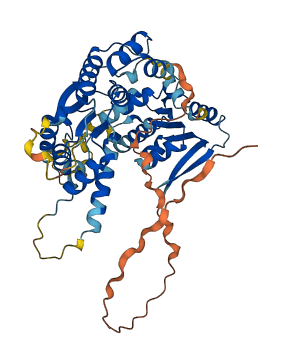
Descriptions
The autoinhibited protein was predicted that may have potential autoinhibitory elements via cis-regPred.
Autoinhibitory domains (AIDs)
Target domain |
|
Relief mechanism |
|
Assay |
cis-regPred |
Accessory elements
No accessory elements
Autoinhibited structure

Activated structure
1 structures for Q32PX9
| Entry ID | Method | Resolution | Chain | Position | Source |
|---|---|---|---|---|---|
| AF-Q32PX9-F1 | Predicted | AlphaFoldDB |
No variants for Q32PX9
| Variant ID(s) | Position | Change | Description | Diseaes Association | Provenance |
|---|---|---|---|---|---|
| No variants for Q32PX9 | |||||
No associated diseases with Q32PX9
No regional properties for Q32PX9
| Type | Name | Position | InterPro Accession |
|---|---|---|---|
| No domain, repeats, and functional sites for Q32PX9 | |||
3 GO annotations of cellular component
| Name | Definition |
|---|---|
| cytoplasm | The contents of a cell excluding the plasma membrane and nucleus, but including other subcellular structures. |
| mitochondrial membrane | Either of the lipid bilayers that surround the mitochondrion and form the mitochondrial envelope. |
| mitochondrion | A semiautonomous, self replicating organelle that occurs in varying numbers, shapes, and sizes in the cytoplasm of virtually all eukaryotic cells. It is notably the site of tissue respiration. |
2 GO annotations of molecular function
| Name | Definition |
|---|---|
| ATP binding | Binding to ATP, adenosine 5'-triphosphate, a universally important coenzyme and enzyme regulator. |
| ATP hydrolysis activity | Catalysis of the reaction: ATP + H2O = ADP + H+ phosphate. ATP hydrolysis is used in some reactions as an energy source, for example to catalyze a reaction or drive transport against a concentration gradient. |
3 GO annotations of biological process
| Name | Definition |
|---|---|
| mitochondrial electron transport, cytochrome c to oxygen | The transfer of electrons from cytochrome c to oxygen that occurs during oxidative phosphorylation, mediated by the multisubunit enzyme known as complex IV. |
| mitochondrial protein catabolic process | The chemical reactions and pathways resulting in the breakdown of a mitochondrial protein. This process is necessary to maintain the healthy state of mitochondria and is thought to occur via the induction of an intramitochondrial lysosome-like organelle that acts to eliminate the damaged oxidised mitochondrial proteins without destroying the mitochondrial structure. |
| mitochondrion organization | A process that is carried out at the cellular level which results in the assembly, arrangement of constituent parts, or disassembly of a mitochondrion; includes mitochondrial morphogenesis and distribution, and replication of the mitochondrial genome as well as synthesis of new mitochondrial components. |
1 homologous proteins in AiPD
| UniProt AC | Gene Name | Protein Name | Species | Evidence Code |
|---|---|---|---|---|
| Q3V384 | Afg1l | AFG1-like ATPase | Mus musculus (Mouse) | PR |
| 10 | 20 | 30 | 40 | 50 | 60 |
| MAASWSPLVT | LRSAARSRLT | GRGVGCGARV | IAIFPPAPGP | RKPLWKAYTV | QTLEGVRPTA |
| 70 | 80 | 90 | 100 | 110 | 120 |
| ASEAHSRALA | VCHGPLAHYD | FLIKAQELKN | DEHQRRVVQC | LQKLQEDLKG | YNIEEGGLFS |
| 130 | 140 | 150 | 160 | 170 | 180 |
| KLFSRNKPPK | GLYVYGDVGT | GKTMVMDMFY | EYVEVKSKRR | VHFHGFMLDV | HKRIHRLKQS |
| 190 | 200 | 210 | 220 | 230 | 240 |
| LPKRKVGFMA | KSYDPIAPIA | EEISQEASLL | CFDEFQVTDI | ADAMILKQLF | ENLFKNGVVV |
| 250 | 260 | 270 | 280 | 290 | 300 |
| VATSNRPPED | LYKNGLQRAN | FVPFIAVLKE | YCNTVQLDSG | VDYRKRELTP | AGKLYYLTSE |
| 310 | 320 | 330 | 340 | 350 | 360 |
| ADVGTVMDKL | FDELAQKQND | LTSPRILKVQ | GRELRLNKAC | GTVADCTFEE | LCERPLGASD |
| 370 | 380 | 390 | 400 | 410 | 420 |
| YLELSKNFDT | VIIRNIPQFS | LAKRTQVRRF | ITLIDNFYDF | KVRIICSASV | PISSLFVYQH |
| 430 | 440 | 450 | 460 | 470 | |
| QDSESDQSRV | LMDDLGLSQD | SAGLSMFTGE | EEIFSFQRTL | SRLTEMQTEQ | YWIEGDRSRK |