Q32LB5
Gene name |
GLIPR1L1 |
Protein name |
GLIPR1-like protein 1 |
Names |
|
Species |
Bos taurus (Bovine) |
KEGG Pathway |
bta:615034 |
EC number |
|
Protein Class |
|
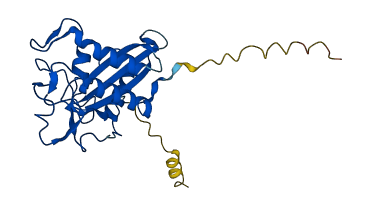
Descriptions
The autoinhibited protein was predicted that may have potential autoinhibitory elements via cis-regPred.
Autoinhibitory domains (AIDs)
Target domain |
|
Relief mechanism |
|
Assay |
cis-regPred |
Accessory elements
No accessory elements
Autoinhibited structure

Activated structure
1 structures for Q32LB5
| Entry ID | Method | Resolution | Chain | Position | Source |
|---|---|---|---|---|---|
| AF-Q32LB5-F1 | Predicted | AlphaFoldDB |
27 variants for Q32LB5
| Variant ID(s) | Position | Change | Description | Diseaes Association | Provenance |
|---|---|---|---|---|---|
| rs109044971 | 6 | K>N | No | EVA | |
| rs380564947 | 26 | A>V | No | EVA | |
| rs439728000 | 46 | R>W | No | EVA | |
| rs453313249 | 47 | T>A | No | EVA | |
| rs441957945 | 57 | K>Q | No | EVA | |
| rs433708821 | 68 | T>S | No | EVA | |
| rs457910983 | 76 | C>S | No | EVA | |
| rs453680790 | 97 | A>S | No | EVA | |
| rs473633711 | 108 | I>R | No | EVA | |
| rs456691187 | 110 | A>E | No | EVA | |
| rs478039961 | 110 | A>P | No | EVA | |
| rs476660674 | 111 | A>E | No | EVA | |
| rs438991402 | 136 | C>G | No | EVA | |
| rs459182545 | 137 | G>V | No | EVA | |
| rs472773318 | 139 | Y>* | No | EVA | |
| rs441328545 | 141 | Q>E | No | EVA | |
| rs378441033 | 175 | A>V | No | EVA | |
| rs454698881 | 181 | M>L | No | EVA | |
| rs461639792 | 187 | G>V | No | EVA | |
| rs714050288 | 192 | M>R | No | EVA | |
| rs474662721 | 195 | G>E | No | EVA | |
| rs457973657 | 204 | R>G | No | EVA | |
| rs436737496 | 207 | E>G | No | EVA | |
| rs799063319 | 208 | R>H | No | EVA | |
| rs384405022 | 215 | P>L | No | EVA | |
| rs721853679 | 222 | T>I | No | EVA | |
| rs714931368 | 223 | R>S | No | EVA |
No associated diseases with Q32LB5
4 regional properties for Q32LB5
| Type | Name | Position | InterPro Accession |
|---|---|---|---|
| domain | CAP domain | 33 - 180 | IPR014044 |
| conserved_site | Allergen V5/Tpx-1-related, conserved site | 137 - 147 | IPR018244-1 |
| conserved_site | Allergen V5/Tpx-1-related, conserved site | 167 - 178 | IPR018244-2 |
| domain | Glioma pathogenesis-related protein 1-like, SCP domain | 33 - 176 | IPR034121 |
Functions
5 GO annotations of cellular component
| Name | Definition |
|---|---|
| acrosomal vesicle | A structure in the head of a spermatozoon that contains acid hydrolases, and is concerned with the breakdown of the outer membrane of the ovum during fertilization. It lies just beneath the plasma membrane and is derived from the lysosome. |
| anchored component of membrane | The component of a membrane consisting of the gene products that are tethered to the membrane only by a covalently attached anchor, such as a lipid group that is embedded in the membrane. Gene products with peptide sequences that are embedded in the membrane are excluded from this grouping. |
| extracellular space | That part of a multicellular organism outside the cells proper, usually taken to be outside the plasma membranes, and occupied by fluid. |
| membrane raft | Any of the small (10-200 nm), heterogeneous, highly dynamic, sterol- and sphingolipid-enriched membrane domains that compartmentalize cellular processes. Small rafts can sometimes be stabilized to form larger platforms through protein-protein and protein-lipid interactions. |
| plasma membrane | The membrane surrounding a cell that separates the cell from its external environment. It consists of a phospholipid bilayer and associated proteins. |
No GO annotations of molecular function
| Name | Definition |
|---|---|
| No GO annotations for molecular function |
1 GO annotations of biological process
| Name | Definition |
|---|---|
| binding of sperm to zona pellucida | The process in which the sperm binds to the zona pellucida glycoprotein layer of the egg. The process begins with the attachment of the sperm plasma membrane to the zona pellucida and includes attachment of the acrosome inner membrane to the zona pellucida after the acrosomal reaction takes place. |
| 10 | 20 | 30 | 40 | 50 | 60 |
| MILRKKLSYL | WTLGLCLVAS | KSPPKAPSIT | NDRFIEECLR | LHNEARTNVS | PPAADMKYMS |
| 70 | 80 | 90 | 100 | 110 | 120 |
| WDEALAKTAE | AWAKKCKFIH | NSCSSKSFKC | HPTFQYAGEN | LWLGPLTISA | AKFAINMWYD |
| 130 | 140 | 150 | 160 | 170 | 180 |
| ERKFYDFNTR | SCSQVCGHYT | QVVWAYSYKV | GCAVAVCPNL | GSPDSALLVC | NYAPAGNYPN |
| 190 | 200 | 210 | 220 | 230 | 240 |
| MSPYTNGTPC | SMCQGDTCEN | NLCRNKERDK | SQRYPNWNPS | GTRQLIACNP | LYLISVLLTI |
| F |