Q2YDP3
Gene name |
DRAP1 |
Protein name |
Dr1-associated corepressor |
Names |
Dr1-associated protein 1, Negative cofactor 2-alpha, NC2-alpha |
Species |
Bos taurus (Bovine) |
KEGG Pathway |
bta:540345 |
EC number |
|
Protein Class |
|
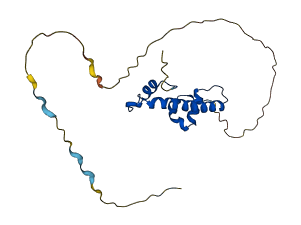
Descriptions
The autoinhibited protein was predicted that may have potential autoinhibitory elements via cis-regPred.
Autoinhibitory domains (AIDs)
Target domain |
|
Relief mechanism |
|
Assay |
cis-regPred |
Accessory elements
No accessory elements
Autoinhibited structure

Activated structure
1 structures for Q2YDP3
| Entry ID | Method | Resolution | Chain | Position | Source |
|---|---|---|---|---|---|
| AF-Q2YDP3-F1 | Predicted | AlphaFoldDB |
47 variants for Q2YDP3
| Variant ID(s) | Position | Change | Description | Diseaes Association | Provenance |
|---|---|---|---|---|---|
| rs521622116 | 16 | R>L | No | EVA | |
| rs468322762 | 17 | I>L | No | EVA | |
| rs433786566 | 18 | K>E | No | EVA | |
| rs464694483 | 24 | D>A | No | EVA | |
| rs433149833 | 30 | V>E | No | EVA | |
| rs456519417 | 37 | I>L | No | EVA | |
| rs470125048 | 57 | T>P | No | EVA | |
| rs455857884 | 62 | A>G | No | EVA | |
| rs441361898 | 68 | S>A | No | EVA | |
| rs441361898 | 68 | S>T | No | EVA | |
| rs451830932 | 69 | H>P | No | EVA | |
| rs480790888 | 75 | E>D | No | EVA | |
| rs449304409 | 104 | G>E | No | EVA | |
| rs465953283 | 105 | D>N | No | EVA | |
| rs434770276 | 105 | D>V | No | EVA | |
| rs445467956 | 106 | K>N | No | EVA | |
| rs465712962 | 107 | G>S | No | EVA | |
| rs437361069 | 108 | P>T | No | EVA | |
| rs476138578 | 119 | R>G | No | EVA | |
| rs1116628448 | 135 | G>E | No | EVA | |
| rs469857787 | 136 | T>A | No | EVA | |
| rs445228888 | 157 | Q>P | No | EVA | |
| rs482612966 | 164 | H>L | No | EVA | |
| rs482612966 | 164 | H>P | No | EVA | |
| rs451105978 | 168 | H>R | No | EVA | |
| rs467946942 | 169 | F>L | No | EVA | |
| rs436611177 | 169 | F>Y | No | EVA | |
| rs465890511 | 170 | Q>H | No | EVA | |
| rs455396742 | 170 | Q>R | No | EVA | |
| rs434360182 | 171 | S>I | No | EVA | |
| rs476802545 | 175 | P>S | No | EVA | |
| rs442211857 | 177 | M>I | No | EVA | |
| rs460860278 | 180 | T>N | No | EVA | |
| rs440068648 | 182 | T>P | No | EVA | |
| rs468487347 | 189 | P>L | No | EVA | |
| rs448336149 | 190 | P>S | No | EVA | |
| rs434020953 | 192 | A>S | No | EVA | |
| rs464489106 | 193 | S>* | No | EVA | |
| rs447762804 | 193 | S>A | No | EVA | |
| rs464489106 | 193 | S>L | No | EVA | |
| rs447762804 | 193 | S>P | No | EVA | |
| rs456753733 | 194 | A>E | No | EVA | |
| rs433190803 | 194 | A>P | No | EVA | |
| rs433190803 | 194 | A>S | No | EVA | |
| rs435740589 | 195 | P>H | No | EVA | |
| rs472619047 | 203 | Y>H | No | EVA | |
| rs440029694 | 204 | D>A | No | EVA |
No associated diseases with Q2YDP3
1 regional properties for Q2YDP3
| Type | Name | Position | InterPro Accession |
|---|---|---|---|
| domain | Transcription factor CBF/NF-Y/archaeal histone domain | 10 - 74 | IPR003958 |
3 GO annotations of cellular component
| Name | Definition |
|---|---|
| negative cofactor 2 complex | A heterodimeric protein complex that can stably associate with TATA-binding protein on promoters, thereby preventing the assembly of transcription factors TFIIA and TFIIB and leading to repression of RNA polymerase II transcription. The two subunits, NC2alpha (Drap1) and NC2beta (Dr1), dimerize through histone fold domains of the H2A/H2B type present in the amino termini. |
| nucleus | A membrane-bounded organelle of eukaryotic cells in which chromosomes are housed and replicated. In most cells, the nucleus contains all of the cell's chromosomes except the organellar chromosomes, and is the site of RNA synthesis and processing. In some species, or in specialized cell types, RNA metabolism or DNA replication may be absent. |
| RNA polymerase II transcription regulator complex | A transcription factor complex that acts at a regulatory region of a gene transcribed by RNA polymerase II. |
8 GO annotations of molecular function
| Name | Definition |
|---|---|
| core promoter sequence-specific DNA binding | Binding to a sequence of DNA that is part of a core promoter region. The core promoter is composed of the transcription start site and binding sites for the RNA polymerase and the basal transcription machinery. The transcribed region might be described as a gene, cistron, or operon. |
| identical protein binding | Binding to an identical protein or proteins. |
| protein heterodimerization activity | Binding to a nonidentical protein to form a heterodimer. |
| RNA polymerase II general transcription initiation factor activity | A general transcription initiation factor activity that contributes to transcription start site selection and transcription initiation of genes transcribed by RNA polymerase II. The general transcription factors for RNA polymerase II include TFIIB, TFIID, TFIIE, TFIIF, TFIIH and TATA-binding protein (TBP). In most species, RNA polymerase II transcribes all messenger RNAs (mRNAs), most untranslated regulatory RNAs, the majority of the snoRNAs, four of the five snRNAs (U1, U2, U4, and U5), and other small noncoding RNAs. For some small RNAs there is variability between species as to whether it is transcribed by RNA polymerase II or RNA polymerase III. However there are also rare exceptions, such as Trypanosoma brucei, where RNA polymerase I transcribes certain mRNAs in addition to its normal role in rRNA transcription. |
| RNA polymerase II general transcription initiation factor binding | Binding to a basal RNA polymerase II transcription factor, any of the factors involved in formation of the preinitiation complex (PIC) by RNA polymerase II and defined as a basal or general transcription factor. |
| TBP-class protein binding | Binding to a member of the class of TATA-binding proteins (TBP), including any of the TBP-related factors (TRFs). |
| transcription coactivator activity | A transcription coregulator activity that activates or increases the transcription of specific gene sets via binding to a DNA-bound DNA-binding transcription factor, either on its own or as part of a complex. Coactivators often act by altering chromatin structure and modifications. For example, one class of transcription coactivators modifies chromatin structure through covalent modification of histones. A second class remodels the conformation of chromatin in an ATP-dependent fashion. A third class modulates interactions of DNA-bound DNA-binding transcription factors with other transcription coregulators. A fourth class of coactivator activity is the bridging of a DNA-binding transcription factor to the general (basal) transcription machinery. The Mediator complex, which bridges sequence-specific DNA binding transcription factors and RNA polymerase, is also a transcription coactivator. |
| transcription corepressor activity | A transcription coregulator activity that represses or decreases the transcription of specific gene sets via binding to a DNA-bound DNA-binding transcription factor, either on its own or as part of a complex. Corepressors often act by altering chromatin structure and modifications. For example, one class of transcription corepressors modifies chromatin structure through covalent modification of histones. A second class remodels the conformation of chromatin in an ATP-dependent fashion. A third class modulates interactions of DNA-bound DNA-binding transcription factors with other transcription coregulators. |
4 GO annotations of biological process
| Name | Definition |
|---|---|
| negative regulation of transcription by RNA polymerase II | Any process that stops, prevents, or reduces the frequency, rate or extent of transcription mediated by RNA polymerase II. |
| positive regulation of transcription by RNA polymerase II | Any process that activates or increases the frequency, rate or extent of transcription from an RNA polymerase II promoter. |
| regulation of DNA-templated transcription | Any process that modulates the frequency, rate or extent of cellular DNA-templated transcription. |
| transcription by RNA polymerase II | The synthesis of RNA from a DNA template by RNA polymerase II (RNAP II), originating at an RNA polymerase II promoter. Includes transcription of messenger RNA (mRNA) and certain small nuclear RNAs (snRNAs). |
4 homologous proteins in AiPD
| UniProt AC | Gene Name | Protein Name | Species | Evidence Code |
|---|---|---|---|---|
| P40096 | BUR6 | Negative cofactor 2 complex subunit alpha | Saccharomyces cerevisiae (strain ATCC 204508 / S288c) (Baker's yeast) | PR |
| Q14919 | DRAP1 | Dr1-associated corepressor | Homo sapiens (Human) | PR |
| Q9D6N5 | Drap1 | Dr1-associated corepressor | Mus musculus (Mouse) | PR |
| A0JPP1 | Drap1 | Dr1-associated corepressor | Rattus norvegicus (Rat) | PR |
| 10 | 20 | 30 | 40 | 50 | 60 |
| MPSKKKKYNA | RFPPARIKKI | MQTDEEIGKV | AAAVPVIISR | ALELFLESLL | KKACQVTQSR |
| 70 | 80 | 90 | 100 | 110 | 120 |
| NAKTMTTSHL | KQCIELEQQF | DFLKDLVASV | PDMQGDGEDN | HMDGDKGPRR | GRKSGSSGRK |
| 130 | 140 | 150 | 160 | 170 | 180 |
| NGGMGSKGKD | KKLSGTDSEQ | EDESEDTDSD | GEEETPQVPP | QASHPPAHFQ | SPPTPFMPFT |
| 190 | 200 | ||||
| STLPVPPAPP | GASAPDAEEE | EDYDS |