Q2VPQ9
Gene name |
Meaf6 |
Protein name |
Chromatin modification-related protein MEAF6 |
Names |
MYST/Esa1-associated factor 6, Esa1-associated factor 6 homolog, Protein EAF6 homolog |
Species |
Mus musculus (Mouse) |
KEGG Pathway |
mmu:70088 |
EC number |
|
Protein Class |
|
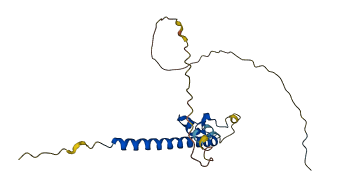
Descriptions
The autoinhibited protein was predicted that may have potential autoinhibitory elements via cis-regPred.
Autoinhibitory domains (AIDs)
Target domain |
|
Relief mechanism |
|
Assay |
cis-regPred |
Accessory elements
No accessory elements
Autoinhibited structure

Activated structure
1 structures for Q2VPQ9
| Entry ID | Method | Resolution | Chain | Position | Source |
|---|---|---|---|---|---|
| AF-Q2VPQ9-F1 | Predicted | AlphaFoldDB |
3 variants for Q2VPQ9
| Variant ID(s) | Position | Change | Description | Diseaes Association | Provenance |
|---|---|---|---|---|---|
| rs3394788846 | 36 | L>* | No | EVA | |
| rs223781207 | 168 | H>Y | No | EVA | |
| rs220944207 | 189 | A>T | No | EVA |
No associated diseases with Q2VPQ9
No regional properties for Q2VPQ9
| Type | Name | Position | InterPro Accession |
|---|---|---|---|
| No domain, repeats, and functional sites for Q2VPQ9 | |||
8 GO annotations of cellular component
| Name | Definition |
|---|---|
| histone acetyltransferase complex | A protein complex that possesses histone acetyltransferase activity. |
| kinetochore | A multisubunit complex that is located at the centromeric region of DNA and provides an attachment point for the spindle microtubules. |
| MOZ/MORF histone acetyltransferase complex | A histone acetyltransferase complex that has histone H3 acetyltransferase and coactivator activities. Subunits of the human complex include MYST3/MOZ, MYST4/MORF, ING5, EAF6 and one of BRPF1, BRD1/BRPF2 and BRPF3. |
| NuA4 histone acetyltransferase complex | A complex having histone acetylase activity on chromatin, as well as ATPase, DNA helicase and structural DNA binding activities. The complex is thought to be involved in double-strand DNA break repair. Subunits of the human complex include HTATIP/TIP60, TRRAP, RUVBL1, BUVBL2, beta-actin and BAF53/ACTL6A. In yeast, the complex has 13 subunits, including the catalytic subunit Esa1 (homologous to human Tip60). |
| nucleolus | A small, dense body one or more of which are present in the nucleus of eukaryotic cells. It is rich in RNA and protein, is not bounded by a limiting membrane, and is not seen during mitosis. Its prime function is the transcription of the nucleolar DNA into 45S ribosomal-precursor RNA, the processing of this RNA into 5.8S, 18S, and 28S components of ribosomal RNA, and the association of these components with 5S RNA and proteins synthesized outside the nucleolus. This association results in the formation of ribonucleoprotein precursors; these pass into the cytoplasm and mature into the 40S and 60S subunits of the ribosome. |
| nucleoplasm | That part of the nuclear content other than the chromosomes or the nucleolus. |
| nucleosome | A complex comprised of DNA wound around a multisubunit core and associated proteins, which forms the primary packing unit of DNA into higher order structures. |
| nucleus | A membrane-bounded organelle of eukaryotic cells in which chromosomes are housed and replicated. In most cells, the nucleus contains all of the cell's chromosomes except the organellar chromosomes, and is the site of RNA synthesis and processing. In some species, or in specialized cell types, RNA metabolism or DNA replication may be absent. |
No GO annotations of molecular function
| Name | Definition |
|---|---|
| No GO annotations for molecular function |
20 GO annotations of biological process
| Name | Definition |
|---|---|
| chromatin organization | The assembly or remodeling of chromatin composed of DNA complexed with histones, other associated proteins, and sometimes RNA. |
| histone acetylation | The modification of a histone by the addition of an acetyl group. |
| histone H2A acetylation | The modification of histone H2A by the addition of an acetyl group. |
| histone H3-K14 acetylation | The modification of histone H3 by the addition of an acetyl group to a lysine residue at position 14 of the histone. |
| histone H4 acetylation | The modification of histone H4 by the addition of an acetyl group. |
| histone H4-K12 acetylation | The modification of histone H4 by the addition of an acetyl group to a lysine residue at position 12 of the histone. |
| histone H4-K5 acetylation | The modification of histone H4 by the addition of an acetyl group to a lysine residue at position 5 of the histone. |
| histone H4-K8 acetylation | The modification of histone H4 by the addition of an acetyl group to a lysine residue at position 8 of the histone. |
| histone modification | The covalent alteration of one or more amino acid residues within a histone protein. |
| positive regulation of DNA-templated transcription | Any process that activates or increases the frequency, rate or extent of cellular DNA-templated transcription. |
| positive regulation of double-strand break repair via homologous recombination | Any process that activates or increases the frequency, rate or extent of double-strand break repair via homologous recombination. |
| regulation of apoptotic process | Any process that modulates the occurrence or rate of cell death by apoptotic process. |
| regulation of cell cycle | Any process that modulates the rate or extent of progression through the cell cycle. |
| regulation of cell growth | Any process that modulates the frequency, rate, extent or direction of cell growth. |
| regulation of developmental process | Any process that modulates the frequency, rate or extent of development, the biological process whose specific outcome is the progression of a multicellular organism over time from an initial condition (e.g. a zygote, or a young adult) to a later condition (e.g. a multicellular animal or an aged adult). |
| regulation of DNA biosynthetic process | Any process that modulates the frequency, rate or extent of DNA biosynthetic process. |
| regulation of DNA replication | Any process that modulates the frequency, rate or extent of DNA replication. |
| regulation of DNA-templated transcription | Any process that modulates the frequency, rate or extent of cellular DNA-templated transcription. |
| regulation of double-strand break repair | Any process that modulates the frequency, rate or extent of double-strand break repair. |
| regulation of hemopoiesis | Any process that modulates the frequency, rate or extent of hemopoiesis. |
| 10 | 20 | 30 | 40 | 50 | 60 |
| MAMHNKTAPP | QIPDTRRELA | ELVKRKQELA | ETLANLERQI | YAFEGSYLED | TQMYGNIIRG |
| 70 | 80 | 90 | 100 | 110 | 120 |
| WDRYLTNQKN | SNSKNDRRNR | KFKEAERLFS | KSSVTSAAAV | SALAGVQDQL | IEKREPGSGT |
| 130 | 140 | 150 | 160 | 170 | 180 |
| ESDTSPDFHN | QENEPAQEDP | EDLDGSVQGV | KPQKAASSTS | SGSHHSSHKK | RKNKNRHRID |
| 190 | |||||
| LKLNKKPRAD | Y |