Q2L6L1
Gene name |
cnpy1 (d121, si:dkey-265a7.3) |
Protein name |
Protein canopy-1 |
Names |
Protein D121 |
Species |
Danio rerio (Zebrafish) (Brachydanio rerio) |
KEGG Pathway |
dre:402819 |
EC number |
|
Protein Class |
|
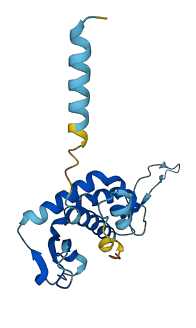
Descriptions
The autoinhibited protein was predicted that may have potential autoinhibitory elements via cis-regPred.
Autoinhibitory domains (AIDs)
Target domain |
|
Relief mechanism |
|
Assay |
cis-regPred |
Accessory elements
No accessory elements
Autoinhibited structure

Activated structure
1 structures for Q2L6L1
| Entry ID | Method | Resolution | Chain | Position | Source |
|---|---|---|---|---|---|
| AF-Q2L6L1-F1 | Predicted | AlphaFoldDB |
No variants for Q2L6L1
| Variant ID(s) | Position | Change | Description | Diseaes Association | Provenance |
|---|---|---|---|---|---|
| No variants for Q2L6L1 | |||||
No associated diseases with Q2L6L1
1 regional properties for Q2L6L1
| Type | Name | Position | InterPro Accession |
|---|---|---|---|
| domain | Domain of unknown function DUF3456 | 31 - 177 | IPR021852 |
1 GO annotations of cellular component
| Name | Definition |
|---|---|
| endoplasmic reticulum | The irregular network of unit membranes, visible only by electron microscopy, that occurs in the cytoplasm of many eukaryotic cells. The membranes form a complex meshwork of tubular channels, which are often expanded into slitlike cavities called cisternae. The ER takes two forms, rough (or granular), with ribosomes adhering to the outer surface, and smooth (with no ribosomes attached). |
No GO annotations of molecular function
| Name | Definition |
|---|---|
| No GO annotations for molecular function |
5 GO annotations of biological process
| Name | Definition |
|---|---|
| determination of left/right symmetry | The establishment of an organism's body plan or part of an organism with respect to the left and right halves. The pattern can either be symmetric, such that the halves are mirror images, or asymmetric where the pattern deviates from this symmetry. |
| fibroblast growth factor receptor signaling pathway | The series of molecular signals generated as a consequence of a fibroblast growth factor receptor binding to one of its physiological ligands. |
| Kupffer's vesicle development | The progression of the Kupffer's vesicle over time from its initial formation until its mature state. The Kupffer's vesicle is a small but distinctive epithelial sac containing fluid, located midventrally posterior to the yolk cell or its extension, and transiently present during most of the segmentation period. |
| midbrain-hindbrain boundary development | The process whose specific outcome is the progression of the midbrain-hindbrain boundary over time, from its formation to the mature structure. The midbrain-hindbrain domain of the embryonic brain is comprised of the mesencephalic vesicle and the first rhombencephalic vesicle at early somitogenesis stages. |
| regulation of fibroblast growth factor receptor signaling pathway | Any process that modulates the frequency, rate or extent of fibroblast growth factor receptor signaling pathway activity. |
1 homologous proteins in AiPD
| UniProt AC | Gene Name | Protein Name | Species | Evidence Code |
|---|---|---|---|---|
| Q9Y2B0 | CNPY2 | Protein canopy homolog 2 | Homo sapiens (Human) | PR |
| 10 | 20 | 30 | 40 | 50 | 60 |
| MSPWIKHICL | VLVAAFMLVK | TTESKKDEAL | YCSACMAIAD | EINYSISQTD | PKKMIHVGGF |
| 70 | 80 | 90 | 100 | 110 | 120 |
| RLKPDGSLTD | KKVPLARSET | YLTELLEEVC | KSMSDYALYE | NPDTKEKSYK | RFAPRDNDGG |
| 130 | 140 | 150 | 160 | 170 | 180 |
| NFPDFKNFKF | DGPESSSALK | FACESIVEEL | EDDIISLFAS | DSDHVAKTLC | SEVSDHCKSS |
| VFQHSEL |