Q29536
Gene name |
PKLR |
Protein name |
Pyruvate kinase PKLR |
Names |
EC 2.7.1.40 , Pyruvate kinase isozymes L/R |
Species |
Canis lupus familiaris (Dog) (Canis familiaris) |
KEGG Pathway |
cfa:490425 |
EC number |
2.7.1.40: Phosphotransferases with an alcohol group as acceptor |
Protein Class |
|
Descriptions
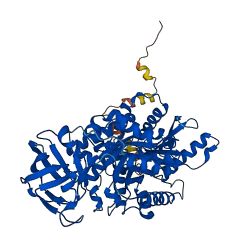
The autoinhibited protein was predicted that may have potential autoinhibitory elements via cis-regPred.
Autoinhibitory domains (AIDs)
Target domain |
86-418 (Pyruvate kinase) |
Relief mechanism |
PTM, Partner binding |
Assay |
|
Accessory elements
No accessory elements
References
- Yeon JH et al. (2016) "Systems-wide Identification of cis-Regulatory Elements in Proteins", Cell systems, 2, 89-100
- Zhang Z et al. (2019) "PKM2, function and expression and regulation", Cell & bioscience, 9, 52
- Zahra K et al. (2020) "Pyruvate Kinase M2 and Cancer: The Role of PKM2 in Promoting Tumorigenesis", Frontiers in oncology, 10, 159
Autoinhibited structure

Activated structure
1 structures for Q29536
| Entry ID | Method | Resolution | Chain | Position | Source |
|---|---|---|---|---|---|
| AF-Q29536-F1 | Predicted | AlphaFoldDB |
1 variants for Q29536
| Variant ID(s) | Position | Change | Description | Diseaes Association | Provenance |
|---|---|---|---|---|---|
| rs852462591 | 25 | K>N | No | EVA |
1 associated diseases with Q29536
Without disease ID
Functions
| Description | ||
|---|---|---|
| EC Number | 2.7.1.40 | Phosphotransferases with an alcohol group as acceptor |
| Subcellular Localization |
|
|
| PANTHER Family | ||
| PANTHER Subfamily | ||
| PANTHER Protein Class | ||
| PANTHER Pathway Category | No pathway information available | |
1 GO annotations of cellular component
| Name | Definition |
|---|---|
| cytoplasm | The contents of a cell excluding the plasma membrane and nucleus, but including other subcellular structures. |
5 GO annotations of molecular function
| Name | Definition |
|---|---|
| ATP binding | Binding to ATP, adenosine 5'-triphosphate, a universally important coenzyme and enzyme regulator. |
| kinase activity | Catalysis of the transfer of a phosphate group, usually from ATP, to a substrate molecule. |
| magnesium ion binding | Binding to a magnesium (Mg) ion. |
| potassium ion binding | Binding to a potassium ion (K+). |
| pyruvate kinase activity | Catalysis of the reaction |
3 GO annotations of biological process
| Name | Definition |
|---|---|
| cellular response to insulin stimulus | Any process that results in a change in state or activity of a cell (in terms of movement, secretion, enzyme production, gene expression, etc.) as a result of an insulin stimulus. Insulin is a polypeptide hormone produced by the islets of Langerhans of the pancreas in mammals, and by the homologous organs of other organisms. |
| glycolytic process | The chemical reactions and pathways resulting in the breakdown of a carbohydrate into pyruvate, with the concomitant production of a small amount of ATP and the reduction of NAD(P) to NAD(P)H. Glycolysis begins with the metabolism of a carbohydrate to generate products that can enter the pathway and ends with the production of pyruvate. Pyruvate may be converted to acetyl-coenzyme A, ethanol, lactate, or other small molecules. |
| phosphorylation | The process of introducing a phosphate group into a molecule, usually with the formation of a phosphoric ester, a phosphoric anhydride or a phosphoric amide. |
12 homologous proteins in AiPD
| UniProt AC | Gene Name | Protein Name | Species | Evidence Code |
|---|---|---|---|---|
| P52489 | PYK2 | Pyruvate kinase 2 | Saccharomyces cerevisiae (strain ATCC 204508 / S288c) (Baker's yeast) | SS |
| P00549 | CDC19 | Pyruvate kinase 1 | Saccharomyces cerevisiae (strain ATCC 204508 / S288c) (Baker's yeast) | SS |
| P11979 | PKM | Pyruvate kinase PKM | Felis catus (Cat) (Felis silvestris catus) | SS |
| P00548 | PKM | Pyruvate kinase PKM | Gallus gallus (Chicken) | SS |
| O62619 | PyK | Pyruvate kinase | Drosophila melanogaster (Fruit fly) | SS |
| P30613 | PKLR | Pyruvate kinase PKLR | Homo sapiens (Human) | SS |
| P14618 | PKM | Pyruvate kinase PKM | Homo sapiens (Human) | EV |
| P52480 | Pkm | Pyruvate kinase PKM | Mus musculus (Mouse) | SS |
| P53657 | Pklr | Pyruvate kinase PKLR | Mus musculus (Mouse) | SS |
| P12928 | Pklr | Pyruvate kinase PKLR | Rattus norvegicus (Rat) | SS |
| P11980 | Pkm | Pyruvate kinase PKM | Rattus norvegicus (Rat) | SS |
| Q9LIK0 | PKP1 | Plastidial pyruvate kinase 1, chloroplastic | Arabidopsis thaliana (Mouse-ear cress) | PR |
| 10 | 20 | 30 | 40 | 50 | 60 |
| MSSQENIQPQ | ELWSRISKSQ | RDLAKSILIG | APGGPAGYLR | RASVAQLTLE | LGTAFFQQQQ |
| 70 | 80 | 90 | 100 | 110 | 120 |
| LSAAMADTFL | EHLCLLDIDS | EPVAARSTSI | IATIGPASHS | VERLKEMIKA | GMNIARLNFS |
| 130 | 140 | 150 | 160 | 170 | 180 |
| HGSHEYHAQS | IANIREAVES | FATSPLGYRP | VAIALDTKGP | EIRTGVLKGG | PETEVELVKG |
| 190 | 200 | 210 | 220 | 230 | 240 |
| SWVLVTVDPA | FRTLGDAHTV | WVDYPNIVKV | VPVGGRIFID | DGLISLQVKK | IDRKGLETQV |
| 250 | 260 | 270 | 280 | 290 | 300 |
| ENGGLLGSRK | GVNLPGAEVD | LPGLSEQDAQ | DLRFGVEHNV | DIVFASFVRK | ASDVAAIRAA |
| 310 | 320 | 330 | 340 | 350 | 360 |
| LGPEGRTIKI | ISKIENHEGV | KKFDEILEVS | DGIMVARGDL | GIEIPAEKVF | LAQKMMIGRC |
| 370 | 380 | 390 | 400 | 410 | 420 |
| NLAGKPVVCA | TQMLESMITK | PRPTRAETSD | VANAVLDGAD | CIMLSGETAK | GKFPVEAVKM |
| 430 | 440 | 450 | 460 | 470 | 480 |
| QHAIAREAEA | AVYHRQLFEE | LRRAAPLSRD | PTEVTAIGAV | EAAFKCCAAA | IIVLTKTGRS |
| 490 | 500 | 510 | 520 | 530 | 540 |
| AQLLSRYRPR | AAVIAVTRSA | QAARQAHLCR | GVFPLLYSEP | PEAIWADDVD | RRVQFGIESG |
| 550 | 560 | 570 | |||
| KLRGFLRVGD | LVIVVTGWRP | GSGYTNIMRV | LSIS |