Q28D01
Gene name |
wdr26 (TGas059a07.1) |
Protein name |
WD repeat-containing protein 26 |
Names |
|
Species |
Xenopus tropicalis (Western clawed frog) (Silurana tropicalis) |
KEGG Pathway |
xtr:733878 |
EC number |
|
Protein Class |
|
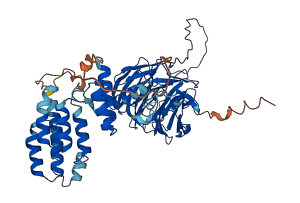
Descriptions
The autoinhibited protein was predicted that may have potential autoinhibitory elements via cis-regPred.
Autoinhibitory domains (AIDs)
Target domain |
|
Relief mechanism |
|
Assay |
cis-regPred |
Accessory elements
No accessory elements
Autoinhibited structure

Activated structure
1 structures for Q28D01
| Entry ID | Method | Resolution | Chain | Position | Source |
|---|---|---|---|---|---|
| AF-Q28D01-F1 | Predicted | AlphaFoldDB |
No variants for Q28D01
| Variant ID(s) | Position | Change | Description | Diseaes Association | Provenance |
|---|---|---|---|---|---|
| No variants for Q28D01 | |||||
No associated diseases with Q28D01
7 regional properties for Q28D01
| Type | Name | Position | InterPro Accession |
|---|---|---|---|
| repeat | WD40 repeat | 297 - 338 | IPR001680-1 |
| repeat | WD40 repeat | 343 - 384 | IPR001680-2 |
| repeat | WD40 repeat | 387 - 427 | IPR001680-3 |
| repeat | WD40 repeat | 510 - 552 | IPR001680-4 |
| repeat | WD40 repeat | 555 - 595 | IPR001680-5 |
| domain | LIS1 homology motif | 67 - 99 | IPR006594 |
| domain | CTLH, C-terminal LisH motif | 100 - 184 | IPR006595 |
3 GO annotations of cellular component
| Name | Definition |
|---|---|
| GID complex | A protein complex with ubiquitin ligase activity that is involved in proteasomal degradation of fructose-1,6-bisphosphatase (FBPase) and phosphoenolpyruvate carboxykinase during the transition from gluconeogenic to glycolytic growth conditions. In S. cerevisiae, the GID (Glucose Induced degradation Deficient) complex consists of Vid30p, Rmd5p, Vid24p, Vid28p, Gid7p, Gid8p, and Fyv10p. |
| mitochondrion | A semiautonomous, self replicating organelle that occurs in varying numbers, shapes, and sizes in the cytoplasm of virtually all eukaryotic cells. It is notably the site of tissue respiration. |
| nucleus | A membrane-bounded organelle of eukaryotic cells in which chromosomes are housed and replicated. In most cells, the nucleus contains all of the cell's chromosomes except the organellar chromosomes, and is the site of RNA synthesis and processing. In some species, or in specialized cell types, RNA metabolism or DNA replication may be absent. |
No GO annotations of molecular function
| Name | Definition |
|---|---|
| No GO annotations for molecular function |
1 GO annotations of biological process
| Name | Definition |
|---|---|
| proteasome-mediated ubiquitin-dependent protein catabolic process | The chemical reactions and pathways resulting in the breakdown of a protein or peptide by hydrolysis of its peptide bonds, initiated by the covalent attachment of ubiquitin, and mediated by the proteasome. |
3 homologous proteins in AiPD
| 10 | 20 | 30 | 40 | 50 | 60 |
| MQANGAAAAA | AGEEPAGSGC | LSAHNGESSE | PAHSNGVLSS | NNGLSGTGST | GPTEQPGGRK |
| 70 | 80 | 90 | 100 | 110 | 120 |
| KKRLSQADED | VIRLIGQHLH | GLGLNQTVDL | LMQESGCRLE | HPSATKFRNH | VMEGEWDKAE |
| 130 | 140 | 150 | 160 | 170 | 180 |
| NDLNELKSLV | HSPHAVAACR | PSSGGSGSEH | SPTSCPTADV | IRRMKFLLLQ | QKYLEYLEDG |
| 190 | 200 | 210 | 220 | 230 | 240 |
| KVLEALQVLR | CELTPLKYNT | ERIHVLSGYL | MCSHADDLRA | KAEWEGKGTA | SRSKLLDKLQ |
| 250 | 260 | 270 | 280 | 290 | 300 |
| TYLPPSVMLP | PRRLQTLLRQ | AVELQRDRCL | YHNTKLDNNL | DSVSLLIDHV | CSRKQFPCFT |
| 310 | 320 | 330 | 340 | 350 | 360 |
| QQVLTEHCNE | VWFCKFSNDG | TKLATGSKDT | TVIIWQVDPD | THQLKLLKTL | EGHAYGVSYL |
| 370 | 380 | 390 | 400 | 410 | 420 |
| AWSPDDNYLI | ACGPDDCSEL | WLWNVQTGEL | RTKMSQSHED | SLTSVAWNPD | GKRFVTGGQR |
| 430 | 440 | 450 | 460 | 470 | 480 |
| GQFYQCDLDG | NLLDSWEGVR | VQCLWCLSDG | KTVLASDTHQ | RIRGYNFEDL | TDRNIVQEDH |
| 490 | 500 | 510 | 520 | 530 | 540 |
| PIMSFTISRN | GRLALLNVAT | QGVHLWDLQD | RVLVRKYQGV | TQGFYTIHSC | FGGHNEDFIA |
| 550 | 560 | 570 | 580 | 590 | 600 |
| SGSEDHKVYV | WHKRSELPIA | ELTGHTRTVN | CVSWNPQIPS | LMASASDDGT | VRIWGPAPYV |
| 610 | |||||
| DNQEFEEECS | SMNS |