Q12406
Gene name |
ARP7 (SWP61, YPR034W, YP9367.14) |
Protein name |
Actin-related protein 7 |
Names |
Actin-like protein ARP7, Chromatin structure-remodeling complex protein ARP7, SWI/SNF complex component ARP7 |
Species |
Saccharomyces cerevisiae (strain ATCC 204508 / S288c) (Baker's yeast) |
KEGG Pathway |
sce:YPR034W |
EC number |
|
Protein Class |
|
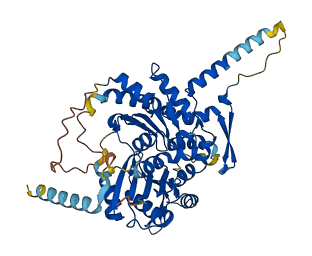
Descriptions
The autoinhibited protein was predicted that may have potential autoinhibitory elements via cis-regPred.
Autoinhibitory domains (AIDs)
Target domain |
|
Relief mechanism |
|
Assay |
cis-regPred |
Accessory elements
No accessory elements
Autoinhibited structure

Activated structure
14 structures for Q12406
| Entry ID | Method | Resolution | Chain | Position | Source |
|---|---|---|---|---|---|
| 3WEE | X-ray | 310 A | B | 1-477 | PDB |
| 4I6M | X-ray | 280 A | A | 1-477 | PDB |
| 5TGC | X-ray | 325 A | A/D | 1-477 | PDB |
| 6KW3 | EM | 713 A | f | 1-477 | PDB |
| 6KW4 | EM | 755 A | f | 1-477 | PDB |
| 6KW5 | EM | 1013 A | f | 1-477 | PDB |
| 6TDA | EM | 1500 A | T | 1-477 | PDB |
| 6UXW | EM | 896 A | P | 1-477 | PDB |
| 6V92 | EM | 2000 A | A | 1-477 | PDB |
| 6VZ4 | EM | 390 A | L | 1-477 | PDB |
| 6VZG | EM | 420 A | L | 1-477 | PDB |
| 7C4J | EM | 289 A | K | 1-477 | PDB |
| 7EGP | EM | 690 A | M | 1-477 | PDB |
| AF-Q12406-F1 | Predicted | AlphaFoldDB |
5 variants for Q12406
| Variant ID(s) | Position | Change | Description | Diseaes Association | Provenance |
|---|---|---|---|---|---|
| s16-639535 | 5 | R>K | No | SGRP | |
| s16-639568 | 16 | R>K | No | SGRP | |
| s16-639645 | 42 | G>R | No | SGRP | |
| s16-639873 | 118 | A>S | No | SGRP | |
| s16-640116 | 199 | P>A | No | SGRP |
No associated diseases with Q12406
No regional properties for Q12406
| Type | Name | Position | InterPro Accession |
|---|---|---|---|
| No domain, repeats, and functional sites for Q12406 | |||
5 GO annotations of cellular component
| Name | Definition |
|---|---|
| chromatin | The ordered and organized complex of DNA, protein, and sometimes RNA, that forms the chromosome. |
| NuA4 histone acetyltransferase complex | A complex having histone acetylase activity on chromatin, as well as ATPase, DNA helicase and structural DNA binding activities. The complex is thought to be involved in double-strand DNA break repair. Subunits of the human complex include HTATIP/TIP60, TRRAP, RUVBL1, BUVBL2, beta-actin and BAF53/ACTL6A. In yeast, the complex has 13 subunits, including the catalytic subunit Esa1 (homologous to human Tip60). |
| nucleus | A membrane-bounded organelle of eukaryotic cells in which chromosomes are housed and replicated. In most cells, the nucleus contains all of the cell's chromosomes except the organellar chromosomes, and is the site of RNA synthesis and processing. In some species, or in specialized cell types, RNA metabolism or DNA replication may be absent. |
| RSC-type complex | A SWI/SNF-type complex that contains a bromodomain containing-protein, such as yeast Rsc1 or Rsc4 or mammalian PB1/BAF180. The RSC complex is generally recruited to RNA polymerase III promoters and is specifically recruited to RNA polymerase II promoters by transcriptional activators and repressors; it is also involved in non-homologous end joining. |
| SWI/SNF complex | A SWI/SNF-type complex that contains 8 to 14 proteins, including both conserved (core) and nonconserved components; contains the ATPase product of the yeast SNF2 or mammalian SMARCA4/BAF190A/BRG1 gene, or an ortholog thereof. |
2 GO annotations of molecular function
| Name | Definition |
|---|---|
| chromatin binding | Binding to chromatin, the network of fibers of DNA, protein, and sometimes RNA, that make up the chromosomes of the eukaryotic nucleus during interphase. |
| structural molecule activity | The action of a molecule that contributes to the structural integrity of a complex or its assembly within or outside a cell. |
10 GO annotations of biological process
| Name | Definition |
|---|---|
| chromatin organization | The assembly or remodeling of chromatin composed of DNA complexed with histones, other associated proteins, and sometimes RNA. |
| chromatin remodeling | A dynamic process of chromatin reorganization resulting in changes to chromatin structure. These changes allow DNA metabolic processes such as transcriptional regulation, DNA recombination, DNA repair, and DNA replication. |
| double-strand break repair via nonhomologous end joining | The repair of a double-strand break in DNA in which the two broken ends are rejoined with little or no sequence complementarity. Information at the DNA ends may be lost due to the modification of broken DNA ends. This term covers instances of separate pathways, called classical (or canonical) and alternative nonhomologous end joining (C-NHEJ and A-NHEJ). These in turn may further branch into sub-pathways, but evidence is still unclear. |
| histone H4 acetylation | The modification of histone H4 by the addition of an acetyl group. |
| nucleosome disassembly | The controlled breakdown of nucleosomes, the beadlike structural units of eukaryotic chromatin composed of histones and DNA. |
| positive regulation of double-strand break repair via homologous recombination | Any process that activates or increases the frequency, rate or extent of double-strand break repair via homologous recombination. |
| positive regulation of transcription by RNA polymerase II | Any process that activates or increases the frequency, rate or extent of transcription from an RNA polymerase II promoter. |
| regulation of DNA-templated transcription | Any process that modulates the frequency, rate or extent of cellular DNA-templated transcription. |
| regulation of transcription by RNA polymerase II | Any process that modulates the frequency, rate or extent of transcription mediated by RNA polymerase II. |
| transcription elongation by RNA polymerase II promoter | The extension of an RNA molecule after transcription initiation and promoter clearance at an RNA polymerase II promoter by the addition of ribonucleotides catalyzed by RNA polymerase II. |
2 homologous proteins in AiPD
| 10 | 20 | 30 | 40 | 50 | 60 |
| MTLNRKCVVI | HNGSHRTVAG | FSNVELPQCI | IPSSYIKRTD | EGGEAEFIFG | TYNMIDAAAE |
| 70 | 80 | 90 | 100 | 110 | 120 |
| KRNGDEVYTL | VDSQGLPYNW | DALEMQWRYL | YDTQLKVSPE | ELPLVITMPA | TNGKPDMAIL |
| 130 | 140 | 150 | 160 | 170 | 180 |
| ERYYELAFDK | LNVPVFQIVI | EPLAIALSMG | KSSAFVIDIG | ASGCNVTPII | DGIVVKNAVV |
| 190 | 200 | 210 | 220 | 230 | 240 |
| RSKFGGDFLD | FQVHERLAPL | IKEENDMENM | ADEQKRSTDV | WYEASTWIQQ | FKSTMLQVSE |
| 250 | 260 | 270 | 280 | 290 | 300 |
| KDLFELERYY | KEQADIYAKQ | QEQLKQMDQQ | LQYTALTGSP | NNPLVQKKNF | LFKPLNKTLT |
| 310 | 320 | 330 | 340 | 350 | 360 |
| LDLKECYQFA | EYLFKPQLIS | DKFSPEDGLG | PLMAKSVKKA | GASINSMKAN | TSTNPNGLGT |
| 370 | 380 | 390 | 400 | 410 | 420 |
| SHINTNVGDN | NSTASSSNIS | PEQVYSLLLT | NVIITGSTSL | IEGMEQRIIK | ELSIRFPQYK |
| 430 | 440 | 450 | 460 | 470 | |
| LTTFANQVMM | DRKIQGWLGA | LTMANLPSWS | LGKWYSKEDY | ETLKRDRKQS | QATNATN |