Q11131
Gene name |
Fut7 |
Protein name |
Alpha-(1,3)-fucosyltransferase 7 |
Names |
Fucosyltransferase 7, Fucosyltransferase VII, Fuc-TVII, FucT-VII, Galactoside 3-L-fucosyltransferase |
Species |
Mus musculus (Mouse) |
KEGG Pathway |
mmu:14347 |
EC number |
|
Protein Class |
|
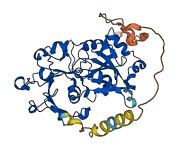
Descriptions
The autoinhibited protein was predicted that may have potential autoinhibitory elements via cis-regPred.
Autoinhibitory domains (AIDs)
Target domain |
|
Relief mechanism |
|
Assay |
cis-regPred |
Accessory elements
No accessory elements
Autoinhibited structure

Activated structure
1 structures for Q11131
| Entry ID | Method | Resolution | Chain | Position | Source |
|---|---|---|---|---|---|
| AF-Q11131-F1 | Predicted | AlphaFoldDB |
17 variants for Q11131
| Variant ID(s) | Position | Change | Description | Diseaes Association | Provenance |
|---|---|---|---|---|---|
| rs583926082 | 8 | A>T | No | EVA | |
| rs255326075 | 12 | T>M | No | EVA | |
| rs3412951745 | 26 | A>P | No | EVA | |
| rs3388532513 | 28 | S>T | No | EVA | |
| rs220669780 | 31 | S>N | No | EVA | |
| rs3388529556 | 69 | A>V | No | EVA | |
| rs212611937 | 83 | A>T | No | EVA | |
| rs3388535448 | 91 | Q>K | No | EVA | |
| rs3388538010 | 94 | L>F | No | EVA | |
| rs3388536335 | 128 | N>K | No | EVA | |
| rs28212116 | 149 | Q>R | No | EVA | |
| rs220485300 | 151 | L>R | No | EVA | |
| rs3388533508 | 231 | Q>E | No | EVA | |
| rs3388538018 | 235 | K>E | No | EVA | |
| rs3391361960 | 245 | Q>H | No | EVA | |
| rs3388529497 | 254 | G>E | No | EVA | |
| rs264688212 | 375 | P>L | No | EVA |
No associated diseases with Q11131
1 regional properties for Q11131
| Type | Name | Position | InterPro Accession |
|---|---|---|---|
| domain | Fucosyltransferase, N-terminal | 92 - 201 | IPR031481 |
4 GO annotations of cellular component
| Name | Definition |
|---|---|
| Golgi apparatus | A membrane-bound cytoplasmic organelle of the endomembrane system that further processes the core oligosaccharides (e.g. N-glycans) added to proteins in the endoplasmic reticulum and packages them into membrane-bound vesicles. The Golgi apparatus operates at the intersection of the secretory, lysosomal, and endocytic pathways. |
| Golgi cisterna membrane | The lipid bilayer surrounding any of the thin, flattened compartments that form the central portion of the Golgi complex. |
| integral component of membrane | The component of a membrane consisting of the gene products and protein complexes having at least some part of their peptide sequence embedded in the hydrophobic region of the membrane. |
| trans-Golgi network | The network of interconnected tubular and cisternal structures located within the Golgi apparatus on the side distal to the endoplasmic reticulum, from which secretory vesicles emerge. The trans-Golgi network is important in the later stages of protein secretion where it is thought to play a key role in the sorting and targeting of secreted proteins to the correct destination. |
3 GO annotations of molecular function
| Name | Definition |
|---|---|
| 4-galactosyl-N-acetylglucosaminide 3-alpha-L-fucosyltransferase activity | Catalysis of the reaction: GDP-beta-L-fucose + beta-D-galactosyl-(1,4)-N-acetyl-D-glucosaminyl-R = GDP + 1,4-beta-D-galactosyl-(1,4)-[alpha-L-fucosyl-(1,3)]-N-acetyl-D-glucosaminyl-R. |
| alpha-(1->3)-fucosyltransferase activity | Catalysis of the transfer of an L-fucosyl group from GDP-beta-L-fucose to an acceptor molecule to form an alpha-(1->3) linkage. |
| fucosyltransferase activity | Catalysis of the transfer of a fucosyl group to an acceptor molecule, typically another carbohydrate or a lipid. |
24 GO annotations of biological process
| Name | Definition |
|---|---|
| CD4-positive, CD25-positive, alpha-beta regulatory T cell differentiation | The process in which a precursor cell type acquires the specialized features of a CD4-positive, CD25-positive, alpha-beta regulatory T cell. |
| ceramide metabolic process | The chemical reactions and pathways involving ceramides, any N-acylated sphingoid. |
| embryo implantation | Attachment of the blastocyst to the uterine lining. |
| fucosylation | The covalent attachment of a fucosyl group to an acceptor molecule. |
| inflammatory response | The immediate defensive reaction (by vertebrate tissue) to infection or injury caused by chemical or physical agents. The process is characterized by local vasodilation, extravasation of plasma into intercellular spaces and accumulation of white blood cells and macrophages. |
| leukocyte migration involved in immune response | The movement of a leukocyte within or between different tissues and organs of the body as part of an immune response. |
| leukocyte migration involved in inflammatory response | The movement of a leukocyte within or between different tissues and organs of the body contributing to an inflammatory response. |
| lymphocyte migration into lymph node | The movement of a lymphocyte within the lymphatic system into a lymph node, and its subsequent positioning within defined functional compartments such as sites of cell activation by antigen. |
| lymphocyte migration into lymphoid organs | The movement of a lymphocyte within the lymphatic system into lymphoid organs such as lymph nodes, spleen or Peyer's patches, and its subsequent positioning within defined functional compartments such as sites of cell activation by antigen. |
| positive regulation of cell adhesion | Any process that activates or increases the frequency, rate or extent of cell adhesion. |
| positive regulation of cell-cell adhesion | Any process that activates or increases the rate or extent of cell adhesion to another cell. |
| positive regulation of leukocyte adhesion to vascular endothelial cell | Any process that activates or increases the frequency, rate or extent of leukocyte adhesion to vascular endothelial cell. |
| positive regulation of leukocyte tethering or rolling | Any process that activates or increases the frequency, rate or extent of leukocyte tethering or rolling. |
| positive regulation of neutrophil migration | Any process that activates or increases the frequency, rate or extent of neutrophil migration. |
| protein glycosylation | A protein modification process that results in the addition of a carbohydrate or carbohydrate derivative unit to a protein amino acid, e.g. the addition of glycan chains to proteins. |
| regulation of cell adhesion molecule production | Any process that modulates the rate, frequency or extent of cell adhesion molecule production. Cell adhesion molecule production is the appearance of a cell adhesion molecule as a result of its biosynthesis or a decrease in its catabolism. |
| regulation of cell-cell adhesion | Any process that modulates the frequency, rate or extent of attachment of a cell to another cell. |
| regulation of insulin receptor signaling pathway | Any process that modulates the frequency, rate or extent of insulin receptor signaling. |
| regulation of leukocyte adhesion to vascular endothelial cell | Any process that modulates the frequency, rate or extent of leukocyte adhesion to vascular endothelial cell. |
| regulation of leukocyte cell-cell adhesion | Any process that modulates the frequency, rate or extent of leukocyte cell-cell adhesion. |
| regulation of leukocyte tethering or rolling | Any process that modulates the frequency, rate or extent of leukocyte tethering or rolling. |
| regulation of neutrophil extravasation | Any process that modulates the frequency, rate or extent of neutrophil extravasation. |
| regulation of type IV hypersensitivity | Any process that modulates the frequency, rate, or extent of type IV hypersensitivity, a type of inflammatory response. |
| T cell migration | The movement of a T cell within or between different tissues and organs of the body. |
| 10 | 20 | 30 | 40 | 50 | 60 |
| MPTPCPPACL | STPGTHRLLP | FPDWKAPSWE | SRKEATCNSS | SPGPWAEPTV | QGYHPTRRLR |
| 70 | 80 | 90 | 100 | 110 | 120 |
| AWGGLAGGAT | FMVIWFFWLW | GSAPGSAPVP | QSTLTILIWH | WPFTNRPPEL | PGDTCTRYGM |
| 130 | 140 | 150 | 160 | 170 | 180 |
| ASCRLSANRS | LLASADAVVF | HHRELQTRQS | LLPLDQRPHG | QPWVWASMES | PSNTHGLHRF |
| 190 | 200 | 210 | 220 | 230 | 240 |
| RGIFNWVLSY | RRDSDIFVPY | GRLEPLSGPT | SPLPAKSRMA | AWVISNFQER | QQRAKLYRQL |
| 250 | 260 | 270 | 280 | 290 | 300 |
| APHLQVDVFG | RASGRPLCAN | CLLPTLARYR | FYLAFENSQH | RDYITEKFWR | NALAAGAVPV |
| 310 | 320 | 330 | 340 | 350 | 360 |
| ALGPPRATYE | AFVPPDAFVH | VDDFSSAREL | AVFLVSMNES | RYRGFFAWRD | RLRVRLLGDW |
| 370 | 380 | ||||
| RERFCTICAR | YPYLPRSQVY | EDLESWFQA |