Q0P5F2
Gene name |
PSMG1 |
Protein name |
Proteasome assembly chaperone 1 |
Names |
|
Species |
Bos taurus (Bovine) |
KEGG Pathway |
bta:614817 |
EC number |
|
Protein Class |
|
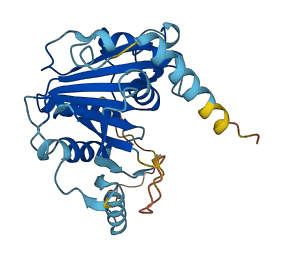
Descriptions
The autoinhibited protein was predicted that may have potential autoinhibitory elements via cis-regPred.
Autoinhibitory domains (AIDs)
Target domain |
|
Relief mechanism |
|
Assay |
cis-regPred |
Accessory elements
No accessory elements
Autoinhibited structure

Activated structure
1 structures for Q0P5F2
| Entry ID | Method | Resolution | Chain | Position | Source |
|---|---|---|---|---|---|
| AF-Q0P5F2-F1 | Predicted | AlphaFoldDB |
38 variants for Q0P5F2
| Variant ID(s) | Position | Change | Description | Diseaes Association | Provenance |
|---|---|---|---|---|---|
| rs440228068 | 2 | A>E | No | EVA | |
| rs451195159 | 3 | A>G | No | EVA | |
| rs471518999 | 3 | A>S | No | EVA | |
| rs469035853 | 4 | T>P | No | EVA | |
| rs467936219 | 5 | F>L | No | EVA | |
| rs435298850 | 5 | F>V | No | EVA | |
| rs447893536 | 6 | F>I | No | EVA | |
| rs465714543 | 7 | G>A | No | EVA | |
| rs483102849 | 8 | E>G | No | EVA | |
| rs442885932 | 9 | V>A | No | EVA | |
| rs442885932 | 9 | V>G | No | EVA | |
| rs480537386 | 10 | V>A | No | EVA | |
| rs480537386 | 10 | V>G | No | EVA | |
| rs460137363 | 11 | R>G | No | EVA | |
| rs440209565 | 11 | R>K | No | EVA | |
| rs471500405 | 12 | T>R | No | EVA | |
| rs451528820 | 14 | C>G | No | EVA | |
| rs443969908 | 15 | R>G | No | EVA | |
| rs455259079 | 16 | A>G | No | EVA | |
| rs435230911 | 18 | T>A | No | EVA | |
| rs435230911 | 18 | T>P | No | EVA | |
| rs466670030 | 18 | T>R | No | EVA | |
| rs454322143 | 20 | E>G | No | EVA | |
| rs434210727 | 21 | E>G | No | EVA | |
| rs381950063 | 26 | D>E | No | EVA | |
| rs445554712 | 28 | N>D | No | EVA | |
| rs445554712 | 28 | N>H | No | EVA | |
| rs524524748 | 30 | E>G | No | EVA | |
| rs480475588 | 35 | R>S | No | EVA | |
| rs440146303 | 43 | R>L | No | EVA | |
| rs471167523 | 54 | T>K | No | EVA | |
| rs460917481 | 75 | I>R | No | EVA | |
| rs448575224 | 76 | G>W | No | EVA | |
| rs380485495 | 89 | N>S | No | EVA | |
| rs385642754 | 109 | T>M | No | EVA | |
| rs466638098 | 151 | E>G | No | EVA | |
| rs3423125365 | 211 | I>T | No | EVA | |
| rs445628388 | 251 | K>Q | No | EVA |
No associated diseases with Q0P5F2
No regional properties for Q0P5F2
| Type | Name | Position | InterPro Accession |
|---|---|---|---|
| No domain, repeats, and functional sites for Q0P5F2 | |||
6 GO annotations of cellular component
| Name | Definition |
|---|---|
| chaperone complex | A protein complex required for the non-covalent folding or unfolding, maturation, stabilization or assembly or disassembly of macromolecular structures. Usually active during or immediately after completion of translation. Many chaperone complexes contain heat shock proteins. |
| cytoplasm | The contents of a cell excluding the plasma membrane and nucleus, but including other subcellular structures. |
| cytosol | The part of the cytoplasm that does not contain organelles but which does contain other particulate matter, such as protein complexes. |
| endoplasmic reticulum | The irregular network of unit membranes, visible only by electron microscopy, that occurs in the cytoplasm of many eukaryotic cells. The membranes form a complex meshwork of tubular channels, which are often expanded into slitlike cavities called cisternae. The ER takes two forms, rough (or granular), with ribosomes adhering to the outer surface, and smooth (with no ribosomes attached). |
| Golgi apparatus | A membrane-bound cytoplasmic organelle of the endomembrane system that further processes the core oligosaccharides (e.g. N-glycans) added to proteins in the endoplasmic reticulum and packages them into membrane-bound vesicles. The Golgi apparatus operates at the intersection of the secretory, lysosomal, and endocytic pathways. |
| nucleoplasm | That part of the nuclear content other than the chromosomes or the nucleolus. |
2 GO annotations of molecular function
| Name | Definition |
|---|---|
| molecular adaptor activity | The binding activity of a molecule that brings together two or more molecules through a selective, non-covalent, often stoichiometric interaction, permitting those molecules to function in a coordinated way. |
| proteasome binding | Binding to a proteasome, a large multisubunit protein complex that catalyzes protein degradation. |
2 GO annotations of biological process
| Name | Definition |
|---|---|
| chaperone-mediated protein complex assembly | The aggregation, arrangement and bonding together of a set of components to form a protein complex, mediated by chaperone molecules that do not form part of the finished complex. |
| proteasome core complex assembly | The aggregation, arrangement and bonding together of a mature, active 20S proteasome core particle complex that does not contain any regulatory particles. |
| 10 | 20 | 30 | 40 | 50 | 60 |
| MAATFFGEVV | RTPCRAGTEE | EEEEEDGNRE | TPEDREVRRQ | LARKREVRLF | RRQTKTTLEV |
| 70 | 80 | 90 | 100 | 110 | 120 |
| SLLEKHPCSK | FIIAIGNNAV | AFLSSFVMNS | GAWEEVGCAK | LWNEWCRTTD | TAHLSPTEAF |
| 130 | 140 | 150 | 160 | 170 | 180 |
| CVFYHLKSNP | SVMLCQCSCY | VAEDQQYQWL | EKVFGSCPRK | NMQVTILTCR | HVTDYKTSES |
| 190 | 200 | 210 | 220 | 230 | 240 |
| TSSLHTPFLK | ALKTQNFKEP | PFCSLLEQPN | IVHDLPAAVL | SYCQVWRIPA | VLYLCYTDVM |
| 250 | 260 | 270 | 280 | ||
| KLDLITIEAF | KPVLSSKSLK | CLVKNIPQST | EILKKLMTTN | EIQSNIYT |