Q0II41
Gene name |
ODF4 |
Protein name |
Outer dense fiber protein 4 |
Names |
Outer dense fiber of sperm tails protein 4 |
Species |
Bos taurus (Bovine) |
KEGG Pathway |
bta:517977 |
EC number |
|
Protein Class |
|
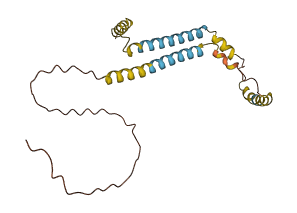
Descriptions
The autoinhibited protein was predicted that may have potential autoinhibitory elements via cis-regPred.
Autoinhibitory domains (AIDs)
Target domain |
|
Relief mechanism |
|
Assay |
cis-regPred |
Accessory elements
No accessory elements
Autoinhibited structure

Activated structure
1 structures for Q0II41
| Entry ID | Method | Resolution | Chain | Position | Source |
|---|---|---|---|---|---|
| AF-Q0II41-F1 | Predicted | AlphaFoldDB |
No variants for Q0II41
| Variant ID(s) | Position | Change | Description | Diseaes Association | Provenance |
|---|---|---|---|---|---|
| No variants for Q0II41 | |||||
No associated diseases with Q0II41
No regional properties for Q0II41
| Type | Name | Position | InterPro Accession |
|---|---|---|---|
| No domain, repeats, and functional sites for Q0II41 | |||
1 GO annotations of cellular component
| Name | Definition |
|---|---|
| integral component of membrane | The component of a membrane consisting of the gene products and protein complexes having at least some part of their peptide sequence embedded in the hydrophobic region of the membrane. |
No GO annotations of molecular function
| Name | Definition |
|---|---|
| No GO annotations for molecular function |
2 GO annotations of biological process
| Name | Definition |
|---|---|
| cell differentiation | The process in which relatively unspecialized cells, e.g. embryonic or regenerative cells, acquire specialized structural and/or functional features that characterize the cells, tissues, or organs of the mature organism or some other relatively stable phase of the organism's life history. Differentiation includes the processes involved in commitment of a cell to a specific fate and its subsequent development to the mature state. |
| spermatogenesis | The developmental process by which male germ line stem cells self renew or give rise to successive cell types resulting in the development of a spermatozoa. |
| 10 | 20 | 30 | 40 | 50 | 60 |
| MNIRSLERAG | RAGKQDGVAV | SPGQEEEVQN | CVSTHDSNWP | VIKDHSVKLH | RVSPLLLQCR |
| 70 | 80 | 90 | 100 | 110 | 120 |
| ITHSSRWIAQ | VLASELSLLA | FILLVVMVFS | KKWLCFERIR | FYQHWTMNVT | TKIYTSVHIM |
| 130 | 140 | 150 | 160 | 170 | 180 |
| SLGLLHIYKS | KSYSNSEWES | FKLWTNHPAF | GVAKITFCLA | LGLGIILTIW | LHLPYIPGLQ |
| 190 | |||||
| KLPFFGWIGT | VMSFCEGAL |