Descriptions
The autoinhibited protein was predicted that may have potential autoinhibitory elements via cis-regPred.
Autoinhibitory domains (AIDs)
Target domain |
|
Relief mechanism |
|
Assay |
cis-regPred |
Accessory elements
No accessory elements
Autoinhibited structure

Activated structure
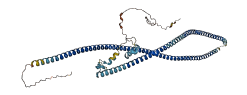
1 structures for Q08C53
| Entry ID | Method | Resolution | Chain | Position | Source |
|---|---|---|---|---|---|
| AF-Q08C53-F1 | Predicted | AlphaFoldDB |
No variants for Q08C53
| Variant ID(s) | Position | Change | Description | Diseaes Association | Provenance |
|---|---|---|---|---|---|
| No variants for Q08C53 | |||||
No associated diseases with Q08C53
No regional properties for Q08C53
| Type | Name | Position | InterPro Accession |
|---|---|---|---|
| No domain, repeats, and functional sites for Q08C53 | |||
2 GO annotations of cellular component
| Name | Definition |
|---|---|
| ciliary basal body | A membrane-tethered, short cylindrical array of microtubules and associated proteins found at the base of a eukaryotic cilium (also called flagellum) that is similar in structure to a centriole and derives from it. The cilium basal body is the site of assembly and remodelling of the cilium and serves as a nucleation site for axoneme growth. As well as anchoring the cilium, it is thought to provide a selective gateway regulating the entry of ciliary proteins and vesicles by intraflagellar transport. |
| cytoplasm | The contents of a cell excluding the plasma membrane and nucleus, but including other subcellular structures. |
No GO annotations of molecular function
| Name | Definition |
|---|---|
| No GO annotations for molecular function |
1 GO annotations of biological process
| Name | Definition |
|---|---|
| motile cilium assembly | The aggregation, arrangement and bonding together of a set of components to form a motile cilium. |
| 10 | 20 | 30 | 40 | 50 | 60 |
| MPKKKGKGKG | KGKGKGKGKK | DGKHDSKADR | ESEIEKLKSN | ASLWEAKFTV | TDISRLEYRE |
| 70 | 80 | 90 | 100 | 110 | 120 |
| AARALAKANE | ELENQQYRAE | KDTKDIIAFL | KRTDFEKTAT | IAALEEELKR | ERAKSAQEKD |
| 130 | 140 | 150 | 160 | 170 | 180 |
| LLVAEYMQKI | DALEEMFRQR | SGDFQRMQGE | LKTIKHYRKI | KANLEEDLIS | IREKMYVDGR |
| 190 | 200 | 210 | 220 | 230 | 240 |
| AHQESLARTE | YKFYMARIRI | EKEAEQKISQ | LAEQAHYEAV | DQLGAASQTV | ITENIRLNEG |
| 250 | 260 | 270 | 280 | 290 | 300 |
| LDYHVKEAEQ | LKRINVALTE | KNSSLALFKE | TNELMKKEAD | SHVQSQHSEI | SELTAKLSTL |
| 310 | 320 | 330 | 340 | 350 | 360 |
| EQALGIMSRE | FEQERVEMER | SAGVNNTELE | ELEMLLAARE | KELSKVKQLA | QSIIEQRREL |
| 370 | 380 | 390 | 400 | 410 | 420 |
| ELFFHEALNH | ARKEIKAQQQ | HYRQEALKSY | RWRMNEAHAG | RLEFPRIRTF | SNAPNSTNDV |
| 430 | 440 | 450 | 460 | 470 | 480 |
| QTELEDSDKW | NNLRSSNVDI | SDLTWEQKER | LLNLLFAKLN | GIKTRKAAHP | PALSASSSEK |
| 490 | 500 | 510 | |||
| IQVSSDAGST | VESPSMTFIT | QMTMANMTSD | PFVLPALKST |