Q08967
Gene name |
FLC1 (BOP1, HUF1, YPL221W) |
Protein name |
Flavin carrier protein 1 |
Names |
Bypass of PAM1 protein 1, FAD transporter 1, Heme utilization factor 1, TRP-like ion channel protein FLC1 |
Species |
Saccharomyces cerevisiae (strain ATCC 204508 / S288c) (Baker's yeast) |
KEGG Pathway |
sce:YPL221W |
EC number |
|
Protein Class |
|
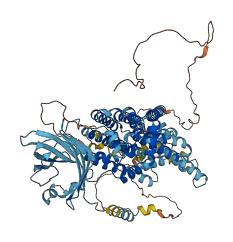
Descriptions
The autoinhibited protein was predicted that may have potential autoinhibitory elements via cis-regPred.
Autoinhibitory domains (AIDs)
Target domain |
|
Relief mechanism |
|
Assay |
cis-regPred |
Accessory elements
No accessory elements
Autoinhibited structure

Activated structure
1 structures for Q08967
| Entry ID | Method | Resolution | Chain | Position | Source |
|---|---|---|---|---|---|
| AF-Q08967-F1 | Predicted | AlphaFoldDB |
13 variants for Q08967
| Variant ID(s) | Position | Change | Description | Diseaes Association | Provenance |
|---|---|---|---|---|---|
| s16-133197 | 52 | D>E | No | SGRP | |
| s16-133288 | 83 | I>V | No | SGRP | |
| s16-133302 | 87 | N>K | No | SGRP | |
| s16-133306 | 89 | D>N | No | SGRP | |
| s16-133366 | 109 | D>N | No | SGRP | |
| s16-133387 | 116 | Q>E | No | SGRP | |
| s16-133387 | 116 | Q>K | No | SGRP | |
| s16-135050 | 670 | R>P | No | SGRP | |
| s16-135193 | 718 | K>E | No | SGRP | |
| s16-135273 | 744 | Q>H | No | SGRP | |
| s16-135327 | 762 | M>I | No | SGRP | |
| s16-135325 | 762 | M>V | No | SGRP | |
| s16-135335 | 765 | M>T | No | SGRP |
No associated diseases with Q08967
24 regional properties for Q08967
| Type | Name | Position | InterPro Accession |
|---|---|---|---|
| domain | F-box domain | 1 - 50 | IPR001810 |
| repeat | Parallel beta-helix repeat | 198 - 217 | IPR006626-1 |
| repeat | Parallel beta-helix repeat | 238 - 260 | IPR006626-2 |
| repeat | Parallel beta-helix repeat | 423 - 444 | IPR006626-3 |
| repeat | Parallel beta-helix repeat | 467 - 489 | IPR006626-4 |
| repeat | Parallel beta-helix repeat | 490 - 512 | IPR006626-5 |
| repeat | Parallel beta-helix repeat | 513 - 535 | IPR006626-6 |
| repeat | Parallel beta-helix repeat | 536 - 558 | IPR006626-7 |
| repeat | Parallel beta-helix repeat | 559 - 581 | IPR006626-8 |
| repeat | Parallel beta-helix repeat | 582 - 604 | IPR006626-9 |
| repeat | Parallel beta-helix repeat | 605 - 627 | IPR006626-10 |
| repeat | Parallel beta-helix repeat | 628 - 650 | IPR006626-11 |
| repeat | Parallel beta-helix repeat | 651 - 673 | IPR006626-12 |
| repeat | Parallel beta-helix repeat | 713 - 735 | IPR006626-13 |
| repeat | Parallel beta-helix repeat | 736 - 758 | IPR006626-14 |
| repeat | Parallel beta-helix repeat | 760 - 782 | IPR006626-15 |
| repeat | Parallel beta-helix repeat | 783 - 805 | IPR006626-16 |
| repeat | Parallel beta-helix repeat | 828 - 850 | IPR006626-17 |
| domain | Carbohydrate-binding/sugar hydrolysis domain | 337 - 511 | IPR006633-1 |
| domain | Carbohydrate-binding/sugar hydrolysis domain | 536 - 672 | IPR006633-2 |
| domain | Carbohydrate-binding/sugar hydrolysis domain | 681 - 804 | IPR006633-3 |
| domain | Periplasmic copper-binding protein NosD, beta helix domain | 719 - 868 | IPR007742 |
| repeat | Parallel beta-helix repeat-2 | 530 - 569 | IPR022441 |
| domain | Right handed beta helix domain | 423 - 568 | IPR039448 |
5 GO annotations of cellular component
| Name | Definition |
|---|---|
| cellular bud neck | The constriction between the mother cell and daughter cell (bud) in an organism that reproduces by budding. |
| endoplasmic reticulum | The irregular network of unit membranes, visible only by electron microscopy, that occurs in the cytoplasm of many eukaryotic cells. The membranes form a complex meshwork of tubular channels, which are often expanded into slitlike cavities called cisternae. The ER takes two forms, rough (or granular), with ribosomes adhering to the outer surface, and smooth (with no ribosomes attached). |
| endoplasmic reticulum membrane | The lipid bilayer surrounding the endoplasmic reticulum. |
| fungal-type vacuole | A vacuole that has both lytic and storage functions. The fungal vacuole is a large, membrane-bounded organelle that functions as a reservoir for the storage of small molecules (including polyphosphate, amino acids, several divalent cations (e.g. calcium), other ions, and other small molecules) as well as being the primary compartment for degradation. It is an acidic compartment, containing an ensemble of acid hydrolases. At least in S. cerevisiae, there are indications that the morphology of the vacuole is variable and correlated with the cell cycle, with logarithmically growing cells having a multilobed, reticulated vacuole, while stationary phase cells contain a single large structure. |
| integral component of membrane | The component of a membrane consisting of the gene products and protein complexes having at least some part of their peptide sequence embedded in the hydrophobic region of the membrane. |
1 GO annotations of molecular function
| Name | Definition |
|---|---|
| FAD transmembrane transporter activity | Enables the directed movement of flavin-adenine dinucleotide (FAD) from one side of a membrane to the other. FAD forms the coenzyme of the prosthetic group of various flavoprotein oxidoreductase enzymes, in which it functions as an electron acceptor by being reversibly converted to its reduced form. |
5 GO annotations of biological process
| Name | Definition |
|---|---|
| FAD transport | The directed movement of flavin-adenine dinucleotide (FAD) into, out of or within a cell, or between cells, by means of some agent such as a transporter or pore. FAD forms the coenzyme of the prosthetic group of various flavoprotein oxidoreductase enzymes, in which it functions as an electron acceptor by being reversibly converted to its reduced form. |
| fungal-type cell wall biogenesis | A cellular process that results in the biosynthesis of constituent macromolecules, assembly, and arrangement of constituent parts of a fungal-type cell wall. The fungal-type cell wall contains beta-glucan and may contain chitin. |
| protein folding | The process of assisting in the covalent and noncovalent assembly of single chain polypeptides or multisubunit complexes into the correct tertiary structure. |
| sphingolipid biosynthetic process | The chemical reactions and pathways resulting in the formation of sphingolipids, any of a class of lipids containing the long-chain amine diol sphingosine or a closely related base (a sphingoid). |
| transmembrane transport | The process in which a solute is transported across a lipid bilayer, from one side of a membrane to the other. |
2 homologous proteins in AiPD
| 10 | 20 | 30 | 40 | 50 | 60 |
| MQVLVTLWCL | ICTCLVLPVA | AKKRTLTASS | LVTCMENSQL | SANSFDVSFS | PDDRSLHYDL |
| 70 | 80 | 90 | 100 | 110 | 120 |
| DMTTQIDSYI | YAYVDVYAYG | FKIITENFDV | CSMGWKQFCP | VHPGNIQIDS | IEYIAQKYVK |
| 130 | 140 | 150 | 160 | 170 | 180 |
| MIPGIAYQVP | DIDAYVRLNI | YNNVSENLAC | IQVFFSNGKT | VSQIGVKWVT | AVIAGIGLLT |
| 190 | 200 | 210 | 220 | 230 | 240 |
| SAVLSTFGNS | TAASHISANT | MSLFLYFQSV | AVVAMQHVDS | VPPIAAAWSE | NLAWSMGLIR |
| 250 | 260 | 270 | 280 | 290 | 300 |
| ITFMQKIFRW | YVEATGGSAS | LYLTATTMSV | LTQRGLDYLK | NTSVYKRAEN | VLYGNSNTLI |
| 310 | 320 | 330 | 340 | 350 | 360 |
| FRGIKRMGYR | MKIENTAIVC | TGFTFFVLCG | YFLAGFIMAC | KYSIELCIRC | GWMRSDRFYQ |
| 370 | 380 | 390 | 400 | 410 | 420 |
| FRKNWRSVLK | GSLLRYIYIG | FTQLTILSFW | EFTERDSAGV | IVIACLFIVL | SCGLMAWAAY |
| 430 | 440 | 450 | 460 | 470 | 480 |
| RTIFFASKSV | EMYNNPAALL | YGDEYVLNKY | GFFYTMFNAK | HYWWNALLTT | YILVKALFVG |
| 490 | 500 | 510 | 520 | 530 | 540 |
| FAQASGKTQA | LAIFIIDLAY | FVAIIRYKPY | LDRPTNIVNI | FICTVTLVNS | FLFMFFSNLF |
| 550 | 560 | 570 | 580 | 590 | 600 |
| NQKYAVSAIM | GWVFFIMNAA | FSLLLLLMIL | AFTTIILFSK | NPDSRFKPAK | DDRASFQKHA |
| 610 | 620 | 630 | 640 | 650 | 660 |
| IPHEGALNKS | VANELMALGN | VAKDHTENWE | YELKSQEGKS | EDNLFGVEYD | DEKTGTNSEN |
| 670 | 680 | 690 | 700 | 710 | 720 |
| AESSSKETTR | PTFSEKVLRS | LSIKRNKSKL | GSFKRSAPDK | ITQQEVSPDR | ASSSPNSKSY |
| 730 | 740 | 750 | 760 | 770 | 780 |
| PGVSHTRQES | EANNGLINAY | EDEQFSLMEP | SILEDAASST | QMHAMPARDL | SLSSVANAQD |
| 790 | |||||
| VTKKANILDP | DYL |