Q06437
Gene name |
Pdha2 |
Protein name |
Pyruvate dehydrogenase E1 component subunit alpha, testis-specific form, mitochondrial |
Names |
PDHE1-A type II |
Species |
Rattus norvegicus (Rat) |
KEGG Pathway |
rno:117098 |
EC number |
1.2.4.1: With a disulfide as acceptor |
Protein Class |
|
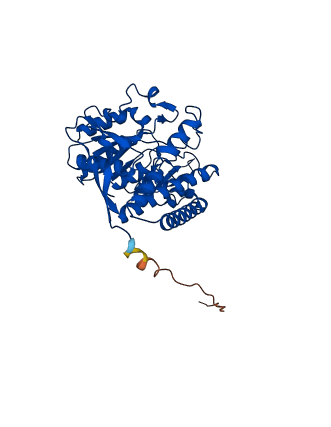
Descriptions
The autoinhibited protein was predicted that may have potential autoinhibitory elements via cis-regPred.
Autoinhibitory domains (AIDs)
Target domain |
|
Relief mechanism |
|
Assay |
cis-regPred |
Accessory elements
No accessory elements
Autoinhibited structure

Activated structure
1 structures for Q06437
| Entry ID | Method | Resolution | Chain | Position | Source |
|---|---|---|---|---|---|
| AF-Q06437-F1 | Predicted | AlphaFoldDB |
No variants for Q06437
| Variant ID(s) | Position | Change | Description | Diseaes Association | Provenance |
|---|---|---|---|---|---|
| No variants for Q06437 | |||||
No associated diseases with Q06437
1 regional properties for Q06437
| Type | Name | Position | InterPro Accession |
|---|---|---|---|
| domain | Dehydrogenase, E1 component | 68 - 361 | IPR001017 |
Functions
| Description | ||
|---|---|---|
| EC Number | 1.2.4.1 | With a disulfide as acceptor |
| Subcellular Localization |
|
|
| PANTHER Family | ||
| PANTHER Subfamily | ||
| PANTHER Protein Class | ||
| PANTHER Pathway Category | No pathway information available | |
3 GO annotations of cellular component
| Name | Definition |
|---|---|
| mitochondrial matrix | The gel-like material, with considerable fine structure, that lies in the matrix space, or lumen, of a mitochondrion. It contains the enzymes of the tricarboxylic acid cycle and, in some organisms, the enzymes concerned with fatty acid oxidation. |
| mitochondrion | A semiautonomous, self replicating organelle that occurs in varying numbers, shapes, and sizes in the cytoplasm of virtually all eukaryotic cells. It is notably the site of tissue respiration. |
| pyruvate dehydrogenase complex | Complex that carries out the oxidative decarboxylation of pyruvate to form acetyl-CoA; comprises subunits possessing three catalytic activities: pyruvate dehydrogenase (E1), dihydrolipoamide S-acetyltransferase (E2), and dihydrolipoamide dehydrogenase (E3). |
1 GO annotations of molecular function
| Name | Definition |
|---|---|
| pyruvate dehydrogenase (acetyl-transferring) activity | Catalysis of the reaction: pyruvate + lipoamide = S-acetyldihydrolipoamide + CO2. |
4 GO annotations of biological process
| Name | Definition |
|---|---|
| acetyl-CoA biosynthetic process from pyruvate | The chemical reactions and pathways resulting in the formation of acetyl-CoA from pyruvate. |
| glucose metabolic process | The chemical reactions and pathways involving glucose, the aldohexose gluco-hexose. D-glucose is dextrorotatory and is sometimes known as dextrose; it is an important source of energy for living organisms and is found free as well as combined in homo- and hetero-oligosaccharides and polysaccharides. |
| pyruvate metabolic process | The chemical reactions and pathways involving pyruvate, 2-oxopropanoate. |
| tricarboxylic acid cycle | A nearly universal metabolic pathway in which the acetyl group of acetyl coenzyme A is effectively oxidized to two CO2 and four pairs of electrons are transferred to coenzymes. The acetyl group combines with oxaloacetate to form citrate, which undergoes successive transformations to isocitrate, 2-oxoglutarate, succinyl-CoA, succinate, fumarate, malate, and oxaloacetate again, thus completing the cycle. In eukaryotes the tricarboxylic acid is confined to the mitochondria. See also glyoxylate cycle. |
1 homologous proteins in AiPD
| UniProt AC | Gene Name | Protein Name | Species | Evidence Code |
|---|---|---|---|---|
| P35487 | Pdha2 | Pyruvate dehydrogenase E1 component subunit alpha, testis-specific form, mitochondrial | Mus musculus (Mouse) | PR |
| 10 | 20 | 30 | 40 | 50 | 60 |
| MRKMLATVLS | QVFSGMVQKP | ALRGLLSSLK | FSNDATCDIK | KCDLYLLEQG | PPTSTVLTRE |
| 70 | 80 | 90 | 100 | 110 | 120 |
| EALKYYRNMQ | VIRRMELKAD | QLYKQKFIRG | FCHLCDGQEA | CNVGLEAGIN | PTDHIITSYR |
| 130 | 140 | 150 | 160 | 170 | 180 |
| AHGLCYTRGL | SVKSILAELT | GRKGGCAKGK | GGSMHMYAKN | FYGGNGIVGA | QVPLGAGVAL |
| 190 | 200 | 210 | 220 | 230 | 240 |
| ACKYLKNGQI | CLALYGDGAA | NQGQVFEAYN | MSALWKLPCV | FICENNRYGM | GTAIERSAAS |
| 250 | 260 | 270 | 280 | 290 | 300 |
| TDYHKKGFVI | PGLRVNGMDI | LSVREATKFA | ADHCRSGKGP | IVMELQTYRY | HGHSMSDPGI |
| 310 | 320 | 330 | 340 | 350 | 360 |
| SYRTREEVQN | VRSKSDPIML | LRERMISNNL | SSVEELKEID | ADVKKEVEEA | AQFATTDPEP |
| 370 | 380 | 390 | |||
| PLEDLANYLY | HQNPPFEVRG | AHKWLKFKSV | S |