Q05791
Gene name |
CDC123 (YLR215C) |
Protein name |
Cell division cycle protein 123 |
Names |
|
Species |
Saccharomyces cerevisiae (strain ATCC 204508 / S288c) (Baker's yeast) |
KEGG Pathway |
sce:YLR215C |
EC number |
|
Protein Class |
|
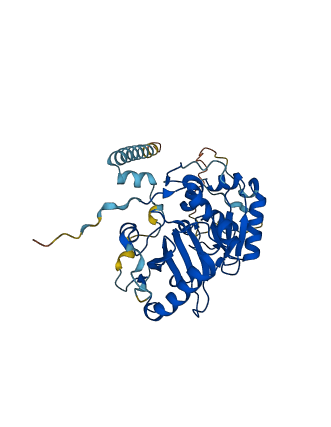
Descriptions
The autoinhibited protein was predicted that may have potential autoinhibitory elements via cis-regPred.
Autoinhibitory domains (AIDs)
Target domain |
|
Relief mechanism |
|
Assay |
cis-regPred |
Accessory elements
No accessory elements
Autoinhibited structure

Activated structure
1 structures for Q05791
| Entry ID | Method | Resolution | Chain | Position | Source |
|---|---|---|---|---|---|
| AF-Q05791-F1 | Predicted | AlphaFoldDB |
9 variants for Q05791
| Variant ID(s) | Position | Change | Description | Diseaes Association | Provenance |
|---|---|---|---|---|---|
| s12-571830 | 11 | D>Y | No | SGRP | |
| s12-571811 | 17 | A>E | No | SGRP | |
| s12-571737 | 42 | K>E | No | SGRP | |
| s12-571667 | 65 | S>C | No | SGRP | |
| s12-571181 | 227 | T>I | No | SGRP | |
| s12-571157 | 235 | I>T | No | SGRP | |
| s12-570845 | 339 | Q>R | No | SGRP | |
| s12-570794 | 356 | S>N | No | SGRP | |
| s12-570788 | 358 | N>S | No | SGRP |
No associated diseases with Q05791
1 GO annotations of cellular component
| Name | Definition |
|---|---|
| cytoplasm | The contents of a cell excluding the plasma membrane and nucleus, but including other subcellular structures. |
2 GO annotations of molecular function
| Name | Definition |
|---|---|
| ATP binding | Binding to ATP, adenosine 5'-triphosphate, a universally important coenzyme and enzyme regulator. |
| magnesium ion binding | Binding to a magnesium (Mg) ion. |
4 GO annotations of biological process
| Name | Definition |
|---|---|
| cell cycle | The progression of biochemical and morphological phases and events that occur in a cell during successive cell replication or nuclear replication events. Canonically, the cell cycle comprises the replication and segregation of genetic material followed by the division of the cell, but in endocycles or syncytial cells nuclear replication or nuclear division may not be followed by cell division. |
| cell division | The process resulting in division and partitioning of components of a cell to form more cells; may or may not be accompanied by the physical separation of a cell into distinct, individually membrane-bounded daughter cells. |
| eukaryotic translation initiation factor 2 complex assembly | The aggregation, arrangement and bonding together of a set of components to form an eukaryotic translation initiation factor 2 complex. |
| positive regulation of translational initiation | Any process that activates or increases the frequency, rate or extent of translational initiation. |
1 homologous proteins in AiPD
| UniProt AC | Gene Name | Protein Name | Species | Evidence Code |
|---|---|---|---|---|
| O75794 | CDC123 | Cell division cycle protein 123 homolog | Homo sapiens (Human) | PR |
| 10 | 20 | 30 | 40 | 50 | 60 |
| MSSQEYTTFI | DIPVTRAQVE | HCSYSFWSSL | YPKYVPKSIV | LKSLPKKFIQ | YLEQDGIKLP |
| 70 | 80 | 90 | 100 | 110 | 120 |
| QEENSRSVYT | EEIIRNEDND | YSDWEDDEDT | ATEFVQEVEP | LIDFPELHQK | LKDALNELGA |
| 130 | 140 | 150 | 160 | 170 | 180 |
| VAPKLNWSAP | RDATWILPNN | TMKCNEVNEL | YLLLNASNYI | MHDLQRAFKG | CVDGDDIKGL |
| 190 | 200 | 210 | 220 | 230 | 240 |
| KFDLVLRQWC | DMNPALEFRV | FVKNAHIVGA | TQRDLNYYDY | LDELSDTFKD | LIDEIVHDVV |
| 250 | 260 | 270 | 280 | 290 | 300 |
| LPKFPDKSFV | LDVYIPRPFN | KIFIVDINPF | ARKTDSLLFS | WNEIAAIAPP | KNDVEDYELR |
| 310 | 320 | 330 | 340 | 350 | |
| LVTRHNTGRF | ASKEHSENHV | PQDLVEASLN | PEAIRELTQK | WKELLSQQAK | EESSDSENET |