Q04750
Gene name |
Top1 (Top-1) |
Protein name |
DNA topoisomerase 1 |
Names |
DNA topoisomerase I |
Species |
Mus musculus (Mouse) |
KEGG Pathway |
mmu:21969 |
EC number |
5.6.2.1: Enzymes altering nucleic acid conformation |
Protein Class |
|
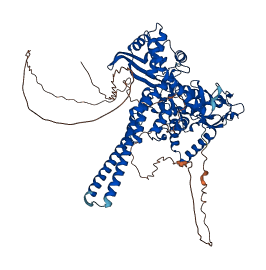
Descriptions
The autoinhibited protein was predicted that may have potential autoinhibitory elements via cis-regPred.
Autoinhibitory domains (AIDs)
Target domain |
|
Relief mechanism |
|
Assay |
cis-regPred |
Accessory elements
No accessory elements
Autoinhibited structure

Activated structure
1 structures for Q04750
| Entry ID | Method | Resolution | Chain | Position | Source |
|---|---|---|---|---|---|
| AF-Q04750-F1 | Predicted | AlphaFoldDB |
13 variants for Q04750
| Variant ID(s) | Position | Change | Description | Diseaes Association | Provenance |
|---|---|---|---|---|---|
| rs3388610283 | 268 | H>L | No | EVA | |
| rs3388605023 | 281 | F>L | No | EVA | |
| rs3388603725 | 349 | R>I | No | EVA | |
| rs3388602489 | 381 | P>S | No | EVA | |
| rs3388606379 | 430 | M>I | No | EVA | |
| rs3388605006 | 434 | S>G | No | EVA | |
| rs3388599840 | 444 | Q>* | No | EVA | |
| rs3388610310 | 465 | E>K | No | EVA | |
| rs3388601013 | 476 | Q>K | No | EVA | |
| rs3388601059 | 491 | A>T | No | EVA | |
| rs3388610295 | 621 | Y>C | No | EVA | |
| rs3392411010 | 734 | W>C | No | EVA | |
| rs3388603685 | 759 | D>G | No | EVA |
No associated diseases with Q04750
5 regional properties for Q04750
| Type | Name | Position | InterPro Accession |
|---|---|---|---|
| domain | DNA topoisomerase I, DNA binding, eukaryotic-type | 217 - 431 | IPR008336 |
| domain | DNA topoisomerase I, eukaryotic-type | 362 - 739 | IPR013499 |
| domain | DNA topoisomerase I, catalytic core, eukaryotic-type | 434 - 665 | IPR013500 |
| active_site | DNA topoisomerase I, active site | 712 - 730 | IPR018521 |
| domain | Topoisomerase I C-terminal domain | 697 - 767 | IPR025834 |
Functions
| Description | ||
|---|---|---|
| EC Number | 5.6.2.1 | Enzymes altering nucleic acid conformation |
| Subcellular Localization |
|
|
| PANTHER Family | ||
| PANTHER Subfamily | ||
| PANTHER Protein Class | ||
| PANTHER Pathway Category | No pathway information available | |
11 GO annotations of cellular component
| Name | Definition |
|---|---|
| cytoplasm | The contents of a cell excluding the plasma membrane and nucleus, but including other subcellular structures. |
| dense fibrillar component | A structure found in the nucleolus, which contains newly synthesized preribosomal RNA (pre-rRNA) and a collection of proteins. |
| fibrillar center | A structure found most metazoan nucleoli, but not usually found in lower eukaryotes; surrounded by the dense fibrillar component; the zone of transcription from multiple copies of the pre-rRNA genes is in the border region between these two structures. |
| male germ cell nucleus | The nucleus of a male germ cell, a reproductive cell in males. |
| nuclear chromosome | A chromosome that encodes the nuclear genome and is found in the nucleus of a eukaryotic cell during the cell cycle phases when the nucleus is intact. |
| nucleolus | A small, dense body one or more of which are present in the nucleus of eukaryotic cells. It is rich in RNA and protein, is not bounded by a limiting membrane, and is not seen during mitosis. Its prime function is the transcription of the nucleolar DNA into 45S ribosomal-precursor RNA, the processing of this RNA into 5.8S, 18S, and 28S components of ribosomal RNA, and the association of these components with 5S RNA and proteins synthesized outside the nucleolus. This association results in the formation of ribonucleoprotein precursors; these pass into the cytoplasm and mature into the 40S and 60S subunits of the ribosome. |
| nucleoplasm | That part of the nuclear content other than the chromosomes or the nucleolus. |
| nucleus | A membrane-bounded organelle of eukaryotic cells in which chromosomes are housed and replicated. In most cells, the nucleus contains all of the cell's chromosomes except the organellar chromosomes, and is the site of RNA synthesis and processing. In some species, or in specialized cell types, RNA metabolism or DNA replication may be absent. |
| P-body | A focus in the cytoplasm where mRNAs may become inactivated by decapping or some other mechanism. Protein and RNA localized to these foci are involved in mRNA degradation, nonsense-mediated mRNA decay (NMD), translational repression, and RNA-mediated gene silencing. |
| perikaryon | The portion of the cell soma (neuronal cell body) that excludes the nucleus. |
| protein-DNA complex | A macromolecular complex containing both protein and DNA molecules. |
12 GO annotations of molecular function
| Name | Definition |
|---|---|
| ATP binding | Binding to ATP, adenosine 5'-triphosphate, a universally important coenzyme and enzyme regulator. |
| chromatin binding | Binding to chromatin, the network of fibers of DNA, protein, and sometimes RNA, that make up the chromosomes of the eukaryotic nucleus during interphase. |
| chromatin DNA binding | Binding to DNA that is assembled into chromatin. |
| DNA binding | Any molecular function by which a gene product interacts selectively and non-covalently with DNA (deoxyribonucleic acid). |
| DNA topoisomerase type I (single strand cut, ATP-independent) activity | Catalysis of a DNA topological transformation by transiently cleaving one DNA strand at a time to allow passage of another strand; changes the linking number by +1 per catalytic cycle. |
| double-stranded DNA binding | Binding to double-stranded DNA. |
| protein domain specific binding | Binding to a specific domain of a protein. |
| protein serine/threonine kinase activity | Catalysis of the reactions: ATP + protein serine = ADP + protein serine phosphate, and ATP + protein threonine = ADP + protein threonine phosphate. |
| protein-containing complex binding | Binding to a macromolecular complex. |
| RNA polymerase II cis-regulatory region sequence-specific DNA binding | Binding to a specific upstream regulatory DNA sequence (transcription factor recognition sequence or binding site) located in cis relative to the transcription start site (i.e., on the same strand of DNA) of a gene transcribed by RNA polymerase II. |
| single-stranded DNA binding | Binding to single-stranded DNA. |
| supercoiled DNA binding | Binding to supercoiled DNA. For example, during replication and transcription, template DNA is negatively supercoiled in the receding downstream DNA and positively supercoiled in the approaching downstream DNA. |
9 GO annotations of biological process
| Name | Definition |
|---|---|
| chromatin remodeling | A dynamic process of chromatin reorganization resulting in changes to chromatin structure. These changes allow DNA metabolic processes such as transcriptional regulation, DNA recombination, DNA repair, and DNA replication. |
| chromosome segregation | The process in which genetic material, in the form of chromosomes, is organized into specific structures and then physically separated and apportioned to two or more sets. In eukaryotes, chromosome segregation begins with the condensation of chromosomes, includes chromosome separation, and ends when chromosomes have completed movement to the spindle poles. |
| circadian regulation of gene expression | Any process that modulates the frequency, rate or extent of gene expression such that an expression pattern recurs with a regularity of approximately 24 hours. |
| DNA replication | The cellular metabolic process in which a cell duplicates one or more molecules of DNA. DNA replication begins when specific sequences, known as origins of replication, are recognized and bound by initiation proteins, and ends when the original DNA molecule has been completely duplicated and the copies topologically separated. The unit of replication usually corresponds to the genome of the cell, an organelle, or a virus. The template for replication can either be an existing DNA molecule or RNA. |
| DNA topological change | The process in which a transformation is induced in the topological structure of a double-stranded DNA helix, resulting in a change in linking number. |
| embryonic cleavage | The first few specialized divisions of an activated animal egg. |
| peptidyl-serine phosphorylation | The phosphorylation of peptidyl-serine to form peptidyl-O-phospho-L-serine. |
| response to xenobiotic stimulus | Any process that results in a change in state or activity of a cell or an organism (in terms of movement, secretion, enzyme production, gene expression, etc.) as a result of a stimulus from a xenobiotic, a compound foreign to the organim exposed to it. It may be synthesized by another organism (like ampicilin) or it can be a synthetic chemical. |
| rRNA transcription | The synthesis of ribosomal RNA (rRNA), any RNA that forms part of the ribosomal structure, from a DNA template. |
| 10 | 20 | 30 | 40 | 50 | 60 |
| MSGDHLHNDS | QIEADFRLND | SHKHKDKHKD | REHRHKEHKK | DKDKDREKSK | HSNSEHKDSE |
| 70 | 80 | 90 | 100 | 110 | 120 |
| KKHKEKEKTK | HKDGSSEKHK | DKHKDRDKER | RKEEKIRAAG | DAKIKKEKEN | GFSSPPRIKD |
| 130 | 140 | 150 | 160 | 170 | 180 |
| EPEDDGYFAP | PKEDIKPLKR | LRDEDDADYK | PKKIKTEDIK | KEKKRKSEEE | EDGKLKKPKN |
| 190 | 200 | 210 | 220 | 230 | 240 |
| KDKDKKVAEP | DNKKKKPKKE | EEQKWKWWEE | ERYPEGIKWK | FLEHKGPVFA | PPYEPLPESV |
| 250 | 260 | 270 | 280 | 290 | 300 |
| KFYYDGKVMK | LSPKAEEVAT | FFAKMLDHEY | TTKEIFRKNF | FKDWRKEMTN | DEKNTITNLS |
| 310 | 320 | 330 | 340 | 350 | 360 |
| KCDFTQMSQY | FKAQSEARKQ | MSKEEKLKIK | EENEKLLKEY | GFCVMDNHRE | RIANFKIEPP |
| 370 | 380 | 390 | 400 | 410 | 420 |
| GLFRGRGNHP | KMGMLKRRIM | PEDIIINCSK | DAKVPSPPPG | HKWKEVRHDN | KVTWLVSWTE |
| 430 | 440 | 450 | 460 | 470 | 480 |
| NIQGSIKYIM | LNPSSRIKGE | KDWQKYETAR | RLKKCVDKIR | NQYREDWKSK | EMKVRQRAVA |
| 490 | 500 | 510 | 520 | 530 | 540 |
| LYFIDKLALR | AGNEKEEGET | ADTVGCCSLR | VEHINLHPEL | DGQEYVVEFD | FPGKDSIRYY |
| 550 | 560 | 570 | 580 | 590 | 600 |
| NKVPVEKRVF | KNLQLFMENK | QPEDDLFDRL | NTGILNKHLQ | DLMEGLTAKV | FRTYNASITL |
| 610 | 620 | 630 | 640 | 650 | 660 |
| QQQLKELTAP | DENVPAKILS | YNRANRAVAI | LCNHQRAPPK | TFEKSMMNLQ | SKIDAKKDQL |
| 670 | 680 | 690 | 700 | 710 | 720 |
| ADARRDLKSA | KADAKVMKDA | KTKKVVESKK | KAVQRLEEQL | MKLEVQATDR | EENKQIALGT |
| 730 | 740 | 750 | 760 | ||
| SKLNYLDPRI | TVAWCKKWGV | PIEKIYNKTQ | REKFAWAIDM | TDEDYEF |