Q04471
Gene name |
YMR114C (YM9718.13C) |
Protein name |
Abasic site processing protein YMR114C |
Names |
|
Species |
Saccharomyces cerevisiae (strain ATCC 204508 / S288c) (Baker's yeast) |
KEGG Pathway |
sce:YMR114C |
EC number |
|
Protein Class |
|
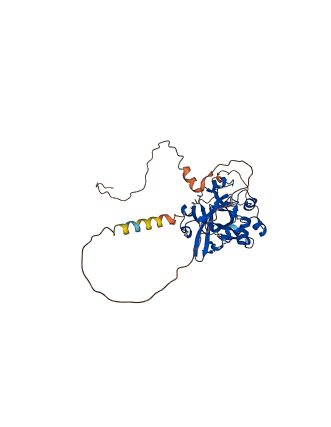
Descriptions
The autoinhibited protein was predicted that may have potential autoinhibitory elements via cis-regPred.
Autoinhibitory domains (AIDs)
Target domain |
|
Relief mechanism |
|
Assay |
cis-regPred |
Accessory elements
No accessory elements
Autoinhibited structure

Activated structure
1 structures for Q04471
| Entry ID | Method | Resolution | Chain | Position | Source |
|---|---|---|---|---|---|
| AF-Q04471-F1 | Predicted | AlphaFoldDB |
8 variants for Q04471
| Variant ID(s) | Position | Change | Description | Diseaes Association | Provenance |
|---|---|---|---|---|---|
| s13-497220 | 77 | I>V | No | SGRP | |
| s13-496954 | 165 | D>E | No | SGRP | |
| s13-496739 | 237 | V>A | No | SGRP | |
| s13-496612 | 279 | D>E | No | SGRP | |
| s13-496540 | 303 | R>S | No | SGRP | |
| s13-496536 | 305 | S>T | No | SGRP | |
| s13-496500 | 317 | E>K | No | SGRP | |
| s13-496389 | 354 | L>M | No | SGRP |
No associated diseases with Q04471
No regional properties for Q04471
| Type | Name | Position | InterPro Accession |
|---|---|---|---|
| No domain, repeats, and functional sites for Q04471 | |||
2 GO annotations of cellular component
| Name | Definition |
|---|---|
| cytoplasm | The contents of a cell excluding the plasma membrane and nucleus, but including other subcellular structures. |
| nucleus | A membrane-bounded organelle of eukaryotic cells in which chromosomes are housed and replicated. In most cells, the nucleus contains all of the cell's chromosomes except the organellar chromosomes, and is the site of RNA synthesis and processing. In some species, or in specialized cell types, RNA metabolism or DNA replication may be absent. |
2 GO annotations of molecular function
| Name | Definition |
|---|---|
| peptidase activity | Catalysis of the hydrolysis of a peptide bond. A peptide bond is a covalent bond formed when the carbon atom from the carboxyl group of one amino acid shares electrons with the nitrogen atom from the amino group of a second amino acid. |
| single-stranded DNA binding | Binding to single-stranded DNA. |
3 GO annotations of biological process
| Name | Definition |
|---|---|
| cellular response to DNA damage stimulus | Any process that results in a change in state or activity of a cell (in terms of movement, secretion, enzyme production, gene expression, etc.) as a result of a stimulus indicating damage to its DNA from environmental insults or errors during metabolism. |
| protein-DNA covalent cross-linking | The formation of a covalent cross-link between DNA and a protein. |
| proteolysis | The hydrolysis of proteins into smaller polypeptides and/or amino acids by cleavage of their peptide bonds. |
1 homologous proteins in AiPD
| UniProt AC | Gene Name | Protein Name | Species | Evidence Code |
|---|---|---|---|---|
| P76318 | yedK | Abasic site processing protein YedK | Escherichia coli (strain K12) | PR |
| 10 | 20 | 30 | 40 | 50 | 60 |
| MCGRFALAYD | SGDLPQLLRD | WNLPVNTPKD | ASSNSQHPHD | EEDTKDQPTV | SKDIFKASYN |
| 70 | 80 | 90 | 100 | 110 | 120 |
| ISPTNYSAVY | RPDTKAIQFM | RWGLVPFWTK | DVSQFKTYRT | FNARLENLQE | SKMWMRPCEK |
| 130 | 140 | 150 | 160 | 170 | 180 |
| KRCAVLMSGY | FEWKTVGKKK | TPYFISRRDG | RLMFVAGMYD | YVEKDDLYTF | TIITAQGPRE |
| 190 | 200 | 210 | 220 | 230 | 240 |
| LEWLHERMPC | VLEPGTESWD | AWMDVDKTTW | STEELVKLLK | PDYDESKLQF | YQVTDDVGKT |
| 250 | 260 | 270 | 280 | 290 | 300 |
| TNTGERLIKP | LLKEDSDMFS | VKREKEEALL | ENDNEQGIDN | RGVKGDKSLK | GEDVFNQKKS |
| 310 | 320 | 330 | 340 | 350 | 360 |
| LKRNSYDGLK | KNEEQEETTL | PEEGSIGDRV | KREEANLSPK | REGNREKRNI | VNMLGNQKDS |
| RGKKKIKK |