Q04049
Gene name |
RAD30 (DBH1, YDR419W) |
Protein name |
DNA polymerase eta |
Names |
Radiation-sensitive protein 30 |
Species |
Saccharomyces cerevisiae (strain ATCC 204508 / S288c) (Baker's yeast) |
KEGG Pathway |
sce:YDR419W |
EC number |
2.7.7.7: Nucleotidyltransferases |
Protein Class |
|
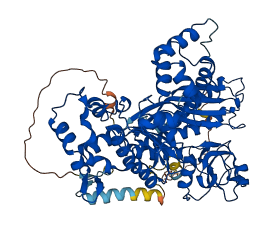
Descriptions
The autoinhibited protein was predicted that may have potential autoinhibitory elements via cis-regPred.
Autoinhibitory domains (AIDs)
Target domain |
|
Relief mechanism |
|
Assay |
cis-regPred |
Accessory elements
No accessory elements
Autoinhibited structure

Activated structure
12 structures for Q04049
| Entry ID | Method | Resolution | Chain | Position | Source |
|---|---|---|---|---|---|
| 1JIH | X-ray | 225 A | A/B | 1-513 | PDB |
| 2R8J | X-ray | 310 A | A/B | 1-531 | PDB |
| 2R8K | X-ray | 330 A | A/B | 1-531 | PDB |
| 2WTF | X-ray | 250 A | A/B | 1-513 | PDB |
| 2XGP | X-ray | 270 A | A/B | 1-513 | PDB |
| 2XGQ | X-ray | 270 A | A/B | 1-513 | PDB |
| 3MFH | X-ray | 200 A | A | 1-513 | PDB |
| 3MFI | X-ray | 176 A | A | 1-513 | PDB |
| 3OHA | X-ray | 200 A | A | 1-513 | PDB |
| 3OHB | X-ray | 200 A | A | 1-513 | PDB |
| 5VTP | X-ray | 280 A | A | 1-528 | PDB |
| AF-Q04049-F1 | Predicted | AlphaFoldDB |
10 variants for Q04049
| Variant ID(s) | Position | Change | Description | Diseaes Association | Provenance |
|---|---|---|---|---|---|
| s04-1303526 | 121 | V>M | No | SGRP | |
| s04-1303669 | 168 | M>I | No | SGRP | |
| s04-1303719 | 185 | D>G | No | SGRP | |
| s04-1304196 | 344 | E>G | No | SGRP | |
| s04-1304346 | 394 | S>N | No | SGRP | |
| s04-1304798 | 545 | E>K | No | SGRP | |
| s04-1304829 | 555 | Y>C | No | SGRP | |
| s04-1304855 | 564 | A>T | No | SGRP | |
| s04-1304870 | 569 | A>T | No | SGRP | |
| s04-1305012 | 616 | K>R | No | SGRP |
No associated diseases with Q04049
Functions
| Description | ||
|---|---|---|
| EC Number | 2.7.7.7 | Nucleotidyltransferases |
| Subcellular Localization |
|
|
| PANTHER Family | ||
| PANTHER Subfamily | ||
| PANTHER Protein Class | ||
| PANTHER Pathway Category | No pathway information available | |
4 GO annotations of cellular component
| Name | Definition |
|---|---|
| mitochondrion | A semiautonomous, self replicating organelle that occurs in varying numbers, shapes, and sizes in the cytoplasm of virtually all eukaryotic cells. It is notably the site of tissue respiration. |
| nucleus | A membrane-bounded organelle of eukaryotic cells in which chromosomes are housed and replicated. In most cells, the nucleus contains all of the cell's chromosomes except the organellar chromosomes, and is the site of RNA synthesis and processing. In some species, or in specialized cell types, RNA metabolism or DNA replication may be absent. |
| replication fork | The Y-shaped region of a replicating DNA molecule, resulting from the separation of the DNA strands and in which the synthesis of new strands takes place. Also includes associated protein complexes. |
| site of double-strand break | A region of a chromosome at which a DNA double-strand break has occurred. DNA damage signaling and repair proteins accumulate at the lesion to respond to the damage and repair the DNA to form a continuous DNA helix. |
3 GO annotations of molecular function
| Name | Definition |
|---|---|
| damaged DNA binding | Binding to damaged DNA. |
| DNA-directed DNA polymerase activity | Catalysis of the reaction: deoxynucleoside triphosphate + DNA(n) = diphosphate + DNA(n+1); the synthesis of DNA from deoxyribonucleotide triphosphates in the presence of a DNA template and a 3'hydroxyl group. |
| metal ion binding | Binding to a metal ion. |
6 GO annotations of biological process
| Name | Definition |
|---|---|
| chromosome segregation | The process in which genetic material, in the form of chromosomes, is organized into specific structures and then physically separated and apportioned to two or more sets. In eukaryotes, chromosome segregation begins with the condensation of chromosomes, includes chromosome separation, and ends when chromosomes have completed movement to the spindle poles. |
| DNA replication | The cellular metabolic process in which a cell duplicates one or more molecules of DNA. DNA replication begins when specific sequences, known as origins of replication, are recognized and bound by initiation proteins, and ends when the original DNA molecule has been completely duplicated and the copies topologically separated. The unit of replication usually corresponds to the genome of the cell, an organelle, or a virus. The template for replication can either be an existing DNA molecule or RNA. |
| error-free translesion synthesis | The conversion of DNA-damage induced single-stranded gaps into large molecular weight DNA after replication by using a specialized DNA polymerase or replication complex to insert a defined nucleotide across the lesion. This process does not remove the replication-blocking lesions but does not causes an increase in the endogenous mutation level. For S. cerevisiae, RAD30 encodes DNA polymerase eta, which incorporates two adenines. When incorporated across a thymine-thymine dimer, it does not increase the endogenous mutation level. |
| error-prone translesion synthesis | The conversion of DNA-damage induced single-stranded gaps into large molecular weight DNA after replication by using a specialized DNA polymerase or replication complex to insert a defined nucleotide across the lesion. This process does not remove the replication-blocking lesions and causes an increase in the endogenous mutation level. For example, in E. coli, a low fidelity DNA polymerase, pol V, copies lesions that block replication fork progress. This produces mutations specifically targeted to DNA template damage sites, but it can also produce mutations at undamaged sites. |
| mitotic sister chromatid cohesion | The cell cycle process in which the sister chromatids of a replicated chromosome are joined along the entire length of the chromosome, from their formation in S phase through metaphase during a mitotic cell cycle. This cohesion cycle is critical for high fidelity chromosome transmission. |
| response to radiation | Any process that results in a change in state or activity of a cell or an organism (in terms of movement, secretion, enzyme production, gene expression, etc.) as a result of an electromagnetic radiation stimulus. Electromagnetic radiation is a propagating wave in space with electric and magnetic components. These components oscillate at right angles to each other and to the direction of propagation. |
1 homologous proteins in AiPD
| UniProt AC | Gene Name | Protein Name | Species | Evidence Code |
|---|---|---|---|---|
| Q8H2D5 | POLH | DNA polymerase eta | Arabidopsis thaliana (Mouse-ear cress) | PR |
| 10 | 20 | 30 | 40 | 50 | 60 |
| MSKFTWKELI | QLGSPSKAYE | SSLACIAHID | MNAFFAQVEQ | MRCGLSKEDP | VVCVQWNSII |
| 70 | 80 | 90 | 100 | 110 | 120 |
| AVSYAARKYG | ISRMDTIQEA | LKKCSNLIPI | HTAVFKKGED | FWQYHDGCGS | WVQDPAKQIS |
| 130 | 140 | 150 | 160 | 170 | 180 |
| VEDHKVSLEP | YRRESRKALK | IFKSACDLVE | RASIDEVFLD | LGRICFNMLM | FDNEYELTGD |
| 190 | 200 | 210 | 220 | 230 | 240 |
| LKLKDALSNI | REAFIGGNYD | INSHLPLIPE | KIKSLKFEGD | VFNPEGRDLI | TDWDDVILAL |
| 250 | 260 | 270 | 280 | 290 | 300 |
| GSQVCKGIRD | SIKDILGYTT | SCGLSSTKNV | CKLASNYKKP | DAQTIVKNDC | LLDFLDCGKF |
| 310 | 320 | 330 | 340 | 350 | 360 |
| EITSFWTLGG | VLGKELIDVL | DLPHENSIKH | IRETWPDNAG | QLKEFLDAKV | KQSDYDRSTS |
| 370 | 380 | 390 | 400 | 410 | 420 |
| NIDPLKTADL | AEKLFKLSRG | RYGLPLSSRP | VVKSMMSNKN | LRGKSCNSIV | DCISWLEVFC |
| 430 | 440 | 450 | 460 | 470 | 480 |
| AELTSRIQDL | EQEYNKIVIP | RTVSISLKTK | SYEVYRKSGP | VAYKGINFQS | HELLKVGIKF |
| 490 | 500 | 510 | 520 | 530 | 540 |
| VTDLDIKGKN | KSYYPLTKLS | MTITNFDIID | LQKTVVDMFG | NQVHTFKSSA | GKEDEEKTTS |
| 550 | 560 | 570 | 580 | 590 | 600 |
| SKADEKTPKL | ECCKYQVTFT | DQKALQEHAD | YHLALKLSEG | LNGAEESSKN | LSFGEKRLLF |
| 610 | 620 | 630 | |||
| SRKRPNSQHT | ATPQKKQVTS | SKNILSFFTR | KK |