P99026
Gene name |
Psmb4 (Lmp3) |
Protein name |
Proteasome subunit beta type-4 |
Names |
Low molecular mass protein 3, Macropain beta chain, Multicatalytic endopeptidase complex beta chain, Proteasome beta chain, Proteasome chain 3 |
Species |
Mus musculus (Mouse) |
KEGG Pathway |
mmu:19172 |
EC number |
|
Protein Class |
|
Descriptions
The autoinhibited protein was predicted that may have potential autoinhibitory elements via cis-regPred.
Autoinhibitory domains (AIDs)
Target domain |
|
Relief mechanism |
|
Assay |
cis-regPred |
Accessory elements
No accessory elements
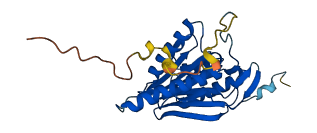
Autoinhibited structure

Activated structure
5 structures for P99026
| Entry ID | Method | Resolution | Chain | Position | Source |
|---|---|---|---|---|---|
| 3UNB | X-ray | 290 A | 3/M/a/o | 46-264 | PDB |
| 3UNE | X-ray | 320 A | 3/M/a/o | 46-264 | PDB |
| 3UNF | X-ray | 290 A | M/a | 46-264 | PDB |
| 3UNH | X-ray | 320 A | M/a | 46-264 | PDB |
| AF-P99026-F1 | Predicted | AlphaFoldDB |
9 variants for P99026
| Variant ID(s) | Position | Change | Description | Diseaes Association | Provenance |
|---|---|---|---|---|---|
| rs13468055 | 26 | A>S | No | EVA | |
| rs3388635496 | 65 | V>M | No | EVA | |
| rs3388639686 | 70 | D>N | No | EVA | |
| rs3388641468 | 81 | F>L | No | EVA | |
| rs3388639721 | 87 | I>T | No | EVA | |
| rs3388641869 | 108 | L>M | No | EVA | |
| rs3388650621 | 170 | V>L | No | EVA | |
| rs243118687 | 197 | E>D | No | EVA | |
| rs3388647481 | 250 | A>T | No | EVA |
No associated diseases with P99026
1 regional properties for P99026
| Type | Name | Position | InterPro Accession |
|---|---|---|---|
| conserved_site | Proteasome beta-type subunit, conserved site | 57 - 104 | IPR016050 |
Functions
9 GO annotations of cellular component
| Name | Definition |
|---|---|
| ciliary basal body | A membrane-tethered, short cylindrical array of microtubules and associated proteins found at the base of a eukaryotic cilium (also called flagellum) that is similar in structure to a centriole and derives from it. The cilium basal body is the site of assembly and remodelling of the cilium and serves as a nucleation site for axoneme growth. As well as anchoring the cilium, it is thought to provide a selective gateway regulating the entry of ciliary proteins and vesicles by intraflagellar transport. |
| cytoplasm | The contents of a cell excluding the plasma membrane and nucleus, but including other subcellular structures. |
| cytosol | The part of the cytoplasm that does not contain organelles but which does contain other particulate matter, such as protein complexes. |
| mitochondrion | A semiautonomous, self replicating organelle that occurs in varying numbers, shapes, and sizes in the cytoplasm of virtually all eukaryotic cells. It is notably the site of tissue respiration. |
| nucleoplasm | That part of the nuclear content other than the chromosomes or the nucleolus. |
| nucleus | A membrane-bounded organelle of eukaryotic cells in which chromosomes are housed and replicated. In most cells, the nucleus contains all of the cell's chromosomes except the organellar chromosomes, and is the site of RNA synthesis and processing. In some species, or in specialized cell types, RNA metabolism or DNA replication may be absent. |
| proteasome complex | A large multisubunit complex which catalyzes protein degradation, found in eukaryotes, archaea and some bacteria. In eukaryotes, this complex consists of the barrel shaped proteasome core complex and one or two associated proteins or complexes that act in regulating entry into or exit from the core. |
| proteasome core complex | A multisubunit barrel shaped endoprotease complex, which is the core of the proteasome complex. |
| proteasome core complex, beta-subunit complex | The proteasome core subcomplex that constitutes the two inner rings of the proteasome core complex. An example of this component is found in Mus musculus. |
1 GO annotations of molecular function
| Name | Definition |
|---|---|
| lipopolysaccharide binding | Binding to a lipopolysaccharide. |
2 GO annotations of biological process
| Name | Definition |
|---|---|
| negative regulation of inflammatory response to antigenic stimulus | Any process that stops, prevents, or reduces the frequency, rate, or extent of an inflammatory response to an antigenic stimulus. |
| proteasomal protein catabolic process | The chemical reactions and pathways resulting in the breakdown of a protein or peptide by hydrolysis of its peptide bonds that is mediated by the proteasome. |
| 10 | 20 | 30 | 40 | 50 | 60 |
| MEAFWESRAG | HWAGGPAPGQ | FYRIPATPSG | LMDPASAPCE | GPITRTQNPM | VTGTSVLGVK |
| 70 | 80 | 90 | 100 | 110 | 120 |
| FDGGVVIAAD | MLGSYGSLAR | FRNISRIMRV | NDSTMLGASG | DYADFQYLKQ | VLGQMVIDEE |
| 130 | 140 | 150 | 160 | 170 | 180 |
| LLGDGHSYSP | RAIHSWLTRA | MYSRRSKMNP | LWNTMVIGGY | ADGESFLGYV | DMLGVAYEAP |
| 190 | 200 | 210 | 220 | 230 | 240 |
| SLATGYGAYL | AQPLLREVLE | KQPVLSQTEA | RELVERCMRV | LYYRDARSYN | RFQIATVTEK |
| 250 | 260 | ||||
| GVEIEGPLSA | QTNWDIAHMI | SGFE |