P97930
Gene name |
Dtymk (Tmk) |
Protein name |
Thymidylate kinase |
Names |
dTMP kinase |
Species |
Mus musculus (Mouse) |
KEGG Pathway |
mmu:21915 |
EC number |
2.7.4.9: Phosphotransferases with a phosphate group as acceptor |
Protein Class |
|
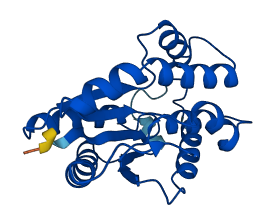
Descriptions
The autoinhibited protein was predicted that may have potential autoinhibitory elements via cis-regPred.
Autoinhibitory domains (AIDs)
Target domain |
|
Relief mechanism |
|
Assay |
cis-regPred |
Accessory elements
No accessory elements
Autoinhibited structure

Activated structure
1 structures for P97930
| Entry ID | Method | Resolution | Chain | Position | Source |
|---|---|---|---|---|---|
| AF-P97930-F1 | Predicted | AlphaFoldDB |
11 variants for P97930
| Variant ID(s) | Position | Change | Description | Diseaes Association | Provenance |
|---|---|---|---|---|---|
| rs582035419 | 17 | A>V | No | EVA | |
| rs3388491746 | 45 | R>S | No | EVA | |
| rs3388491617 | 57 | L>S | No | EVA | |
| rs3388489890 | 64 | E>D | No | EVA | |
| rs3388490366 | 107 | G>D | No | EVA | |
| rs3388489029 | 118 | K>E | No | EVA | |
| rs3388489942 | 126 | K>T | No | EVA | |
| rs3388490463 | 135 | L>V | No | EVA | |
| rs3388490526 | 147 | G>D | No | EVA | |
| rs3388490397 | 172 | N>I | No | EVA | |
| rs3388489950 | 209 | E>K | No | EVA |
No associated diseases with P97930
Functions
| Description | ||
|---|---|---|
| EC Number | 2.7.4.9 | Phosphotransferases with a phosphate group as acceptor |
| Subcellular Localization |
|
|
| PANTHER Family | ||
| PANTHER Subfamily | ||
| PANTHER Protein Class | ||
| PANTHER Pathway Category | No pathway information available | |
5 GO annotations of cellular component
| Name | Definition |
|---|---|
| cytoplasm | The contents of a cell excluding the plasma membrane and nucleus, but including other subcellular structures. |
| mitochondrial intermembrane space | The region between the inner and outer lipid bilayers of the mitochondrial envelope. |
| mitochondrial matrix | The gel-like material, with considerable fine structure, that lies in the matrix space, or lumen, of a mitochondrion. It contains the enzymes of the tricarboxylic acid cycle and, in some organisms, the enzymes concerned with fatty acid oxidation. |
| mitochondrion | A semiautonomous, self replicating organelle that occurs in varying numbers, shapes, and sizes in the cytoplasm of virtually all eukaryotic cells. It is notably the site of tissue respiration. |
| nucleus | A membrane-bounded organelle of eukaryotic cells in which chromosomes are housed and replicated. In most cells, the nucleus contains all of the cell's chromosomes except the organellar chromosomes, and is the site of RNA synthesis and processing. In some species, or in specialized cell types, RNA metabolism or DNA replication may be absent. |
4 GO annotations of molecular function
| Name | Definition |
|---|---|
| ATP binding | Binding to ATP, adenosine 5'-triphosphate, a universally important coenzyme and enzyme regulator. |
| nucleoside diphosphate kinase activity | Catalysis of the reaction: ATP + nucleoside diphosphate = ADP + nucleoside triphosphate. |
| thymidylate kinase activity | Catalysis of the reaction: ATP + thymidine 5'-phosphate = ADP + thymidine 5'-diphosphate. |
| uridylate kinase activity | Catalysis of the reaction: ATP + (d)UMP = ADP + (d)UDP. |
7 GO annotations of biological process
| Name | Definition |
|---|---|
| cellular response to growth factor stimulus | Any process that results in a change in state or activity of a cell (in terms of movement, secretion, enzyme production, gene expression, etc.) as a result of a growth factor stimulus. |
| dTDP biosynthetic process | The chemical reactions and pathways resulting in the formation of dTDP, deoxyribosylthymine diphosphate (2'-deoxyribosylthymine5'-diphosphate). |
| dTTP biosynthetic process | The chemical reactions and pathways resulting in the formation of dTTP, deoxyribosylthymine triphosphate. |
| dUDP biosynthetic process | The chemical reactions and pathways resulting in the formation of dUDP, deoxyuridine diphosphate (2'-deoxy-5'-uridylyl phosphate). |
| nucleotide biosynthetic process | The chemical reactions and pathways resulting in the formation of nucleotides, any nucleoside that is esterified with (ortho)phosphate or an oligophosphate at any hydroxyl group on the glycose moiety; may be mono-, di- or triphosphate; this definition includes cyclic-nucleotides (nucleoside cyclic phosphates). |
| phosphorylation | The process of introducing a phosphate group into a molecule, usually with the formation of a phosphoric ester, a phosphoric anhydride or a phosphoric amide. |
| thymidine biosynthetic process | The chemical reactions and pathways resulting in the formation of thymidine, deoxyribosylthymine thymine 2-deoxyriboside, a deoxynucleoside very widely distributed but occurring almost entirely as phosphoric esters in deoxynucleotides and deoxyribonucleic acid, DNA. |
1 homologous proteins in AiPD
| UniProt AC | Gene Name | Protein Name | Species | Evidence Code |
|---|---|---|---|---|
| Q3U5Q7 | Cmpk2 | UMP-CMP kinase 2, mitochondrial | Mus musculus (Mouse) | PR |
| 10 | 20 | 30 | 40 | 50 | 60 |
| MASRRGALIV | LEGVDRAGKT | TQGLKLVTAL | CASGHRAELL | RFPERSTEIG | KLLNSYLEKK |
| 70 | 80 | 90 | 100 | 110 | 120 |
| TELEDHSVHL | LFSANRWEQV | PLIKAKLNQG | VTLVLDRYAF | SGVAFTGAKE | NFSLDWCKQP |
| 130 | 140 | 150 | 160 | 170 | 180 |
| DVGLPKPDLI | LFLQLQLLDA | AARGEFGLER | YETGTFQKQV | LLCFQQLMEE | KNLNWKVVDA |
| 190 | 200 | 210 | |||
| SKSIEEVHKE | IRAHSEDAIR | NAAQRPLGEL | WK |