P97832
Gene name |
Hand1 (Ehand) |
Protein name |
Heart- and neural crest derivatives-expressed protein 1 |
Names |
Extraembryonic tissues, heart, autonomic nervous system and neural crest derivatives-expressed protein 1, eHAND |
Species |
Rattus norvegicus (Rat) |
KEGG Pathway |
rno:59112 |
EC number |
|
Protein Class |
|
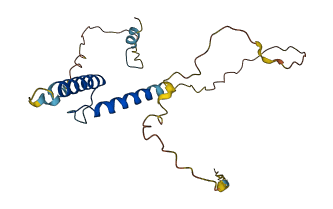
Descriptions
The autoinhibited protein was predicted that may have potential autoinhibitory elements via cis-regPred.
Autoinhibitory domains (AIDs)
Target domain |
|
Relief mechanism |
|
Assay |
cis-regPred |
Accessory elements
No accessory elements
Autoinhibited structure

Activated structure
1 structures for P97832
| Entry ID | Method | Resolution | Chain | Position | Source |
|---|---|---|---|---|---|
| AF-P97832-F1 | Predicted | AlphaFoldDB |
No variants for P97832
| Variant ID(s) | Position | Change | Description | Diseaes Association | Provenance |
|---|---|---|---|---|---|
| No variants for P97832 | |||||
No associated diseases with P97832
1 regional properties for P97832
| Type | Name | Position | InterPro Accession |
|---|---|---|---|
| active_site | Phenylalanine/histidine ammonia-lyases, active site | 186 - 202 | IPR022313 |
Functions
5 GO annotations of cellular component
| Name | Definition |
|---|---|
| cytoplasm | The contents of a cell excluding the plasma membrane and nucleus, but including other subcellular structures. |
| nucleolus | A small, dense body one or more of which are present in the nucleus of eukaryotic cells. It is rich in RNA and protein, is not bounded by a limiting membrane, and is not seen during mitosis. Its prime function is the transcription of the nucleolar DNA into 45S ribosomal-precursor RNA, the processing of this RNA into 5.8S, 18S, and 28S components of ribosomal RNA, and the association of these components with 5S RNA and proteins synthesized outside the nucleolus. This association results in the formation of ribonucleoprotein precursors; these pass into the cytoplasm and mature into the 40S and 60S subunits of the ribosome. |
| nucleoplasm | That part of the nuclear content other than the chromosomes or the nucleolus. |
| nucleus | A membrane-bounded organelle of eukaryotic cells in which chromosomes are housed and replicated. In most cells, the nucleus contains all of the cell's chromosomes except the organellar chromosomes, and is the site of RNA synthesis and processing. In some species, or in specialized cell types, RNA metabolism or DNA replication may be absent. |
| RNA polymerase II transcription regulator complex | A transcription factor complex that acts at a regulatory region of a gene transcribed by RNA polymerase II. |
13 GO annotations of molecular function
| Name | Definition |
|---|---|
| bHLH transcription factor binding | Binding to a basic Helix-Loop-Helix (bHLH) superfamily of transcription factors, important regulatory components in transcriptional networks of many developmental pathways. |
| DNA binding | Any molecular function by which a gene product interacts selectively and non-covalently with DNA (deoxyribonucleic acid). |
| DNA-binding transcription activator activity, RNA polymerase II-specific | A DNA-binding transcription factor activity that activates or increases transcription of specific gene sets transcribed by RNA polymerase II. |
| DNA-binding transcription factor activity, RNA polymerase II-specific | A DNA-binding transcription factor activity that modulates the transcription of specific gene sets transcribed by RNA polymerase II. |
| DNA-binding transcription repressor activity, RNA polymerase II-specific | A DNA-binding transcription factor activity that represses or decreases the transcription of specific gene sets transcribed by RNA polymerase II. |
| enzyme binding | Binding to an enzyme, a protein with catalytic activity. |
| identical protein binding | Binding to an identical protein or proteins. |
| protein homodimerization activity | Binding to an identical protein to form a homodimer. |
| RNA polymerase II cis-regulatory region sequence-specific DNA binding | Binding to a specific upstream regulatory DNA sequence (transcription factor recognition sequence or binding site) located in cis relative to the transcription start site (i.e., on the same strand of DNA) of a gene transcribed by RNA polymerase II. |
| RNA polymerase II transcription regulatory region sequence-specific DNA binding | Binding to a specific sequence of DNA that is part of a regulatory region that controls the transcription of a gene or cistron by RNA polymerase II. |
| RNA polymerase II-specific DNA-binding transcription factor binding | Binding to a sequence-specific DNA binding RNA polymerase II transcription factor, any of the factors that interact selectively and non-covalently with a specific DNA sequence in order to modulate transcription. |
| sequence-specific DNA binding | Binding to DNA of a specific nucleotide composition, e.g. GC-rich DNA binding, or with a specific sequence motif or type of DNA e.g. promotor binding or rDNA binding. |
| transcription coregulator binding | Binding to a transcription coregulator, a protein involved in regulation of transcription via protein-protein interactions with transcription factors and other transcription regulatory proteins. Cofactors do not bind DNA directly, but rather mediate protein-protein interactions between regulatory transcription factors and the basal transcription machinery. |
26 GO annotations of biological process
| Name | Definition |
|---|---|
| angiogenesis | Blood vessel formation when new vessels emerge from the proliferation of pre-existing blood vessels. |
| blastocyst development | The process whose specific outcome is the progression of the blastocyst over time, from its formation to the mature structure. The mammalian blastocyst is a hollow ball of cells containing two cell types, the inner cell mass and the trophectoderm. |
| cardiac left ventricle formation | The developmental process pertaining to the initial formation of a left cardiac ventricle from unspecified parts. |
| cardiac right ventricle formation | The developmental process pertaining to the initial formation of a right cardiac ventricle from unspecified parts. |
| cardiac septum morphogenesis | The process in which the anatomical structure of a cardiac septum is generated and organized. A cardiac septum is a partition that separates parts of the heart. |
| cartilage morphogenesis | The process in which the anatomical structures of cartilage are generated and organized. |
| cell differentiation | The process in which relatively unspecialized cells, e.g. embryonic or regenerative cells, acquire specialized structural and/or functional features that characterize the cells, tissues, or organs of the mature organism or some other relatively stable phase of the organism's life history. Differentiation includes the processes involved in commitment of a cell to a specific fate and its subsequent development to the mature state. |
| determination of heart left/right asymmetry | Determination of the asymmetric location of the heart with respect to the left and right halves of the organism. |
| developmental process | A biological process whose specific outcome is the progression of an integrated living unit: an anatomical structure (which may be a subcellular structure, cell, tissue, or organ), or organism over time from an initial condition to a later condition. |
| embryonic heart tube development | The process whose specific outcome is the progression of the embryonic heart tube over time, from its formation to the mature structure. The heart tube forms as the heart rudiment from the heart field. |
| embryonic heart tube formation | The process that gives rise to the embryonic heart tube. This process pertains to the initial formation of a structure from unspecified parts. The embryonic heart tube is an epithelial tube that will give rise to the mature heart. |
| heart development | The process whose specific outcome is the progression of the heart over time, from its formation to the mature structure. The heart is a hollow, muscular organ, which, by contracting rhythmically, keeps up the circulation of the blood. |
| heart looping | The tube morphogenesis process in which the primitive heart tube loops asymmetrically. This looping brings the primitive heart chambers into alignment preceding their future integration. Heart looping begins with dextral-looping and ends when the main regional divisions of the mature heart and primordium of the great arterial trunks become established preceeding septation. |
| in utero embryonic development | The process whose specific outcome is the progression of the embryo in the uterus over time, from formation of the zygote in the oviduct, to birth. An example of this process is found in Mus musculus. |
| mesenchyme development | The process whose specific outcome is the progression of a mesenchymal tissue over time, from its formation to the mature structure. A mesenchymal tissue is made up of loosely packed stellate cells. |
| mesoderm formation | The process that gives rise to the mesoderm. This process pertains to the initial formation of the structure from unspecified parts. |
| negative regulation of DNA-binding transcription factor activity | Any process that stops, prevents, or reduces the frequency, rate or extent of the activity of a transcription factor, any factor involved in the initiation or regulation of transcription. |
| negative regulation of DNA-templated transcription | Any process that stops, prevents, or reduces the frequency, rate or extent of cellular DNA-templated transcription. |
| negative regulation of RNA polymerase II regulatory region sequence-specific DNA binding | Any process that stops, prevents or reduces the frequency, rate or extent of RNA polymerase II regulatory region sequence-specific DNA binding. |
| negative regulation of transcription by RNA polymerase II | Any process that stops, prevents, or reduces the frequency, rate or extent of transcription mediated by RNA polymerase II. |
| odontogenesis of dentin-containing tooth | The process whose specific outcome is the progression of a dentin-containing tooth over time, from its formation to the mature structure. A dentin-containing tooth is a hard, bony organ borne on the jaw or other bone of a vertebrate, and is composed mainly of dentin, a dense calcified substance, covered by a layer of enamel. |
| positive regulation of transcription by RNA polymerase II | Any process that activates or increases the frequency, rate or extent of transcription from an RNA polymerase II promoter. |
| regulation of transcription by RNA polymerase II | Any process that modulates the frequency, rate or extent of transcription mediated by RNA polymerase II. |
| trophectodermal cell differentiation | The process in which a relatively unspecialized cell acquires the specialized features of a trophectoderm cell. |
| trophoblast giant cell differentiation | The process in which a relatively unspecialized cell acquires specialized features of a trophoblast giant cell of the placenta. Trophoblast giant cells are the cell of the placenta that line the maternal decidua. |
| ventricular cardiac muscle tissue morphogenesis | The process in which the anatomical structures of cardiac ventricle muscle is generated and organized. |
5 homologous proteins in AiPD
| UniProt AC | Gene Name | Protein Name | Species | Evidence Code |
|---|---|---|---|---|
| Q0VCE2 | HAND1 | Heart- and neural crest derivatives-expressed protein 1 | Bos taurus (Bovine) | PR |
| Q90691 | HAND1 | Heart- and neural crest derivatives-expressed protein 1 | Gallus gallus (Chicken) | PR |
| O96004 | HAND1 | Heart- and neural crest derivatives-expressed protein 1 | Homo sapiens (Human) | PR |
| Q9JLR5 | Tcf23 | Transcription factor 23 | Mus musculus (Mouse) | PR |
| Q64279 | Hand1 | Heart- and neural crest derivatives-expressed protein 1 | Mus musculus (Mouse) | PR |
| 10 | 20 | 30 | 40 | 50 | 60 |
| MNLVGSYAHH | HHHHHSHPPH | PMLHEPFLFG | PASRCHQERP | YFQSWLLSPA | DAAPDFPAGG |
| 70 | 80 | 90 | 100 | 110 | 120 |
| PPPTTAVAAA | AYGPDARPSQ | SPGRLEALGG | RLPRRKGSGP | KKERRRTESI | NSAFAELREC |
| 130 | 140 | 150 | 160 | 170 | 180 |
| IPNVPADTKL | SKIKTLRLAT | SYIAYLMDVL | AKDAQAGDPE | AFKAELKKTD | GGRESKRKRE |
| 190 | 200 | 210 | |||
| SPQQHEGLPP | ALGPSEKRIK | GRTGWPQQVW | ALELNQ |