P97467
Gene name |
Pam |
Protein name |
Peptidyl-glycine alpha-amidating monooxygenase |
Names |
PAM |
Species |
Mus musculus (Mouse) |
KEGG Pathway |
mmu:18484 |
EC number |
1.14.17.3: With reduced ascorbate as one donor, and incorporation of one atom of oxygen |
Protein Class |
|
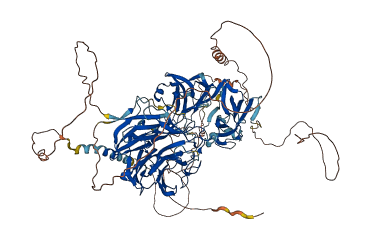
Descriptions
The autoinhibited protein was predicted that may have potential autoinhibitory elements via cis-regPred.
Autoinhibitory domains (AIDs)
Target domain |
|
Relief mechanism |
|
Assay |
cis-regPred |
Accessory elements
No accessory elements
Autoinhibited structure

Activated structure
1 structures for P97467
| Entry ID | Method | Resolution | Chain | Position | Source |
|---|---|---|---|---|---|
| AF-P97467-F1 | Predicted | AlphaFoldDB |
68 variants for P97467
| Variant ID(s) | Position | Change | Description | Diseaes Association | Provenance |
|---|---|---|---|---|---|
| rs249638524 | 50 | T>I | No | EVA | |
| rs3388492486 | 93 | V>M | No | EVA | |
| rs3388490175 | 102 | M>T | No | EVA | |
| rs3388493548 | 108 | M>I | No | EVA | |
| rs3388491779 | 130 | C>Y | No | EVA | |
| rs3388491004 | 147 | T>P | No | EVA | |
| rs3388491471 | 251 | G>D | No | EVA | |
| rs3388491471 | 251 | G>DG* | No | EVA | |
| rs3388492024 | 252 | Y>* | No | EVA | |
| rs3388491741 | 254 | V>A | No | EVA | |
| rs3388494344 | 259 | W>* | No | EVA | |
| rs3388490189 | 260 | T>R | No | EVA | |
| rs3388491718 | 262 | I>V | No | EVA | |
| rs3388494311 | 286 | D>N | No | EVA | |
| rs219176258 | 293 | V>M | No | EVA | |
| rs3388492319 | 297 | E>V | No | EVA | |
| rs3388494355 | 319 | M>I | No | EVA | |
| rs3388491989 | 330 | F>Y | No | EVA | |
| rs3388491793 | 332 | T>I | No | EVA | |
| rs222669691 | 388 | A>V | No | EVA | |
| rs3388490634 | 415 | N>K | No | EVA | |
| rs8239087 | 419 | K>R | No | EVA | |
| rs38444704 | 433 | V>I | No | EVA | |
| rs225976582 | 448 | A>T | No | EVA | |
| rs8239088 | 450 | H>R | No | EVA | |
| rs3388494485 | 484 | Q>H | No | EVA | |
| rs8239089 | 484 | Q>R | No | EVA | |
| rs3388490578 | 486 | P>S | No | EVA | |
| rs36911792 | 491 | W>R | No | EVA | |
| rs214058782 | 495 | L>P | No | EVA | |
| rs3388492528 | 551 | Q>* | No | EVA | |
| rs3388489043 | 574 | Q>R | No | EVA | |
| rs3388491415 | 581 | F>E | No | EVA | |
| rs3388489020 | 582 | Y>S | No | EVA | |
| rs3388490546 | 610 | P>S | No | EVA | |
| rs215275920 | 611 | R>H | No | EVA | |
| rs3388494474 | 614 | E>D | No | EVA | |
| rs252078021 | 626 | P>A | No | EVA | |
| rs3412803299 | 636 | P>T | No | EVA | |
| rs3390367113 | 638 | D>S | No | EVA | |
| rs3388490635 | 640 | A>T | No | EVA | |
| rs36292592 | 642 | E>D | No | EVA | |
| rs3388494481 | 650 | V>M | No | EVA | |
| rs3388491560 | 656 | N>S | No | EVA | |
| rs36321707 | 660 | V>M | No | EVA | |
| rs8239091 | 664 | P>L | No | EVA | |
| rs3388489092 | 680 | S>G | No | EVA | |
| rs3388491945 | 688 | V>D | No | EVA | |
| rs3412985799 | 694 | L>H | No | EVA | |
| rs3388491592 | 722 | V>A | No | EVA | |
| rs3388490221 | 748 | N>H | No | EVA | |
| rs3388492052 | 789 | V>L | No | EVA | |
| rs3388494381 | 793 | D>H | No | EVA | |
| rs3388490279 | 796 | V>M | No | EVA | |
| rs3388491430 | 811 | L>P | No | EVA | |
| rs3388492542 | 811 | L>V | No | EVA | |
| rs3388490459 | 812 | T>N | No | EVA | |
| rs3388492533 | 824 | K>R | No | EVA | |
| rs3388489021 | 825 | K>T | No | EVA | |
| rs3388492379 | 854 | Q>* | No | EVA | |
| rs3388490305 | 862 | L>M | No | EVA | |
| rs3388490561 | 865 | D>Y | No | EVA | |
| rs3388490330 | 877 | T>I | No | EVA | |
| rs3388490478 | 900 | A>V | No | EVA | |
| rs3388489088 | 906 | R>L | No | EVA | |
| rs259401642 | 919 | L>F | No | EVA | |
| rs3388490325 | 944 | F>I | No | EVA | |
| rs3388494374 | 950 | E>G | No | EVA |
No associated diseases with P97467
8 regional properties for P97467
| Type | Name | Position | InterPro Accession |
|---|---|---|---|
| domain | Copper type II, ascorbate-dependent monooxygenase, N-terminal | 64 - 175 | IPR000323 |
| repeat | NHL repeat | 570 - 611 | IPR001258-1 |
| repeat | NHL repeat | 620 - 665 | IPR001258-2 |
| repeat | NHL repeat | 673 - 717 | IPR001258-3 |
| repeat | NHL repeat | 769 - 812 | IPR001258-4 |
| conserved_site | Copper type II, ascorbate-dependent monooxygenase, histidine-cluster-2 conserved site | 234 - 246 | IPR014783 |
| conserved_site | Copper type II, ascorbate-dependent monooxygenase, histidine-cluster-1 conserved site | 106 - 113 | IPR020611 |
| domain | Copper type II ascorbate-dependent monooxygenase, C-terminal | 201 - 344 | IPR024548 |
Functions
| Description | ||
|---|---|---|
| EC Number | 1.14.17.3 | With reduced ascorbate as one donor, and incorporation of one atom of oxygen |
| Subcellular Localization |
|
|
| PANTHER Family | ||
| PANTHER Subfamily | ||
| PANTHER Protein Class | ||
| PANTHER Pathway Category | No pathway information available | |
14 GO annotations of cellular component
| Name | Definition |
|---|---|
| cell surface | The external part of the cell wall and/or plasma membrane. |
| cytosol | The part of the cytoplasm that does not contain organelles but which does contain other particulate matter, such as protein complexes. |
| extracellular region | The space external to the outermost structure of a cell. For cells without external protective or external encapsulating structures this refers to space outside of the plasma membrane. This term covers the host cell environment outside an intracellular parasite. |
| extracellular space | That part of a multicellular organism outside the cells proper, usually taken to be outside the plasma membranes, and occupied by fluid. |
| integral component of plasma membrane | The component of the plasma membrane consisting of the gene products and protein complexes having at least some part of their peptide sequence embedded in the hydrophobic region of the membrane. |
| neuron projection | A prolongation or process extending from a nerve cell, e.g. an axon or dendrite. |
| neuronal cell body | The portion of a neuron that includes the nucleus, but excludes cell projections such as axons and dendrites. |
| perikaryon | The portion of the cell soma (neuronal cell body) that excludes the nucleus. |
| perinuclear region of cytoplasm | Cytoplasm situated near, or occurring around, the nucleus. |
| plasma membrane | The membrane surrounding a cell that separates the cell from its external environment. It consists of a phospholipid bilayer and associated proteins. |
| secretory granule | A small subcellular vesicle, surrounded by a membrane, that is formed from the Golgi apparatus and contains a highly concentrated protein destined for secretion. Secretory granules move towards the periphery of the cell and upon stimulation, their membranes fuse with the cell membrane, and their protein load is exteriorized. Processing of the contained protein may take place in secretory granules. |
| secretory granule membrane | The lipid bilayer surrounding a secretory granule. |
| trans-Golgi network | The network of interconnected tubular and cisternal structures located within the Golgi apparatus on the side distal to the endoplasmic reticulum, from which secretory vesicles emerge. The trans-Golgi network is important in the later stages of protein secretion where it is thought to play a key role in the sorting and targeting of secreted proteins to the correct destination. |
| transport vesicle membrane | The lipid bilayer surrounding a transport vesicle. |
8 GO annotations of molecular function
| Name | Definition |
|---|---|
| calcium ion binding | Binding to a calcium ion (Ca2+). |
| copper ion binding | Binding to a copper (Cu) ion. |
| identical protein binding | Binding to an identical protein or proteins. |
| L-ascorbic acid binding | Binding to L-ascorbic acid, (2R)-2-[(1S)-1,2-dihydroxyethyl]-4-hydroxy-5-oxo-2,5-dihydrofuran-3-olate; L-ascorbic acid is vitamin C and has co-factor and anti-oxidant activities in many species. |
| peptidylamidoglycolate lyase activity | Catalysis of the reaction: peptidylamidoglycolate = peptidyl amide + glyoxylate. |
| peptidylglycine monooxygenase activity | Catalysis of the reaction: peptidyl-glycine + ascorbate + O2 = peptidyl(2-hydroxyglycine) + dehydroascorbate + H2O. |
| protein kinase binding | Binding to a protein kinase, any enzyme that catalyzes the transfer of a phosphate group, usually from ATP, to a protein substrate. |
| zinc ion binding | Binding to a zinc ion (Zn). |
24 GO annotations of biological process
| Name | Definition |
|---|---|
| central nervous system development | The process whose specific outcome is the progression of the central nervous system over time, from its formation to the mature structure. The central nervous system is the core nervous system that serves an integrating and coordinating function. In vertebrates it consists of the brain and spinal cord. In those invertebrates with a central nervous system it typically consists of a brain, cerebral ganglia and a nerve cord. |
| fatty acid primary amide biosynthetic process | The chemical reactions and pathways resulting in the formation of a fatty acid primary amide. |
| heart development | The process whose specific outcome is the progression of the heart over time, from its formation to the mature structure. The heart is a hollow, muscular organ, which, by contracting rhythmically, keeps up the circulation of the blood. |
| lactation | The regulated release of milk from the mammary glands and the period of time that a mother lactates to feed her young. |
| limb development | The process whose specific outcome is the progression of a limb over time, from its formation to the mature structure. A limb is an appendage of an animal used for locomotion or grasping. Examples include legs, arms or some types of fin. |
| long-chain fatty acid metabolic process | The chemical reactions and pathways involving long-chain fatty acids, A long-chain fatty acid is a fatty acid with a chain length between C13 and C22. |
| maternal process involved in female pregnancy | A reproductive process occurring in the mother that allows an embryo or fetus to develop within it. |
| odontogenesis | The process whose specific outcome is the progression of a tooth or teeth over time, from formation to the mature structure(s). A tooth is any hard bony, calcareous, or chitinous organ found in the mouth or pharynx of an animal and used in procuring or masticating food. |
| ovulation cycle process | A process involved in the sexual cycle seen in females, often with physiologic changes in the endometrium that recur at regular intervals during the reproductive years. |
| peptide amidation | The posttranslational conversion of C-terminal glycine-extended peptides to C-terminal alpha-amidated peptides. Occurs to over half of all peptide hormones to give bioactive peptides. This is a two step process catalyzed by a peptidyl-glycine alpha-hydroxylating monooxygenase and a peptidyl-alpha-hydroxyglycine alpha-amidating lyase. In some organisms, this process is catalyzed by two separate enzymes, whereas in higher organisms, one polypeptide catalyzes both reactions. |
| peptide metabolic process | The chemical reactions and pathways involving peptides, compounds of two or more amino acids where the alpha carboxyl group of one is bound to the alpha amino group of another. |
| protein amidation | Addition of an amide group from a glycine to a protein amino acid. |
| protein metabolic process | The chemical reactions and pathways involving a protein. Includes protein modification. |
| regulation of actin cytoskeleton organization | Any process that modulates the frequency, rate or extent of the formation, arrangement of constituent parts, or disassembly of cytoskeletal structures comprising actin filaments and their associated proteins. |
| regulation of protein secretion | Any process that modulates the frequency, rate or extent of the controlled release of a protein from a cell. |
| regulation of transcription by RNA polymerase II | Any process that modulates the frequency, rate or extent of transcription mediated by RNA polymerase II. |
| response to copper ion | Any process that results in a change in state or activity of a cell or an organism (in terms of movement, secretion, enzyme production, gene expression, etc.) as a result of a copper ion stimulus. |
| response to estradiol | Any process that results in a change in state or activity of a cell or an organism (in terms of movement, secretion, enzyme production, gene expression, etc.) as a result of stimulus by estradiol, a C18 steroid hormone hydroxylated at C3 and C17 that acts as a potent estrogen. |
| response to glucocorticoid | Any process that results in a change in state or activity of a cell or an organism (in terms of movement, secretion, enzyme production, gene expression, etc.) as a result of a glucocorticoid stimulus. Glucocorticoids are hormonal C21 corticosteroids synthesized from cholesterol with the ability to bind with the cortisol receptor and trigger similar effects. Glucocorticoids act primarily on carbohydrate and protein metabolism, and have anti-inflammatory effects. |
| response to hypoxia | Any process that results in a change in state or activity of a cell or an organism (in terms of movement, secretion, enzyme production, gene expression, etc.) as a result of a stimulus indicating lowered oxygen tension. Hypoxia, defined as a decline in O2 levels below normoxic levels of 20.8 - 20.95%, results in metabolic adaptation at both the cellular and organismal level. |
| response to pH | Any process that results in a change in state or activity of a cell or an organism (in terms of movement, secretion, enzyme production, gene expression, etc.) as a result of a pH stimulus. pH is a measure of the acidity or basicity of an aqueous solution. |
| response to xenobiotic stimulus | Any process that results in a change in state or activity of a cell or an organism (in terms of movement, secretion, enzyme production, gene expression, etc.) as a result of a stimulus from a xenobiotic, a compound foreign to the organim exposed to it. It may be synthesized by another organism (like ampicilin) or it can be a synthetic chemical. |
| response to zinc ion | Any process that results in a change in state or activity of a cell or an organism (in terms of movement, secretion, enzyme production, gene expression, etc.) as a result of a zinc ion stimulus. |
| toxin metabolic process | The chemical reactions and pathways involving a toxin, a poisonous compound (typically a protein) that is produced by cells or organisms and that can cause disease when introduced into the body or tissues of an organism. |
| 10 | 20 | 30 | 40 | 50 | 60 |
| MAGRARSRLL | LLLGLLALQS | SCLAFRSPLS | VFKRFKETTR | SFSNECLGTT | RPITPIDSSD |
| 70 | 80 | 90 | 100 | 110 | 120 |
| FTLDIRMPGV | TPKESDTYFC | MSMRLPVDEE | AFVIDFKPRA | SMDTVHHMLL | FGCNMPSSTG |
| 130 | 140 | 150 | 160 | 170 | 180 |
| SYWFCDEGTC | TDKANILYAW | ARNAPPTRLP | KGVGFRVGGE | TGSKYFVLQV | HYGDISAFRD |
| 190 | 200 | 210 | 220 | 230 | 240 |
| NHKDCSGVSL | HLTRVPQPLI | AGMYLMMSVN | TVIPPGEKVV | NSDISCHYKM | YPMHVFAYRV |
| 250 | 260 | 270 | 280 | 290 | 300 |
| HTHHLGKVVS | GYRVRNGQWT | LIGRQSPQLP | QAFYPVEHPV | DVAFGDILAA | RCVFTGEGRT |
| 310 | 320 | 330 | 340 | 350 | 360 |
| EATHIGGTSS | DEMCNLYIMY | YMEAKHAVSF | MTCTQNVAPD | MFRTIPEEAN | IPIPVKSDMV |
| 370 | 380 | 390 | 400 | 410 | 420 |
| MIHGHHKETE | NKEKSALIQQ | PKQGEEEAFE | QGDFYSLLSK | LLGEREDVVH | VHKYNPTEKT |
| 430 | 440 | 450 | 460 | 470 | 480 |
| ESGSDLVAEI | ANVVQKKDLG | RSDAREGAEH | EEGGNAILVR | DRIHKFHRLE | STLRPAESRA |
| 490 | 500 | 510 | 520 | 530 | 540 |
| LSFQQPGEGP | WEPELAGDFH | VEEALEWPGV | YLLPGQVSGV | ALDSKNNLVI | FHRGDHVWDG |
| 550 | 560 | 570 | 580 | 590 | 600 |
| NSFDSKFVYQ | QRGLGPIEED | TILVIDPNKA | EILQSSGKNL | FYLPHGLSID | TDGNYWVTDV |
| 610 | 620 | 630 | 640 | 650 | 660 |
| ALHQVFKLEP | RSKEGPLLVL | GRSMQPGSDQ | NHFCQPTDVA | VEPSTGAVFV | SDGYCNSRIV |
| 670 | 680 | 690 | 700 | 710 | 720 |
| QFSPSGKFIT | QWGEESSGSS | PKPGQFSVPH | SLALVPHLNQ | LCVADRENGR | IQCFKTDTKE |
| 730 | 740 | 750 | 760 | 770 | 780 |
| FVREIKHASF | GRNVFAISYI | PGFLFAVNGK | PYFGDQEPVQ | GFVMNFSSGE | IIDVFKPVRK |
| 790 | 800 | 810 | 820 | 830 | 840 |
| HFDMPHDIVA | SEDGTVYIGD | AHTNTVWKFT | LTESRLEVEH | RSVKKAGIEV | PEIKEAEAVV |
| 850 | 860 | 870 | 880 | 890 | 900 |
| EPKVKNKPTS | SELQKMQEKK | KLIKDPGSGV | PVVLITTLLV | IPVVVLLAIA | MFIRWKKSRA |
| 910 | 920 | 930 | 940 | 950 | 960 |
| FGDHDRKLES | SSGRVLGRLR | GKGSSGLNLG | NFFASRKGYS | RKGFDRVSTE | GSDQEKDEDD |
| 970 | |||||
| GSESEEEYSA | PLPTPAPSS |