P75898
Gene name |
rutA (ycdM, b1012, JW0997) |
Protein name |
Pyrimidine monooxygenase RutA |
Names |
|
Species |
Escherichia coli (strain K12) |
KEGG Pathway |
eco:b1012 |
EC number |
1.14.99.46: Miscellaneous |
Protein Class |
|
Descriptions
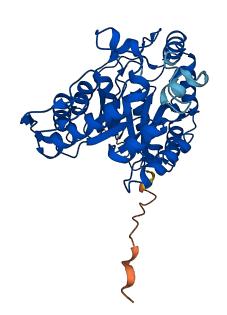
The autoinhibited protein was predicted that may have potential autoinhibitory elements via cis-regPred.
Autoinhibitory domains (AIDs)
Target domain |
|
Relief mechanism |
|
Assay |
cis-regPred |
Accessory elements
No accessory elements
Autoinhibited structure

Activated structure
9 structures for P75898
| Entry ID | Method | Resolution | Chain | Position | Source |
|---|---|---|---|---|---|
| 5WAN | X-ray | 180 A | A | 2-382 | PDB |
| 6SGG | X-ray | 180 A | AAA | 20-382 | PDB |
| 6SGL | X-ray | 201 A | AAA | 19-382 | PDB |
| 6SGM | X-ray | 200 A | AAA | 20-382 | PDB |
| 6SGN | X-ray | 250 A | AAA | 20-382 | PDB |
| 6TEE | X-ray | 220 A | AAA | 20-382 | PDB |
| 6TEF | X-ray | 180 A | AAA | 19-382 | PDB |
| 6TEG | X-ray | 180 A | AAA | 19-382 | PDB |
| AF-P75898-F1 | Predicted | AlphaFoldDB |
No variants for P75898
| Variant ID(s) | Position | Change | Description | Diseaes Association | Provenance |
|---|---|---|---|---|---|
| No variants for P75898 | |||||
No associated diseases with P75898
1 regional properties for P75898
| Type | Name | Position | InterPro Accession |
|---|---|---|---|
| domain | Luciferase-like domain | 20 - 339 | IPR011251 |
Functions
| Description | ||
|---|---|---|
| EC Number | 1.14.99.46 | Miscellaneous |
| Subcellular Localization |
|
|
| PANTHER Family | ||
| PANTHER Subfamily | ||
| PANTHER Protein Class | ||
| PANTHER Pathway Category | No pathway information available | |
No GO annotations of cellular component
| Name | Definition |
|---|---|
| No GO annotations for cellular component |
3 GO annotations of molecular function
| Name | Definition |
|---|---|
| alkanesulfonate monooxygenase activity | Catalysis of the reaction: an alkanesulfonate + O2 + FMNH2 = an aldehyde + sulfite + H2O + FMN. |
| monooxygenase activity | Catalysis of the incorporation of one atom from molecular oxygen into a compound and the reduction of the other atom of oxygen to water. |
| uracil oxygenase activity | Catalysis of the reaction: uracil + NADH + O2 + H+ = ureidoacrylate peracid + NAD+. Ureidoacrylate peracid is spontaneously reduced by NADH to form ureidoacrylate. |
5 GO annotations of biological process
| Name | Definition |
|---|---|
| alkanesulfonate catabolic process | The chemical reactions and pathways resulting in the breakdown of alkanesulfonates, the anion of alkanesulfonic acids, sulfonic acid derivatives containing an aliphatic hydrocarbon group. |
| nitrogen utilization | A series of processes that forms an integrated mechanism by which a cell or an organism detects the depletion of primary nitrogen source, usually ammonia, and then activates genes to scavenge the last traces of the primary nitrogen source and to transport and metabolize alternative nitrogen sources. The utilization process begins when the cell or organism detects nitrogen levels, includes the activation of genes whose products detect, transport or metabolize nitrogen-containing substances, and ends when nitrogen is incorporated into the cell or organism's metabolism. |
| pyrimidine nucleobase catabolic process | The chemical reactions and pathways resulting in the breakdown of pyrimidine nucleobases, 1,3-diazine, organic nitrogenous bases. |
| thymine catabolic process | The chemical reactions and pathways resulting in the breakdown of thymine, 5-methyluracil, one of the two major pyrimidine bases present (as thymidine) in DNA but not found in RNA other than (as ribothymidine) in transfer RNA, where it is a minor base. |
| uracil catabolic process | The chemical reactions and pathways resulting in the breakdown of uracil, 2,4-dioxopyrimidine, one of the pyrimidine bases occurring in RNA, but not in DNA. |
1 homologous proteins in AiPD
| UniProt AC | Gene Name | Protein Name | Species | Evidence Code |
|---|---|---|---|---|
| P80645 | ssuD | Alkanesulfonate monooxygenase | Escherichia coli (strain K12) | PR |
| 10 | 20 | 30 | 40 | 50 | 60 |
| MQDAAPRLTF | TLRDEERLMM | KIGVFVPIGN | NGWLISTHAP | QYMPTFELNK | AIVQKAEHYH |
| 70 | 80 | 90 | 100 | 110 | 120 |
| FDFALSMIKL | RGFGGKTEFW | DHNLESFTLM | AGLAAVTSRI | QIYATAATLT | LPPAIVARMA |
| 130 | 140 | 150 | 160 | 170 | 180 |
| ATIDSISGGR | FGVNLVTGWQ | KPEYEQMGIW | PGDDYFSRRY | DYLTEYVQVL | RDLWGTGKSD |
| 190 | 200 | 210 | 220 | 230 | 240 |
| FKGDFFTMND | CRVSPQPSVP | MKVICAGQSD | AGMAFSARYA | DFNFCFGKGV | NTPTAFAPTA |
| 250 | 260 | 270 | 280 | 290 | 300 |
| ARMKQAAEQT | GRDVGSYVLF | MVIADETDDA | ARAKWEHYKA | GADEEALSWL | TEQSQKDTRS |
| 310 | 320 | 330 | 340 | 350 | 360 |
| GTDTNVRQMA | DPTSAVNINM | GTLVGSYASV | ARMLDEVASV | PGAEGVLLTF | DDFLSGIETF |
| 370 | 380 | ||||
| GERIQPLMQC | RAHLPALTQE | VA |