Descriptions
The autoinhibited protein was predicted that may have potential autoinhibitory elements via cis-regPred.
Autoinhibitory domains (AIDs)
Target domain |
|
Relief mechanism |
|
Assay |
cis-regPred |
Accessory elements
No accessory elements
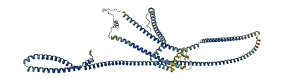
Autoinhibited structure

Activated structure
1 structures for P70403
| Entry ID | Method | Resolution | Chain | Position | Source |
|---|---|---|---|---|---|
| AF-P70403-F1 | Predicted | AlphaFoldDB |
No variants for P70403
| Variant ID(s) | Position | Change | Description | Diseaes Association | Provenance |
|---|---|---|---|---|---|
| No variants for P70403 | |||||
No associated diseases with P70403
1 regional properties for P70403
| Type | Name | Position | InterPro Accession |
|---|---|---|---|
| domain | CASP, C-terminal | 423 - 641 | IPR012955 |
7 GO annotations of cellular component
| Name | Definition |
|---|---|
| cytoplasm | The contents of a cell excluding the plasma membrane and nucleus, but including other subcellular structures. |
| Golgi apparatus | A membrane-bound cytoplasmic organelle of the endomembrane system that further processes the core oligosaccharides (e.g. N-glycans) added to proteins in the endoplasmic reticulum and packages them into membrane-bound vesicles. The Golgi apparatus operates at the intersection of the secretory, lysosomal, and endocytic pathways. |
| Golgi membrane | The lipid bilayer surrounding any of the compartments of the Golgi apparatus. |
| integral component of Golgi membrane | The component of the Golgi membrane consisting of the gene products and protein complexes having at least some part of their peptide sequence embedded in the hydrophobic region of the membrane. |
| neuron projection | A prolongation or process extending from a nerve cell, e.g. an axon or dendrite. |
| nucleoplasm | That part of the nuclear content other than the chromosomes or the nucleolus. |
| nucleus | A membrane-bounded organelle of eukaryotic cells in which chromosomes are housed and replicated. In most cells, the nucleus contains all of the cell's chromosomes except the organellar chromosomes, and is the site of RNA synthesis and processing. In some species, or in specialized cell types, RNA metabolism or DNA replication may be absent. |
8 GO annotations of molecular function
| Name | Definition |
|---|---|
| chromatin binding | Binding to chromatin, the network of fibers of DNA, protein, and sometimes RNA, that make up the chromosomes of the eukaryotic nucleus during interphase. |
| DNA binding | Any molecular function by which a gene product interacts selectively and non-covalently with DNA (deoxyribonucleic acid). |
| DNA-binding transcription factor activity, RNA polymerase II-specific | A DNA-binding transcription factor activity that modulates the transcription of specific gene sets transcribed by RNA polymerase II. |
| protein-macromolecule adaptor activity | The binding activity of a protein that brings together two or more macromolecules in contact, permitting those molecules to function in a coordinated way. The adaptor can bring together two proteins, or a protein and another macromolecule such as a lipid or a nucleic acid. |
| RNA polymerase II cis-regulatory region sequence-specific DNA binding | Binding to a specific upstream regulatory DNA sequence (transcription factor recognition sequence or binding site) located in cis relative to the transcription start site (i.e., on the same strand of DNA) of a gene transcribed by RNA polymerase II. |
| RNA polymerase II transcription regulatory region sequence-specific DNA binding | Binding to a specific sequence of DNA that is part of a regulatory region that controls the transcription of a gene or cistron by RNA polymerase II. |
| sequence-specific DNA binding | Binding to DNA of a specific nucleotide composition, e.g. GC-rich DNA binding, or with a specific sequence motif or type of DNA e.g. promotor binding or rDNA binding. |
| sequence-specific double-stranded DNA binding | Binding to double-stranded DNA of a specific nucleotide composition, e.g. GC-rich DNA binding, or with a specific sequence motif or type of DNA, e.g. promotor binding or rDNA binding. |
6 GO annotations of biological process
| Name | Definition |
|---|---|
| inner ear auditory receptor cell differentiation | The process in which a relatively unspecialized inner cell acquires specialized features of an auditory hair cell. |
| kidney development | The process whose specific outcome is the progression of the kidney over time, from its formation to the mature structure. The kidney is an organ that filters the blood and/or excretes the end products of body metabolism in the form of urine. |
| lung development | The process whose specific outcome is the progression of the lung over time, from its formation to the mature structure. In all air-breathing vertebrates the lungs are developed from the ventral wall of the oesophagus as a pouch which divides into two sacs. In amphibians and many reptiles the lungs retain very nearly this primitive sac-like character, but in the higher forms the connection with the esophagus becomes elongated into the windpipe and the inner walls of the sacs become more and more divided, until, in the mammals, the air spaces become minutely divided into tubes ending in small air cells, in the walls of which the blood circulates in a fine network of capillaries. In mammals the lungs are more or less divided into lobes, and each lung occupies a separate cavity in the thorax. |
| negative regulation of transcription by RNA polymerase II | Any process that stops, prevents, or reduces the frequency, rate or extent of transcription mediated by RNA polymerase II. |
| regulation of transcription by RNA polymerase II | Any process that modulates the frequency, rate or extent of transcription mediated by RNA polymerase II. |
| retrograde transport, vesicle recycling within Golgi | The retrograde movement of substances within the Golgi, mediated by COP I vesicles. Cis-Golgi vesicles are constantly moving forward through the Golgi stack by cisternal progression, eventually becoming trans-Golgi vesicles. They then selectively transport membrane and luminal proteins from the trans- to the medial-Golgi while leaving others behind in the trans-Golgi cisternae; similarly, they selectively move proteins from the medial- to the cis-Golgi. |
1 homologous proteins in AiPD
| UniProt AC | Gene Name | Protein Name | Species | Evidence Code |
|---|---|---|---|---|
| Q22812 | ceh-39 | Homeobox protein ceh-39 | Caenorhabditis elegans | PR |
| 10 | 20 | 30 | 40 | 50 | 60 |
| MAANVGSMSQ | YWKRFDLQQL | QRELDAAATV | LANRQDESEQ | SRKRLIEQSR | EFKKNTPEDL |
| 70 | 80 | 90 | 100 | 110 | 120 |
| RKQVAPLLKS | FQGEIDALSK | RSKEAEAAFL | TVYKRLIDVP | DPVPALDVGQ | QLEIKVQRLH |
| 130 | 140 | 150 | 160 | 170 | 180 |
| DIETENQKLR | ETLEEYNKEF | AEVKNQEVTI | KALKEKIREY | EQTLKSQAET | IALEKEQKLQ |
| 190 | 200 | 210 | 220 | 230 | 240 |
| NDFAEKERKL | QETQMSTTSK | LEEAEHKLQT | LQTALEKTRT | ELFDLKTKYD | EETTAKADEI |
| 250 | 260 | 270 | 280 | 290 | 300 |
| EMIMTDLERA | NQRAEVAQRE | AETLREQLSS | ANHSLQLASQ | IQKAPDVEQA | IEVLTRSSLE |
| 310 | 320 | 330 | 340 | 350 | 360 |
| VELAAKEREI | AQLVEDVQRL | QASLTKLREN | SASQISQLEQ | QLNAKNSTLK | QLEEKLKGQA |
| 370 | 380 | 390 | 400 | 410 | 420 |
| DYEEVKKELN | TLKSMEFAPS | EGAGTQDSTK | PLEVLLLEKN | RSLQSENATL | RISNSDLSGR |
| 430 | 440 | 450 | 460 | 470 | 480 |
| CAELQIHLTE | ATAKAVEQKE | LIARLEQDLS | TIQSIQRPDA | EGASEQGLEK | IPEPIKEATA |
| 490 | 500 | 510 | 520 | 530 | 540 |
| LFYGPSMSSS | GTLPEGQVDS | LLSIISSQRE | RFRTRNQELE | AESRMAQHTI | QALQSELDSL |
| 550 | 560 | 570 | 580 | 590 | 600 |
| RADNIKLFEK | IKFLQSYPGR | GIGSDDTELR | YSSQYEERLD | PFSSFSKRER | QRKYLGLSPW |
| 610 | 620 | 630 | 640 | 650 | 660 |
| DKATLGMGRL | ILSNKTARTI | GFFYTLFLHC | LVFLVLYKLA | WSESVERDCA | ATCAKKFADH |
| 670 | |||||
| LHKFHESDNG | AAAGDLWQ |