P70371
Gene name |
Terf1 (Trf1) |
Protein name |
Telomeric repeat-binding factor 1 |
Names |
TTAGGG repeat-binding factor 1 |
Species |
Mus musculus (Mouse) |
KEGG Pathway |
mmu:21749 |
EC number |
|
Protein Class |
|
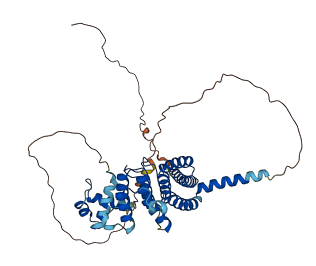
Descriptions
The autoinhibited protein was predicted that may have potential autoinhibitory elements via cis-regPred.
Autoinhibitory domains (AIDs)
Target domain |
|
Relief mechanism |
|
Assay |
cis-regPred |
Accessory elements
No accessory elements
Autoinhibited structure

Activated structure
1 structures for P70371
| Entry ID | Method | Resolution | Chain | Position | Source |
|---|---|---|---|---|---|
| AF-P70371-F1 | Predicted | AlphaFoldDB |
25 variants for P70371
| Variant ID(s) | Position | Change | Description | Diseaes Association | Provenance |
|---|---|---|---|---|---|
| rs32105024 | 15 | R>G | No | EVA | |
| rs241104061 | 17 | G>S | No | EVA | |
| rs3388458446 | 35 | L>M | No | EVA | |
| rs217523877 | 40 | L>I | No | EVA | |
| rs3388458063 | 50 | N>K | No | EVA | |
| rs13475080 | 51 | A>T | No | EVA | |
| rs261211600 | 100 | H>Q | No | EVA | |
| rs3388459710 | 126 | D>V | No | EVA | |
| rs3388458029 | 143 | M>K | No | EVA | |
| rs3388459722 | 149 | E>V | No | EVA | |
| rs227881018 | 185 | E>K | No | EVA | |
| rs32114424 | 221 | S>N | No | EVA | |
| rs3388459422 | 227 | I>F | No | EVA | |
| rs227536614 | 232 | G>D | No | EVA | |
| rs235017557 | 233 | D>Y | No | EVA | |
| rs32114426 | 236 | S>N | No | EVA | |
| rs32114429 | 241 | T>S | No | EVA | |
| rs237177340 | 244 | M>L | No | EVA | |
| rs259394085 | 260 | A>P | No | EVA | |
| rs32116326 | 281 | E>G | No | EVA | |
| rs214707579 | 298 | T>S | No | EVA | |
| rs3388458526 | 306 | K>R | No | EVA | |
| rs226024747 | 314 | H>Q | No | EVA | |
| rs45688773 | 316 | R>S | No | EVA | |
| rs47652592 | 317 | A>V | No | EVA |
No associated diseases with P70371
1 regional properties for P70371
| Type | Name | Position | InterPro Accession |
|---|---|---|---|
| domain | Proteasome component (PCI) domain | 326 - 519 | IPR000717 |
Functions
10 GO annotations of cellular component
| Name | Definition |
|---|---|
| chromosome, telomeric region | The end of a linear chromosome, required for the integrity and maintenance of the end. A chromosome telomere usually includes a region of telomerase-encoded repeats the length of which rarely exceeds 20 bp each and that permits the formation of a telomeric loop (T-loop). The telomeric repeat region is usually preceded by a sub-telomeric region that is gene-poor but rich in repetitive elements. Some telomeres only consist of the latter part (for eg. D. melanogaster telomeres). |
| cytoplasm | The contents of a cell excluding the plasma membrane and nucleus, but including other subcellular structures. |
| fibrillar center | A structure found most metazoan nucleoli, but not usually found in lower eukaryotes; surrounded by the dense fibrillar component; the zone of transcription from multiple copies of the pre-rRNA genes is in the border region between these two structures. |
| nuclear body | Extra-nucleolar nuclear domains usually visualized by confocal microscopy and fluorescent antibodies to specific proteins. |
| nuclear telomere cap complex | A complex of DNA and protein located at the end of a linear chromosome in the nucleus that protects and stabilizes a linear chromosome. |
| nucleolus | A small, dense body one or more of which are present in the nucleus of eukaryotic cells. It is rich in RNA and protein, is not bounded by a limiting membrane, and is not seen during mitosis. Its prime function is the transcription of the nucleolar DNA into 45S ribosomal-precursor RNA, the processing of this RNA into 5.8S, 18S, and 28S components of ribosomal RNA, and the association of these components with 5S RNA and proteins synthesized outside the nucleolus. This association results in the formation of ribonucleoprotein precursors; these pass into the cytoplasm and mature into the 40S and 60S subunits of the ribosome. |
| nucleoplasm | That part of the nuclear content other than the chromosomes or the nucleolus. |
| nucleus | A membrane-bounded organelle of eukaryotic cells in which chromosomes are housed and replicated. In most cells, the nucleus contains all of the cell's chromosomes except the organellar chromosomes, and is the site of RNA synthesis and processing. In some species, or in specialized cell types, RNA metabolism or DNA replication may be absent. |
| shelterin complex | A nuclear telomere cap complex that is formed by the association of telomeric ssDNA- and dsDNA-binding proteins with telomeric DNA, and is involved in telomere protection and recruitment of telomerase. The complex is known to contain TERF1, TERF2, POT1, RAP1, TINF2 and ACD in mammalian cells, and Pot1, Tpz1, Rap1, Rif1, Rif2 and Taz1 in Saccharomyces. Taz1 and Rap1 (or their mammalian equivalents) form a dsDNA-binding subcomplex, Pot1 and Tpz1 form an ssDNA-binding subcomplex, and the two subcomplexes are bridged by Poz1, which acts as an effector molecule along with Ccq1. |
| spindle | The array of microtubules and associated molecules that forms between opposite poles of a eukaryotic cell during mitosis or meiosis and serves to move the duplicated chromosomes apart. |
10 GO annotations of molecular function
| Name | Definition |
|---|---|
| ankyrin repeat binding | Binding to an ankyrin repeat of a protein. Ankyrin repeats are tandemly repeated modules of about 33 amino acids; each repeat folds into a helix-loop-helix structure with a beta-hairpin/loop region projecting out from the helices at a 90-degree angle, and repeats stack to form an L-shaped structure. |
| DNA binding, bending | The activity of binding selectively and non-covalently to and distorting the original structure of DNA, typically a straight helix, into a bend, or increasing the bend if the original structure was intrinsically bent due to its sequence. |
| double-stranded telomeric DNA binding | Binding to double-stranded telomere-associated DNA. |
| G-rich strand telomeric DNA binding | Binding to G-rich, single-stranded, telomere-associated DNA. |
| identical protein binding | Binding to an identical protein or proteins. |
| microtubule binding | Binding to a microtubule, a filament composed of tubulin monomers. |
| protein C-terminus binding | Binding to a protein C-terminus, the end of a peptide chain at which the 1-carboxyl function of a constituent amino acid is not attached in peptide linkage to another amino-acid residue. |
| protein homodimerization activity | Binding to an identical protein to form a homodimer. |
| telomerase activity | Catalysis of the reaction: deoxynucleoside triphosphate + DNA(n) = diphosphate + DNA(n+1). Catalyzes extension of the 3'- end of a DNA strand by one deoxynucleotide at a time using an internal RNA template that encodes the telomeric repeat sequence. |
| telomeric DNA binding | Binding to a telomere, a specific structure at the end of a linear chromosome required for the integrity and maintenance of the end. |
16 GO annotations of biological process
| Name | Definition |
|---|---|
| cell division | The process resulting in division and partitioning of components of a cell to form more cells; may or may not be accompanied by the physical separation of a cell into distinct, individually membrane-bounded daughter cells. |
| meiotic telomere clustering | The cell cycle process in which the dynamic reorganization of telomeres occurs in early meiotic prophase, during which meiotic chromosome ends are gathered in a bouquet arrangement at the inner surface of the nuclear envelope proximal to the spindle pole body. This plays an important role in progression through meiosis and precedes synapsis. |
| negative regulation of DNA replication | Any process that stops, prevents, or reduces the frequency, rate or extent of DNA replication. |
| negative regulation of establishment of protein localization to telomere | Any process that stops, prevents or reduces the frequency, rate or extent of establishment of protein localization to telomere. |
| negative regulation of establishment of RNA localization to telomere | Any process that stops, prevents or reduces the frequency, rate or extent of establishment of RNA localization to telomere. |
| negative regulation of exonuclease activity | Any process that stops, prevents or reduces the frequency, rate or extent of exonuclease activity. |
| negative regulation of telomerase activity | Any process that stops or reduces the activity of the enzyme telomerase, which catalyzes of the reaction: deoxynucleoside triphosphate + DNA(n) = diphosphate + DNA(n+1). |
| negative regulation of telomere maintenance via telomerase | Any process that stops, prevents, or reduces the frequency, rate or extent of the addition of telomeric repeats by telomerase. |
| negative regulation of telomeric D-loop disassembly | Any process that stops, prevents or reduces the frequency, rate or extent of telomeric D-loop disassembly. |
| positive regulation of shelterin complex assembly | Any process that activates or increases the frequency, rate or extent of shelterin complex assembly. |
| positive regulation of telomere maintenance | Any process that activates or increases the frequency, rate or extent of a process that affects and monitors the activity of telomeric proteins and the length of telomeric DNA. |
| response to xenobiotic stimulus | Any process that results in a change in state or activity of a cell or an organism (in terms of movement, secretion, enzyme production, gene expression, etc.) as a result of a stimulus from a xenobiotic, a compound foreign to the organim exposed to it. It may be synthesized by another organism (like ampicilin) or it can be a synthetic chemical. |
| telomere capping | A process in which telomeres are protected from degradation and fusion, thereby ensuring chromosome stability by protecting the ends from both degradation and from being recognized as damaged DNA. May be mediated by specific single- or double-stranded telomeric DNA binding proteins. |
| telomere maintenance | Any process that contributes to the maintenance of proper telomeric length and structure by affecting and monitoring the activity of telomeric proteins, the length of telomeric DNA and the replication and repair of the DNA. These processes includes those that shorten, lengthen, replicate and repair the telomeric DNA sequences. |
| telomere maintenance via telomerase | The maintenance of proper telomeric length by the addition of telomeric repeats by telomerase. |
| telomeric D-loop disassembly | A telomere loop disassembly process that results in the disassembly of telomeric D-loops. A telomeric D-loop is a three-stranded DNA displacement loop that forms at the site where the telomeric 3' single-stranded DNA overhang (formed of the repeat sequence TTAGGG in mammals) is tucked back inside the double-stranded component of telomeric DNA molecule, thus forming a t-loop or telomeric-loop and protecting the chromosome terminus. |
1 homologous proteins in AiPD
| UniProt AC | Gene Name | Protein Name | Species | Evidence Code |
|---|---|---|---|---|
| P54274 | TERF1 | Telomeric repeat-binding factor 1 | Homo sapiens (Human) | PR |
| 10 | 20 | 30 | 40 | 50 | 60 |
| MAETVSSAAR | DAPSREGWTD | SDSPEQEEVG | DDAELLQCQL | QLGTPREMEN | AELVAEVEAV |
| 70 | 80 | 90 | 100 | 110 | 120 |
| AAGWMLDFLC | LSLCRAFRDG | RSEDFRRTRD | SAEAIIHGLH | RLTAYQLKTV | YICQFLTRVA |
| 130 | 140 | 150 | 160 | 170 | 180 |
| SGKALDAQFE | VDERITPLES | ALMIWNSIEK | EHDKLHDEIK | NLIKIQAVAV | CMEIGSFKEA |
| 190 | 200 | 210 | 220 | 230 | 240 |
| EEVFERIFGD | PEFYTPLERK | LLKIISQKDV | FHSLFQHFSY | SCMMEKIQSY | VGDVLSEKSS |
| 250 | 260 | 270 | 280 | 290 | 300 |
| TFLMKAATKV | VENEKARTQA | SKDRPDATNT | GMDTEVGLNK | EKSVNGQQST | ETEPLVDTVS |
| 310 | 320 | 330 | 340 | 350 | 360 |
| SIRSHKNALS | QLKHRRAPSD | FSRNEARTGT | LQCETTMERN | RRTSGRNRLC | VSENQPDTDD |
| 370 | 380 | 390 | 400 | 410 | 420 |
| KSGRRKRQTW | LWEEDRILKC | GVKKYGEGNW | AKILSHYKFN | NRTSVMLKDR | WRTMKRLKLI |
| S |