P70205
Gene name |
Adcyap1r1 |
Protein name |
Pituitary adenylate cyclase-activating polypeptide type I receptor |
Names |
PACAP type I receptor, PACAP-R-1, PACAP-R1 |
Species |
Mus musculus (Mouse) |
KEGG Pathway |
mmu:11517 |
EC number |
|
Protein Class |
|
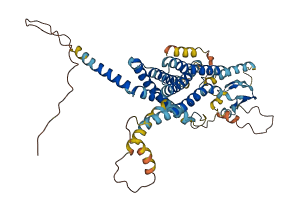
Descriptions
The autoinhibited protein was predicted that may have potential autoinhibitory elements via cis-regPred.
Autoinhibitory domains (AIDs)
Target domain |
|
Relief mechanism |
|
Assay |
cis-regPred |
Accessory elements
No accessory elements
Autoinhibited structure

Activated structure
1 structures for P70205
| Entry ID | Method | Resolution | Chain | Position | Source |
|---|---|---|---|---|---|
| AF-P70205-F1 | Predicted | AlphaFoldDB |
31 variants for P70205
| Variant ID(s) | Position | Change | Description | Diseaes Association | Provenance |
|---|---|---|---|---|---|
| rs3388820827 | 20 | A>D | No | EVA | |
| rs3388830577 | 22 | H>N | No | EVA | |
| rs3388824747 | 85 | N>Y | No | EVA | |
| rs3388831427 | 98 | S>Y | No | EVA | |
| rs3388829006 | 126 | P>S | No | EVA | |
| rs3388836557 | 135 | G>R | No | EVA | |
| rs3388828916 | 138 | D>G | No | EVA | |
| rs3388829003 | 153 | V>G | No | EVA | |
| rs3388836495 | 175 | L>M | No | EVA | |
| rs3388831885 | 192 | L>P | No | EVA | |
| rs3388824674 | 211 | Y>F | No | EVA | |
| rs247610122 | 239 | S>A | No | EVA | |
| rs3388809508 | 240 | N>Y | No | EVA | |
| rs3388831384 | 241 | Y>F | No | EVA | |
| rs3388797673 | 246 | I>N | No | EVA | |
| rs3388837747 | 262 | E>K | No | EVA | |
| rs3388818305 | 270 | T>S | No | EVA | |
| rs3388828956 | 276 | T>I | No | EVA | |
| rs3388797683 | 277 | P>L | No | EVA | |
| rs3388815663 | 280 | C>R | No | EVA | |
| rs3388797697 | 286 | V>M | No | EVA | |
| rs3388830604 | 295 | G>R | No | EVA | |
| rs3388820791 | 310 | K>* | No | EVA | |
| rs3388830640 | 334 | K>Q | No | EVA | |
| rs3388828961 | 337 | S>F | No | EVA | |
| rs3388831371 | 404 | V>I | No | EVA | |
| rs3388820854 | 415 | G>V | No | EVA | |
| rs3388809485 | 458 | H>L | No | EVA | |
| rs3388797677 | 469 | N>K | No | EVA | |
| rs3388836571 | 473 | Q>* | No | EVA | |
| rs3388828973 | 482 | S>F | No | EVA |
No associated diseases with P70205
4 regional properties for P70205
| Type | Name | Position | InterPro Accession |
|---|---|---|---|
| domain | GPCR, family 2, extracellular hormone receptor domain | 33 - 143 | IPR001879 |
| domain | GPCR, family 2-like, transmembrane domain | 153 - 432 | IPR017981 |
| conserved_site | GPCR, family 2, secretin-like, conserved site | 54 - 78 | IPR017983-1 |
| conserved_site | GPCR, family 2, secretin-like, conserved site | 420 - 435 | IPR017983-2 |
11 GO annotations of cellular component
| Name | Definition |
|---|---|
| bicellular tight junction | An occluding cell-cell junction that is composed of a branching network of sealing strands that completely encircles the apical end of each cell in an epithelial sheet; the outer leaflets of the two interacting plasma membranes are seen to be tightly apposed where sealing strands are present. Each sealing strand is composed of a long row of transmembrane adhesion proteins embedded in each of the two interacting plasma membranes. |
| caveola | A membrane raft that forms small pit, depression, or invagination that communicates with the outside of a cell and extends inward, indenting the cytoplasm and the cell membrane. Examples include flask-shaped invaginations of the plasma membrane in adipocytes associated with caveolin proteins, and minute pits or incuppings of the cell membrane formed during pinocytosis. Caveolae may be pinched off to form free vesicles within the cytoplasm. |
| cell surface | The external part of the cell wall and/or plasma membrane. |
| cytoplasm | The contents of a cell excluding the plasma membrane and nucleus, but including other subcellular structures. |
| endosome | A vacuole to which materials ingested by endocytosis are delivered. |
| integral component of membrane | The component of a membrane consisting of the gene products and protein complexes having at least some part of their peptide sequence embedded in the hydrophobic region of the membrane. |
| intracellular membrane-bounded organelle | Organized structure of distinctive morphology and function, bounded by a single or double lipid bilayer membrane and occurring within the cell. Includes the nucleus, mitochondria, plastids, vacuoles, and vesicles. Excludes the plasma membrane. |
| neuron projection | A prolongation or process extending from a nerve cell, e.g. an axon or dendrite. |
| plasma membrane | The membrane surrounding a cell that separates the cell from its external environment. It consists of a phospholipid bilayer and associated proteins. |
| receptor complex | Any protein complex that undergoes combination with a hormone, neurotransmitter, drug or intracellular messenger to initiate a change in cell function. |
| rough endoplasmic reticulum | The rough (or granular) endoplasmic reticulum (ER) has ribosomes adhering to the outer surface; the ribosomes are the site of translation of the mRNA for those proteins which are either to be retained within the cisternae (ER-resident proteins), the proteins of the lysosomes, or the proteins destined for export from the cell. Glycoproteins undergo their initial glycosylation within the cisternae. |
7 GO annotations of molecular function
| Name | Definition |
|---|---|
| adenylate cyclase binding | Binding to an adenylate cyclase. |
| G protein-coupled peptide receptor activity | Combining with a peptide and transmitting the signal across the membrane by activating an associated G-protein; promotes the exchange of GDP for GTP on the alpha subunit of a heterotrimeric G-protein complex. |
| G protein-coupled receptor activity | Combining with an extracellular signal and transmitting the signal across the membrane by activating an associated G-protein; promotes the exchange of GDP for GTP on the alpha subunit of a heterotrimeric G-protein complex. |
| neuropeptide binding | Interacting selectively and non-covalently and stoichiometrically with neuropeptides, peptides with direct synaptic effects (peptide neurotransmitters) or indirect modulatory effects on the nervous system (peptide neuromodulators). |
| peptide hormone binding | Binding to a peptide with hormonal activity in animals. |
| small GTPase binding | Binding to a small monomeric GTPase. |
| vasoactive intestinal polypeptide receptor activity | Combining with vasoactive intestinal polypeptide to initiate a change in cell activity. |
12 GO annotations of biological process
| Name | Definition |
|---|---|
| activation of phospholipase C activity | The initiation of the activity of the inactive enzyme phospolipase C as the result of The series of molecular signals generated as a consequence of a G protein-coupled receptor binding to its physiological ligand. |
| adenylate cyclase-modulating G protein-coupled receptor signaling pathway | A G protein-coupled receptor signaling pathway in which the signal is transmitted via the activation or inhibition of adenylyl cyclase activity and a subsequent change in the intracellular concentration of cyclic AMP (cAMP). |
| cAMP-mediated signaling | Any intracellular signal transduction in which the signal is passed on within the cell via cyclic AMP (cAMP). Includes production of cAMP, and downstream effectors that further transmit the signal within the cell. |
| cell differentiation | The process in which relatively unspecialized cells, e.g. embryonic or regenerative cells, acquire specialized structural and/or functional features that characterize the cells, tissues, or organs of the mature organism or some other relatively stable phase of the organism's life history. Differentiation includes the processes involved in commitment of a cell to a specific fate and its subsequent development to the mature state. |
| cell surface receptor signaling pathway | The series of molecular signals initiated by activation of a receptor on the surface of a cell. The pathway begins with binding of an extracellular ligand to a cell surface receptor, or for receptors that signal in the absence of a ligand, by ligand-withdrawal or the activity of a constitutively active receptor. The pathway ends with regulation of a downstream cellular process, e.g. transcription. |
| G protein-coupled receptor signaling pathway | The series of molecular signals initiated by a ligand binding to its receptor, in which the activated receptor promotes the exchange of GDP for GTP on the alpha-subunit of an associated heterotrimeric G-protein complex. The GTP-bound activated alpha-G-protein then dissociates from the beta- and gamma-subunits to further transmit the signal within the cell. The pathway begins with receptor-ligand interaction, and ends with regulation of a downstream cellular process. The pathway can start from the plasma membrane, Golgi or nuclear membrane. |
| negative regulation of cell death | Any process that decreases the rate or frequency of cell death. Cell death is the specific activation or halting of processes within a cell so that its vital functions markedly cease, rather than simply deteriorating gradually over time, which culminates in cell death. |
| positive regulation of calcium ion transport into cytosol | Any process that increases the rate of the directed movement of calcium ions into the cytosol of a cell. The cytosol is that part of the cytoplasm that does not contain membranous or particulate subcellular components. |
| positive regulation of cAMP-mediated signaling | Any process which activates, maintains or increases the frequency, rate or extent of cAMP-mediated signaling. |
| positive regulation of inositol phosphate biosynthetic process | Any process that increases the rate, frequency or extent of inositol phosphate biosynthesis. Inositol phosphate biosynthetic processes are the chemical reactions and pathways resulting in the formation of an inositol phosphate, 1,2,3,4,5,6-cyclohexanehexol, with one or more phosphate groups attached. |
| positive regulation of small GTPase mediated signal transduction | Any process that activates or increases the frequency, rate or extent of small GTPase mediated signal transduction. |
| spermatogenesis | The developmental process by which male germ line stem cells self renew or give rise to successive cell types resulting in the development of a spermatozoa. |
| 10 | 20 | 30 | 40 | 50 | 60 |
| MARTLQLSLT | ALLLLPMAIA | MHSDCIFKKE | QAMCLERIQR | ANDLMGLNES | SPGCPGMWDN |
| 70 | 80 | 90 | 100 | 110 | 120 |
| ITCWKPAQIG | EMVLVSCPEV | FRIFNPDQVW | MTETIGDSGF | ADSNSLEITD | MGVVGRNCTE |
| 130 | 140 | 150 | 160 | 170 | 180 |
| DGWSEPFPHY | FDACGFDDYE | PESGDQDYYY | LSVKALYTVG | YSTSLVTLTT | AMVILCRFRK |
| 190 | 200 | 210 | 220 | 230 | 240 |
| LHCTRNFIHM | NLFVSFMLRA | ISVFIKDWIL | YAEQDSSHCF | VSTVECKAVM | VFFHYCVVSN |
| 250 | 260 | 270 | 280 | 290 | 300 |
| YFWLFIEGLY | LFTLLVETFF | PERRYFYWYT | IIGWGTPTVC | VTVWAVLRLY | FDDAGCWDMN |
| 310 | 320 | 330 | 340 | 350 | 360 |
| DSTALWWVIK | GPVVGSIMVN | FVLFIGIIII | LVQKLQSPDM | GGNESSIYFS | CVQKCYCKPQ |
| 370 | 380 | 390 | 400 | 410 | 420 |
| RAQQHSCKMS | ELSTITLRLA | RSTLLLIPLF | GIHYTVFAFS | PENVSKRERL | VFELGLGSFQ |
| 430 | 440 | 450 | 460 | 470 | 480 |
| GFVVAVLYCF | LNGEVQAEIK | RKWRSWKVNR | YFTMDFKHRH | PSLASSGVNG | GTQLSILSKS |
| 490 | |||||
| SSQLRMSSLP | ADNLAT |