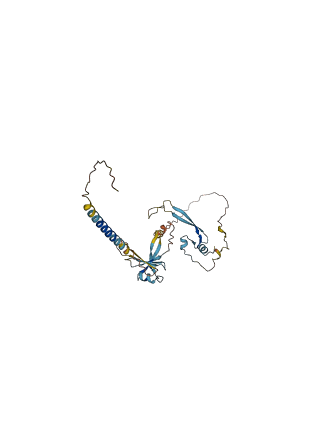
Descriptions
The autoinhibited protein was predicted that may have potential autoinhibitory elements via cis-regPred.
Autoinhibitory domains (AIDs)
Target domain |
|
Relief mechanism |
|
Assay |
cis-regPred |
Accessory elements
No accessory elements
Autoinhibited structure

Activated structure
1 structures for P58239
| Entry ID | Method | Resolution | Chain | Position | Source |
|---|---|---|---|---|---|
| AF-P58239-F1 | Predicted | AlphaFoldDB |
No variants for P58239
| Variant ID(s) | Position | Change | Description | Diseaes Association | Provenance |
|---|---|---|---|---|---|
| No variants for P58239 | |||||
No associated diseases with P58239
1 regional properties for P58239
| Type | Name | Position | InterPro Accession |
|---|---|---|---|
| domain | BRICHOS domain | 75 - 157 | IPR007084 |
3 GO annotations of cellular component
| Name | Definition |
|---|---|
| endomembrane system | A collection of membranous structures involved in transport within the cell. The main components of the endomembrane system are endoplasmic reticulum, Golgi bodies, vesicles, cell membrane and nuclear envelope. Members of the endomembrane system pass materials through each other or though the use of vesicles. |
| extracellular region | The space external to the outermost structure of a cell. For cells without external protective or external encapsulating structures this refers to space outside of the plasma membrane. This term covers the host cell environment outside an intracellular parasite. |
| integral component of membrane | The component of a membrane consisting of the gene products and protein complexes having at least some part of their peptide sequence embedded in the hydrophobic region of the membrane. |
No GO annotations of molecular function
| Name | Definition |
|---|---|
| No GO annotations for molecular function |
4 GO annotations of biological process
| Name | Definition |
|---|---|
| cartilage development | The process whose specific outcome is the progression of a cartilage element over time, from its formation to the mature structure. Cartilage elements are skeletal elements that consist of connective tissue dominated by extracellular matrix containing collagen type II and large amounts of proteoglycan, particularly chondroitin sulfate. |
| cell differentiation | The process in which relatively unspecialized cells, e.g. embryonic or regenerative cells, acquire specialized structural and/or functional features that characterize the cells, tissues, or organs of the mature organism or some other relatively stable phase of the organism's life history. Differentiation includes the processes involved in commitment of a cell to a specific fate and its subsequent development to the mature state. |
| negative regulation of angiogenesis | Any process that stops, prevents, or reduces the frequency, rate or extent of angiogenesis. |
| negative regulation of endothelial cell proliferation | Any process that stops, prevents, or reduces the rate or extent of endothelial cell proliferation. |
4 homologous proteins in AiPD
| UniProt AC | Gene Name | Protein Name | Species | Evidence Code |
|---|---|---|---|---|
| P17404 | CNMD | Leukocyte cell-derived chemotaxin 1 | Bos taurus (Bovine) | PR |
| Q9PUU8 | CNMD | Leukocyte cell-derived chemotaxin 1 | Gallus gallus (Chicken) | PR |
| O75829 | CNMD | Leukocyte cell-derived chemotaxin 1 | Homo sapiens (Human) | PR |
| Q9Z1F6 | Cnmd | Leukocyte cell-derived chemotaxin 1 | Mus musculus (Mouse) | PR |
| 10 | 20 | 30 | 40 | 50 | 60 |
| MEETAEKTPV | EAYSTLKPKG | LMKMKKTALV | AFIAGAALLL | FGGVGAFYLW | KVTEKEAISA |
| 70 | 80 | 90 | 100 | 110 | 120 |
| HLGRNIDIKI | ENDSDSAEGT | IVEVQDFKAG | ITAVKFPGKE | KCFIKSQART | ELSEDEAGVK |
| 130 | 140 | 150 | 160 | 170 | 180 |
| AEVASLVWIT | SEEPLKDSSF | LSPEILRFCA | DLPIYWHHPA | NSRALRKRRS | ATRMRRQTSA |
| 190 | 200 | 210 | 220 | 230 | 240 |
| GVNRQPARRR | NSTASARDER | PTGPEYNPEN | PYHQNQGSEG | TMVFDPMLDH | RGICCTECHR |
| 250 | 260 | 270 | 280 | ||
| SYTHCERVCE | PLGGYWPWPY | NYHGCRPVCR | LIMPCRWWAA | RVLGLV |