P58022
Gene name |
Loxl2 |
Protein name |
Lysyl oxidase homolog 2 |
Names |
MAC-inhibitory protein, MAC-IP, Membrane attack complex inhibition factor, MACIF, Protectin, Lysyl oxidase-like protein 2 |
Species |
Mus musculus (Mouse) |
KEGG Pathway |
mmu:94352 |
EC number |
1.4.3.13: With oxygen as acceptor |
Protein Class |
|
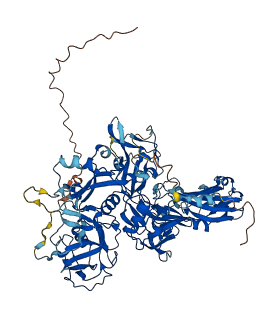
Descriptions
The autoinhibited protein was predicted that may have potential autoinhibitory elements via cis-regPred.
Autoinhibitory domains (AIDs)
Target domain |
|
Relief mechanism |
|
Assay |
cis-regPred |
Accessory elements
No accessory elements
Autoinhibited structure

Activated structure
1 structures for P58022
| Entry ID | Method | Resolution | Chain | Position | Source |
|---|---|---|---|---|---|
| AF-P58022-F1 | Predicted | AlphaFoldDB |
2 variants for P58022
| Variant ID(s) | Position | Change | Description | Diseaes Association | Provenance |
|---|---|---|---|---|---|
| rs3389336351 | 726 | D>E | No | EVA | |
| rs3389262989 | 732 | M>L | No | EVA |
No associated diseases with P58022
9 regional properties for P58022
| Type | Name | Position | InterPro Accession |
|---|---|---|---|
| domain | SRCR domain | 61 - 162 | IPR001190-1 |
| domain | SRCR domain | 191 - 305 | IPR001190-2 |
| domain | SRCR domain | 329 - 428 | IPR001190-3 |
| domain | SRCR domain | 438 - 546 | IPR001190-4 |
| domain | SRCR-like domain | 61 - 162 | IPR017448-1 |
| domain | SRCR-like domain | 189 - 305 | IPR017448-2 |
| domain | SRCR-like domain | 329 - 428 | IPR017448-3 |
| domain | SRCR-like domain | 438 - 546 | IPR017448-4 |
| conserved_site | Lysyl oxidase, conserved site | 622 - 635 | IPR019828 |
Functions
| Description | ||
|---|---|---|
| EC Number | 1.4.3.13 | With oxygen as acceptor |
| Subcellular Localization |
|
|
| PANTHER Family | ||
| PANTHER Subfamily | ||
| PANTHER Protein Class | ||
| PANTHER Pathway Category | No pathway information available | |
8 GO annotations of cellular component
| Name | Definition |
|---|---|
| basement membrane | A collagen-containing extracellular matrix consisting of a thin layer of dense material found in various animal tissues interposed between the cells and the adjacent connective tissue. It consists of the basal lamina plus an associated layer of reticulin fibers. |
| chromatin | The ordered and organized complex of DNA, protein, and sometimes RNA, that forms the chromosome. |
| collagen-containing extracellular matrix | An extracellular matrix consisting mainly of proteins (especially collagen) and glycosaminoglycans (mostly as proteoglycans) that provides not only essential physical scaffolding for the cellular constituents but can also initiate crucial biochemical and biomechanical cues required for tissue morphogenesis, differentiation and homeostasis. The components are secreted by cells in the vicinity and form a sheet underlying or overlying cells such as endothelial and epithelial cells. |
| endoplasmic reticulum | The irregular network of unit membranes, visible only by electron microscopy, that occurs in the cytoplasm of many eukaryotic cells. The membranes form a complex meshwork of tubular channels, which are often expanded into slitlike cavities called cisternae. The ER takes two forms, rough (or granular), with ribosomes adhering to the outer surface, and smooth (with no ribosomes attached). |
| extracellular space | That part of a multicellular organism outside the cells proper, usually taken to be outside the plasma membranes, and occupied by fluid. |
| membrane | A lipid bilayer along with all the proteins and protein complexes embedded in it an attached to it. |
| nucleoplasm | That part of the nuclear content other than the chromosomes or the nucleolus. |
| nucleus | A membrane-bounded organelle of eukaryotic cells in which chromosomes are housed and replicated. In most cells, the nucleus contains all of the cell's chromosomes except the organellar chromosomes, and is the site of RNA synthesis and processing. In some species, or in specialized cell types, RNA metabolism or DNA replication may be absent. |
5 GO annotations of molecular function
| Name | Definition |
|---|---|
| calcium ion binding | Binding to a calcium ion (Ca2+). |
| copper ion binding | Binding to a copper (Cu) ion. |
| oligosaccharide binding | Binding to an oligosaccharide, a molecule with between two and (about) 20 monosaccharide residues connected by glycosidic linkages. |
| protein-lysine 6-oxidase activity | Catalysis of the reaction: peptidyl-L-lysyl-peptide + H2O + O2 = peptidyl-allysyl-peptide + NH3 + hydrogen peroxide. |
| scavenger receptor activity | Combining with any modified low-density lipoprotein (LDL) or other polyanionic ligand and delivering the ligand into the cell via endocytosis. Ligands include acetylated and oxidized LDL, Gram-positive and Gram-negative bacteria, apoptotic cells, amyloid-beta fibrils, and advanced glycation end products (AGEs). |
15 GO annotations of biological process
| Name | Definition |
|---|---|
| collagen fibril organization | Any process that determines the size and arrangement of collagen fibrils within an extracellular matrix. |
| endothelial cell migration | The orderly movement of an endothelial cell into the extracellular matrix to form an endothelium. |
| endothelial cell proliferation | The multiplication or reproduction of endothelial cells, resulting in the expansion of a cell population. Endothelial cells are thin flattened cells which line the inside surfaces of body cavities, blood vessels, and lymph vessels, making up the endothelium. |
| epithelial to mesenchymal transition | A transition where an epithelial cell loses apical/basolateral polarity, severs intercellular adhesive junctions, degrades basement membrane components and becomes a migratory mesenchymal cell. |
| heterochromatin organization | Any process that results in the specification, formation or maintenance of the physical structure of eukaryotic heterochromatin, a compact and highly condensed form of chromatin. |
| negative regulation of DNA-templated transcription | Any process that stops, prevents, or reduces the frequency, rate or extent of cellular DNA-templated transcription. |
| negative regulation of stem cell population maintenance | Any process that stops, prevents or reduces the frequency, rate or extent of stem cell population maintenance. |
| negative regulation of transcription by RNA polymerase II | Any process that stops, prevents, or reduces the frequency, rate or extent of transcription mediated by RNA polymerase II. |
| peptidyl-lysine oxidation | The oxidation of the terminal amino-methylene groups of peptidyl-L-lysine or peptidyl-5-hydroxy-L-lysine to aldehyde groups to form allysine or hydroxyallysine residues, respectively; these are intermediates in the formation of covalent cross-links between adjacent polypeptide chains in proteins such as collagens. |
| positive regulation of chondrocyte differentiation | Any process that activates or increases the frequency, rate or extent of chondrocyte differentiation. |
| positive regulation of epithelial to mesenchymal transition | Any process that increases the rate, frequency, or extent of epithelial to mesenchymal transition. Epithelial to mesenchymal transition is where an epithelial cell loses apical/basolateral polarity, severs intercellular adhesive junctions, degrades basement membrane components and becomes a migratory mesenchymal cell. |
| protein modification process | The covalent alteration of one or more amino acids occurring in proteins, peptides and nascent polypeptides (co-translational, post-translational modifications). Includes the modification of charged tRNAs that are destined to occur in a protein (pre-translation modification). |
| response to copper ion | Any process that results in a change in state or activity of a cell or an organism (in terms of movement, secretion, enzyme production, gene expression, etc.) as a result of a copper ion stimulus. |
| response to hypoxia | Any process that results in a change in state or activity of a cell or an organism (in terms of movement, secretion, enzyme production, gene expression, etc.) as a result of a stimulus indicating lowered oxygen tension. Hypoxia, defined as a decline in O2 levels below normoxic levels of 20.8 - 20.95%, results in metabolic adaptation at both the cellular and organismal level. |
| sprouting angiogenesis | The extension of new blood vessels from existing vessels into avascular tissues, this process includes the specialization of endothelial cells into leading tip and stalk cells, proliferation and migration of the endothelial cells and cell adhesion resulting in angiogenic sprout fusion or lumen formation. |
1 homologous proteins in AiPD
| UniProt AC | Gene Name | Protein Name | Species | Evidence Code |
|---|---|---|---|---|
| P58022 | Loxl2 | Lysyl oxidase homolog 2 | Mus musculus (Mouse) | PR |
| 10 | 20 | 30 | 40 | 50 | 60 |
| MELHFGSCLS | GCLALLVLLP | SLSLAQYEGW | PYQLQYPEYF | QQPAPEHHQR | QVPSDVVKIQ |
| 70 | 80 | 90 | 100 | 110 | 120 |
| VRLAGQKRKH | NEGRVEVYYE | GQWGTVCDDD | FSIHAAHVVC | RQVGYVEAKS | WAASSSYGPG |
| 130 | 140 | 150 | 160 | 170 | 180 |
| EGPIWLDNIY | CTGKESTLAS | CSSNGWGVTD | CKHTEDVGVV | CSEKRIPGFK | FDNSLINQIE |
| 190 | 200 | 210 | 220 | 230 | 240 |
| SLNIQVEDIR | IRPILSAFRH | RKPVTEGYVE | VKEGKAWKQI | CNKHWTAKNS | HVVCGMFGFP |
| 250 | 260 | 270 | 280 | 290 | 300 |
| AEKTYNPKAY | KTFASRRKLR | YWKFSMNCTG | TEAHISSCKL | GPSVTRDPVK | NATCENGQPA |
| 310 | 320 | 330 | 340 | 350 | 360 |
| VVSCVPSQIF | SPDGPSRFRK | AYKPEQPLVR | LRGGAQVGEG | RVEVLKNGEW | GTICDDKWDL |
| 370 | 380 | 390 | 400 | 410 | 420 |
| VSASVVCREL | GFGTAKEAIT | GSRLGQGIGP | IHLNEVQCTG | TEKSIIDCKF | NTESQGCNHE |
| 430 | 440 | 450 | 460 | 470 | 480 |
| EDAGVRCNIP | IMGFQKKVRL | NGGRNPYEGR | VEVLTERNGS | LVWGTVCGQN | WGIVEAMVVC |
| 490 | 500 | 510 | 520 | 530 | 540 |
| RQLGLGFASN | AFQETWYWHG | NIFANNVVMS | GVKCSGTELS | LAHCRHDEEV | ACPEGGVRFG |
| 550 | 560 | 570 | 580 | 590 | 600 |
| AGVACSETAP | DLVLNAEIVQ | QTAYLEDRPM | SLLQCAMEEN | CLSASAVHTD | PTRGHRRLLR |
| 610 | 620 | 630 | 640 | 650 | 660 |
| FSSQIHNNGQ | SDFRPKNGRH | AWIWHDCHRH | YHSMEVFTYY | DLLSLNGTKV | AEGHKASFCL |
| 670 | 680 | 690 | 700 | 710 | 720 |
| EDTECEGDIQ | KSYECANFGE | QGITMGCWDM | YRHDIDCQWI | DITDVPPGDY | LFQVVINPNY |
| 730 | 740 | 750 | 760 | 770 | |
| EVPESDFSNN | IMKCRSRYDG | YRIWMYNCHV | GGAFSEETEQ | KFEHFSGLLN | NQLSVQ |