P53990
Gene name |
IST1 (KIAA0174) |
Protein name |
IST1 homolog |
Names |
hIST1, Charged multivesicular body protein 8, CHMP8, Putative MAPK-activating protein PM28 |
Species |
Homo sapiens (Human) |
KEGG Pathway |
hsa:9798 |
EC number |
|
Protein Class |
|
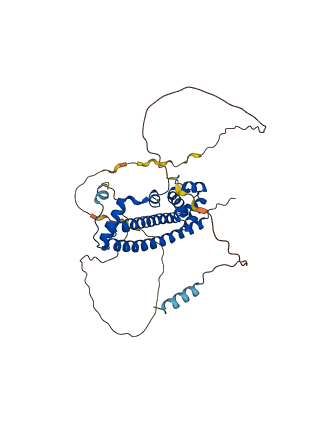
Descriptions
The autoinhibited protein was predicted that may have potential autoinhibitory elements via cis-regPred.
Autoinhibitory domains (AIDs)
Target domain |
|
Relief mechanism |
|
Assay |
cis-regPred |
Accessory elements
No accessory elements
Autoinhibited structure

Activated structure
14 structures for P53990
| Entry ID | Method | Resolution | Chain | Position | Source |
|---|---|---|---|---|---|
| 3FRR | X-ray | 180 A | A | 1-189 | PDB |
| 3FRS | X-ray | 261 A | A | 5-189 | PDB |
| 3JC1 | EM | 400 A | Aa/Ac/Ae/Ag/Ai/Ak/Am/Ao/Aq/As/Au/Aw/Ay/Ba/Bc/Be/Bg/Bi/Bk/Bm/Bo/Bq/Bs/Bu/Bw/By/Ca/Cc/Ce/Cg | 6-187 | PDB |
| 4U7E | X-ray | 160 A | A | 341-364 | PDB |
| 4U7I | X-ray | 179 A | B | 341-364 | PDB |
| 4U7Y | X-ray | 250 A | B | 341-364 | PDB |
| 4WZX | X-ray | 139 A | E | 342-364 | PDB |
| 6E8G | EM | 290 A | A/BA/BB/C/DA/DB/E/FA/FB/G/HA/HB/I/JA/JB/K/LA/LB/M/NA/NB/O/PA/PB/Q/RA/RB/S/TA/TB | 1-364 | PDB |
| 6TZ4 | EM | 320 A | 01/AA/AB/B/CA/CB/D/EA/EB/F/GA/GB/H/IA/IB/J/KA/KB/L/MA/MB/N/OA/OB/P/QA/QB/R/SA/SB | 1-189 | PDB |
| 6TZ5 | EM | 310 A | A/BA/BB/C/DA/DB/E/FA/FB/G/HA/HB/I/JA/JB/K/LA/LB/M/NA/NB/O/PA/PB/Q/RA/S/TA/V/VA | 1-189 | PDB |
| 6TZA | EM | 720 A | A/B/C/D/E/F/G/H/I/J/K/L/M/N | 1-189 | PDB |
| 7S7J | X-ray | 115 A | B | 342-364 | PDB |
| 8UC6 | X-ray | 270 A | E/G | 320-364 | PDB |
| AF-P53990-F1 | Predicted | AlphaFoldDB |
No variants for P53990
| Variant ID(s) | Position | Change | Description | Diseaes Association | Provenance |
|---|---|---|---|---|---|
| No variants for P53990 | |||||
No associated diseases with P53990
No regional properties for P53990
| Type | Name | Position | InterPro Accession |
|---|---|---|---|
| No domain, repeats, and functional sites for P53990 | |||
Functions
10 GO annotations of cellular component
| Name | Definition |
|---|---|
| azurophil granule lumen | The volume enclosed by the membrane of an azurophil granule, a primary lysosomal granule found in neutrophil granulocytes that contains a wide range of hydrolytic enzymes and is released into the extracellular fluid. |
| centrosome | A structure comprised of a core structure (in most organisms, a pair of centrioles) and peripheral material from which a microtubule-based structure, such as a spindle apparatus, is organized. Centrosomes occur close to the nucleus during interphase in many eukaryotic cells, though in animal cells it changes continually during the cell-division cycle. |
| cytosol | The part of the cytoplasm that does not contain organelles but which does contain other particulate matter, such as protein complexes. |
| endoplasmic reticulum-Golgi intermediate compartment | A complex system of membrane-bounded compartments located between endoplasmic reticulum (ER) and the Golgi complex, with a distinctive membrane protein composition; involved in ER-to-Golgi and Golgi-to-ER transport. |
| extracellular exosome | A vesicle that is released into the extracellular region by fusion of the limiting endosomal membrane of a multivesicular body with the plasma membrane. Extracellular exosomes, also simply called exosomes, have a diameter of about 40-100 nm. |
| extracellular region | The space external to the outermost structure of a cell. For cells without external protective or external encapsulating structures this refers to space outside of the plasma membrane. This term covers the host cell environment outside an intracellular parasite. |
| Flemming body | A cell part that is the central region of the midbody characterized by a gap in alpha-tubulin staining. It is a dense structure of antiparallel microtubules from the central spindle in the middle of the intercellular bridge. |
| intracellular membrane-bounded organelle | Organized structure of distinctive morphology and function, bounded by a single or double lipid bilayer membrane and occurring within the cell. Includes the nucleus, mitochondria, plastids, vacuoles, and vesicles. Excludes the plasma membrane. |
| midbody | A thin cytoplasmic bridge formed between daughter cells at the end of cytokinesis. The midbody forms where the contractile ring constricts, and may persist for some time before finally breaking to complete cytokinesis. |
| nuclear envelope | The double lipid bilayer enclosing the nucleus and separating its contents from the rest of the cytoplasm; includes the intermembrane space, a gap of width 20-40 nm (also called the perinuclear space). |
5 GO annotations of molecular function
| Name | Definition |
|---|---|
| cadherin binding | Binding to cadherin, a type I membrane protein involved in cell adhesion. |
| identical protein binding | Binding to an identical protein or proteins. |
| MIT domain binding | Binding to a MIT protein domain. The MIT domain is found in vacuolar sorting proteins, spastin (probable ATPase involved in the assembly or function of nuclear protein complexes), and a sorting nexin, which may play a role in intracellular trafficking. |
| protein domain specific binding | Binding to a specific domain of a protein. |
| protein-containing complex binding | Binding to a macromolecular complex. |
13 GO annotations of biological process
| Name | Definition |
|---|---|
| abscission | The controlled shedding of a body part. |
| cell division | The process resulting in division and partitioning of components of a cell to form more cells; may or may not be accompanied by the physical separation of a cell into distinct, individually membrane-bounded daughter cells. |
| collateral sprouting | The process in which outgrowths develop from the shafts of existing axons. |
| cytoskeleton-dependent cytokinesis | A cytokinesis that involves the function of a set of proteins that are part of the microfilament or microtubule cytoskeleton. |
| ESCRT III complex disassembly | The disaggregation of an ESCRT III complex into its constituent components. |
| establishment of protein localization | The directed movement of a protein to a specific location. |
| multivesicular body assembly | The aggregation, arrangement and bonding together of a set of components to form a multivesicular body, a type of late endosome in which regions of the limiting endosomal membrane invaginate to form internal vesicles; membrane proteins that enter the internal vesicles are sequestered from the cytoplasm. |
| positive regulation of collateral sprouting | Any process that activates or increases the frequency, rate or extent of collateral sprouting. |
| positive regulation of proteolysis | Any process that activates or increases the frequency, rate or extent of the hydrolysis of a peptide bond or bonds within a protein. |
| protein localization | Any process in which a protein is transported to, or maintained in, a specific location. |
| protein transport | The directed movement of proteins into, out of or within a cell, or between cells, by means of some agent such as a transporter or pore. |
| viral capsid secondary envelopment | The process in which a capsid acquires another membrane envelope, subsequent to acquiring an initial membrane envelope. |
| viral release from host cell | The dissemination of mature viral particles from the host cell, e.g. by cell lysis or the budding of virus particles from the cell membrane. |
| 10 | 20 | 30 | 40 | 50 | 60 |
| MLGSGFKAER | LRVNLRLVIN | RLKLLEKKKT | ELAQKARKEI | ADYLAAGKDE | RARIRVEHII |
| 70 | 80 | 90 | 100 | 110 | 120 |
| REDYLVEAME | ILELYCDLLL | ARFGLIQSMK | ELDSGLAESV | STLIWAAPRL | QSEVAELKIV |
| 130 | 140 | 150 | 160 | 170 | 180 |
| ADQLCAKYSK | EYGKLCRTNQ | IGTVNDRLMH | KLSVEAPPKI | LVERYLIEIA | KNYNVPYEPD |
| 190 | 200 | 210 | 220 | 230 | 240 |
| SVVMAEAPPG | VETDLIDVGF | TDDVKKGGPG | RGGSGGFTAP | VGGPDGTVPM | PMPMPMPSAN |
| 250 | 260 | 270 | 280 | 290 | 300 |
| TPFSYPLPKG | PSDFNGLPMG | TYQAFPNIHP | PQIPATPPSY | ESVDDINADK | NISSAQIVGP |
| 310 | 320 | 330 | 340 | 350 | 360 |
| GPKPEASAKL | PSRPADNYDN | FVLPELPSVP | DTLPTASAGA | STSASEDIDF | DDLSRRFEEL |
| KKKT |