P53303
Gene name |
ZPR1 (YGR211W) |
Protein name |
Zinc finger protein ZPR1 |
Names |
|
Species |
Saccharomyces cerevisiae (strain ATCC 204508 / S288c) (Baker's yeast) |
KEGG Pathway |
sce:YGR211W |
EC number |
|
Protein Class |
|
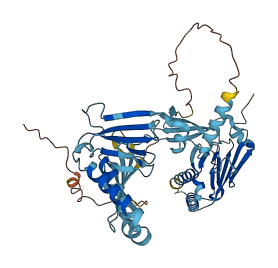
Descriptions
The autoinhibited protein was predicted that may have potential autoinhibitory elements via cis-regPred.
Autoinhibitory domains (AIDs)
Target domain |
|
Relief mechanism |
|
Assay |
cis-regPred |
Accessory elements
No accessory elements
Autoinhibited structure

Activated structure
1 structures for P53303
| Entry ID | Method | Resolution | Chain | Position | Source |
|---|---|---|---|---|---|
| AF-P53303-F1 | Predicted | AlphaFoldDB |
5 variants for P53303
| Variant ID(s) | Position | Change | Description | Diseaes Association | Provenance |
|---|---|---|---|---|---|
| s07-915264 | 7 | D>H | No | SGRP | |
| s07-915343 | 33 | G>D | No | SGRP | |
| s07-915625 | 127 | T>I | No | SGRP | |
| s07-915958 | 238 | I>T | No | SGRP | |
| s07-916525 | 427 | K>M | No | SGRP |
No associated diseases with P53303
2 regional properties for P53303
| Type | Name | Position | InterPro Accession |
|---|---|---|---|
| domain | Zinc finger, ZPR1-type | 52 - 212 | IPR004457-1 |
| domain | Zinc finger, ZPR1-type | 293 - 486 | IPR004457-2 |
2 GO annotations of cellular component
| Name | Definition |
|---|---|
| cytoplasm | The contents of a cell excluding the plasma membrane and nucleus, but including other subcellular structures. |
| nucleus | A membrane-bounded organelle of eukaryotic cells in which chromosomes are housed and replicated. In most cells, the nucleus contains all of the cell's chromosomes except the organellar chromosomes, and is the site of RNA synthesis and processing. In some species, or in specialized cell types, RNA metabolism or DNA replication may be absent. |
1 GO annotations of molecular function
| Name | Definition |
|---|---|
| zinc ion binding | Binding to a zinc ion (Zn). |
2 GO annotations of biological process
| Name | Definition |
|---|---|
| G2/M transition of mitotic cell cycle | The mitotic cell cycle transition by which a cell in G2 commits to M phase. The process begins when the kinase activity of M cyclin/CDK complex reaches a threshold high enough for the cell cycle to proceed. This is accomplished by activating a positive feedback loop that results in the accumulation of unphosphorylated and active M cyclin/CDK complex. |
| response to glucose | Any process that results in a change in state or activity of a cell or an organism (in terms of movement, secretion, enzyme production, gene expression, etc.) as a result of a glucose stimulus. |
| 10 | 20 | 30 | 40 | 50 | 60 |
| MSEQKEDLFK | PVGEAAAEVE | DESIAEQNKA | NDGVKLTGAQ | DAMGHPVQEI | ESLCMNCGKN |
| 70 | 80 | 90 | 100 | 110 | 120 |
| GTTRLLLTSI | PYFREIIIMS | FDCPHCGFKN | CEIQPASQIQ | EKGSRYVLKV | ECREDFNRQV |
| 130 | 140 | 150 | 160 | 170 | 180 |
| IKSETATCKF | VELDIEIPAK | RGQLTTVEGL | LSEMIDDLSQ | DQEMRKSIDE | ALYKKIDDFI |
| 190 | 200 | 210 | 220 | 230 | 240 |
| QKVKSYINCE | PNTIPITFIL | DDPAGNSWIE | YKPGEPQHKW | SHTQYVRTDE | QNVQVGIITR |
| 250 | 260 | 270 | 280 | 290 | 300 |
| DQLEQRRQEQ | LKQLANRERN | PSESVKVGSA | NPQFLSDATD | IENFNNEVQT | FRASCPSCTQ |
| 310 | 320 | 330 | 340 | 350 | 360 |
| ECETHMKPVN | IPHFKEVIIM | STVCDHCGYK | SNEVKTGGAI | PDKGRRITLY | CDDAADLSRD |
| 370 | 380 | 390 | 400 | 410 | 420 |
| ILKSETCSMV | IPELHLDIQE | GTLGGRFTTL | EGLLRQVYEE | LESRIFTQTS | DSMDEATKAR |
| 430 | 440 | 450 | 460 | 470 | 480 |
| WVEFFAKLKE | AIAGKVKFTV | IMEDPLAGSY | IQNVYAPDPD | PNMTIEDYER | TKEQNEDLGL |
| SDIKVE |