P53104
Gene name |
ATG1 |
Protein name |
Serine/threonine-protein kinase ATG1 |
Names |
Autophagy protein 3, Autophagy-related protein 1, Cytoplasm to vacuole targeting protein 10 |
Species |
Saccharomyces cerevisiae (strain ATCC 204508 / S288c) (Baker's yeast) |
KEGG Pathway |
sce:YGL180W |
EC number |
2.7.11.1: Protein-serine/threonine kinases |
Protein Class |
|
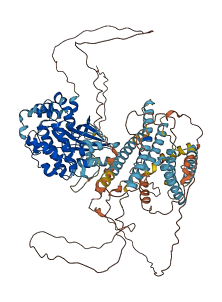
Descriptions
The autoinhibited protein was predicted that may have potential autoinhibitory elements via cis-regPred.
Autoinhibitory domains (AIDs)
Target domain |
|
Relief mechanism |
|
Assay |
cis-regPred |
Accessory elements
210-232 (Activation loop from InterPro)
Target domain |
24-325 (Protein kinase domain) |
Relief mechanism |
|
Assay |
|
Autoinhibited structure

Activated structure
1 structures for P53104
| Entry ID | Method | Resolution | Chain | Position | Source |
|---|---|---|---|---|---|
| AF-P53104-F1 | Predicted | AlphaFoldDB |
11 variants for P53104
| Variant ID(s) | Position | Change | Description | Diseaes Association | Provenance |
|---|---|---|---|---|---|
| s07-160968 | 300 | E>* | No | SGRP | |
| s07-160969 | 300 | E>G | No | SGRP | |
| s07-161004 | 312 | Q>K | No | SGRP | |
| s07-161193 | 375 | S>P | No | SGRP | |
| s07-161233 | 388 | K>R | No | SGRP | |
| s07-161451 | 461 | S>P | No | SGRP | |
| s07-161533 | 488 | P>L | No | SGRP | |
| s07-161551 | 494 | T>R | No | SGRP | |
| s07-162018 | 650 | A>T | No | SGRP | |
| s07-162649 | 860 | K>T | No | SGRP | |
| s07-162760 | 897 | N>S | No | SGRP |
No associated diseases with P53104
4 regional properties for P53104
| Type | Name | Position | InterPro Accession |
|---|---|---|---|
| domain | Protein kinase domain | 24 - 325 | IPR000719 |
| active_site | Serine/threonine-protein kinase, active site | 168 - 180 | IPR008271 |
| binding_site | Protein kinase, ATP binding site | 30 - 54 | IPR017441 |
| domain | Serine/threonine-protein kinase Atg1-like, tMIT domain | 588 - 893 | IPR022708 |
Functions
| Description | ||
|---|---|---|
| EC Number | 2.7.11.1 | Protein-serine/threonine kinases |
| Subcellular Localization |
|
|
| PANTHER Family | ||
| PANTHER Subfamily | ||
| PANTHER Protein Class | ||
| PANTHER Pathway Category | No pathway information available | |
9 GO annotations of cellular component
| Name | Definition |
|---|---|
| Atg1/ULK1 kinase complex | A protein complex consisting of Atg1 (or Atg1 homologs e.g. ULK1, ULK2 in mammals) and Atg13 along with other proteins that regulate its function (e.g. Atg17 in yeast or RB1CC1(FIP200) in mammals). This complex has serine/threonine protein kinase activity and is involved in autophagosome formation. |
| autophagosome membrane | The lipid bilayer surrounding an autophagosome, a double-membrane-bounded vesicle in which endogenous cellular material is sequestered. |
| cytoplasm | The contents of a cell excluding the plasma membrane and nucleus, but including other subcellular structures. |
| cytosol | The part of the cytoplasm that does not contain organelles but which does contain other particulate matter, such as protein complexes. |
| extrinsic component of autophagosome membrane | The component of the autophagosome membrane consisting of gene products and protein complexes that are loosely bound to one of its surfaces, but not integrated into the hydrophobic region. |
| phagophore | A disk-like structure that expands, rounds up into a cup-shaped structure, and eventually closes around its cargo (for example cytoplasmic components) to become an autophagosome or Cvt vesicle. |
| phagophore assembly site | Punctate structures proximal to the endoplasmic reticulum which are the sites where the Atg machinery assembles upon autophagy induction. |
| phagophore assembly site membrane | A cellular membrane associated with the phagophore assembly site. |
| vacuole-isolation membrane contact site | An organelle membrane contact site formed at the junction of the vacuolar membrane and the isolation membrane or phagophore in response to starvation or other stresses, leading to the formation of the autophagosome. |
4 GO annotations of molecular function
| Name | Definition |
|---|---|
| ATP binding | Binding to ATP, adenosine 5'-triphosphate, a universally important coenzyme and enzyme regulator. |
| protein kinase activity | Catalysis of the phosphorylation of an amino acid residue in a protein, usually according to the reaction: a protein + ATP = a phosphoprotein + ADP. |
| protein serine kinase activity | Catalysis of the reactions: ATP + protein serine = ADP + protein serine phosphate. |
| protein serine/threonine kinase activity | Catalysis of the reactions: ATP + protein serine = ADP + protein serine phosphate, and ATP + protein threonine = ADP + protein threonine phosphate. |
11 GO annotations of biological process
| Name | Definition |
|---|---|
| autophagosome assembly | The formation of a double membrane-bounded structure, the autophagosome, that occurs when a specialized membrane sac, called the isolation membrane, starts to enclose a portion of the cytoplasm. |
| autophagy | The cellular catabolic process in which cells digest parts of their own cytoplasm; allows for both recycling of macromolecular constituents under conditions of cellular stress and remodeling the intracellular structure for cell differentiation. |
| autophagy of mitochondrion | The autophagic process in which mitochondria are delivered to a type of vacuole and degraded in response to changing cellular conditions. |
| cytoplasm to vacuole transport by the Cvt pathway | A cytoplasm to vacuole targeting pathway that uses machinery common with autophagy. The Cvt vesicle is formed when the receptor protein, Atg19, binds to the complexes of the target protein (aminopeptidase or alpha-mannosidase homododecamers), forming the Cvt complex. Atg11 binds to Atg9 and transports the Cvt complex to the pre-autophagosome (PAS). The phagophore membrane expands around the Cvt complex (excluding bulk cytoplasm) forming the Cvt vesicle. This pathway is mostly observed in yeast. |
| late nucleophagy | A type of nucleophagy, distinct from piecemeal microautophagy of the nucleus (PNM) where the nuclear material is delivered to the vacuole/lysosome for breakdown and recycling later than observed for PNM. |
| macroautophagy | The major inducible pathway for the general turnover of cytoplasmic constituents in eukaryotic cells, it is also responsible for the degradation of active cytoplasmic enzymes and organelles during nutrient starvation. Macroautophagy involves the formation of double-membrane-bounded autophagosomes which enclose the cytoplasmic constituent targeted for degradation in a membrane-bounded structure. Autophagosomes then fuse with a lysosome (or vacuole) releasing single-membrane-bounded autophagic bodies that are then degraded within the lysosome (or vacuole). Some types of macroautophagy, e.g. pexophagy, mitophagy, involve selective targeting of the targets to be degraded. |
| peptidyl-serine phosphorylation | The phosphorylation of peptidyl-serine to form peptidyl-O-phospho-L-serine. |
| piecemeal microautophagy of the nucleus | Degradation of a cell nucleus by lysosomal microautophagy. |
| protein phosphorylation | The process of introducing a phosphate group on to a protein. |
| response to starvation | Any process that results in a change in state or activity of a cell or an organism (in terms of movement, secretion, enzyme production, gene expression, etc.) as a result of a starvation stimulus, deprivation of nourishment. |
| reticulophagy | The selective autohagy process in which parts of the endoplasmic reticulum are loaded into autophagosomes, delivered to the vacuole, and degraded in response to changing cellular conditions. |
1 homologous proteins in AiPD
| UniProt AC | Gene Name | Protein Name | Species | Evidence Code |
|---|---|---|---|---|
| Q9QY01 | Ulk2 | Serine/threonine-protein kinase ULK2 | Mus musculus (Mouse) | PR |
| 10 | 20 | 30 | 40 | 50 | 60 |
| MGDIKNKDHT | TSVNHNLMAS | AGNYTAEKEI | GKGSFATVYR | GHLTSDKSQH | VAIKEVSRAK |
| 70 | 80 | 90 | 100 | 110 | 120 |
| LKNKKLLENL | EIEIAILKKI | KHPHIVGLID | CERTSTDFYL | IMEYCALGDL | TFLLKRRKEL |
| 130 | 140 | 150 | 160 | 170 | 180 |
| MENHPLLRTV | FEKYPPPSEN | HNGLHRAFVL | SYLQQLASAL | KFLRSKNLVH | RDIKPQNLLL |
| 190 | 200 | 210 | 220 | 230 | 240 |
| STPLIGYHDS | KSFHELGFVG | IYNLPILKIA | DFGFARFLPN | TSLAETLCGS | PLYMAPEILN |
| 250 | 260 | 270 | 280 | 290 | 300 |
| YQKYNAKADL | WSVGTVVFEM | CCGTPPFRAS | NHLELFKKIK | RANDVITFPS | YCNIEPELKE |
| 310 | 320 | 330 | 340 | 350 | 360 |
| LICSLLTFDP | AQRIGFEEFF | ANKVVNEDLS | SYELEDDLPE | LESKSKGIVE | SNMFVSEYLS |
| 370 | 380 | 390 | 400 | 410 | 420 |
| KQPKSPNSNL | AGHQSMADNP | AELSDALKNS | NILTAPAVKT | DHTQAVDKKA | SNNKYHNSLV |
| 430 | 440 | 450 | 460 | 470 | 480 |
| SDRSFEREYV | VVEKKSVEVN | SLADEVAQAG | FNPNPIKHPT | STQNQNVLLN | EQFSPNNQQY |
| 490 | 500 | 510 | 520 | 530 | 540 |
| FQNQGENPRL | LRATSSSSGG | SDGSRRPSLV | DRRLSISSLN | PSNALSRALG | IASTRLFGGA |
| 550 | 560 | 570 | 580 | 590 | 600 |
| NQQQQQQQIT | SSPPYSQTLL | NSQLFHELTE | NIILRIDHLQ | HPETLKLDNT | NIVSILESLA |
| 610 | 620 | 630 | 640 | 650 | 660 |
| AKAFVVYSYA | EVKFSQIVPL | STTLKGMANF | ENRRSMDSNA | IAEEQDSDDA | EEEDETLKKY |
| 670 | 680 | 690 | 700 | 710 | 720 |
| KEDCLSTKTF | GKGRTLSATS | QLSATFNKLP | RSEMILLCNE | AIVLYMKALS | ILSKSMQVTS |
| 730 | 740 | 750 | 760 | 770 | 780 |
| NWWYESQEKS | CSLRVNVLVQ | WLREKFNECL | EKADFLRLKI | NDLRFKHASE | VAENQTLEEK |
| 790 | 800 | 810 | 820 | 830 | 840 |
| GSSEEPVYLE | KLLYDRALEI | SKMAAHMELK | GENLYNCELA | YATSLWMLET | SLDDDDFTNA |
| 850 | 860 | 870 | 880 | 890 | |
| YGDYPFKTNI | HLKSNDVEDK | EKYHSVLDEN | DRIIIRKYID | SIANRLKILR | QKMNHQN |