P51868
Gene name |
Casq2 |
Protein name |
Calsequestrin-2 |
Names |
PECAM-1, Apo-1 antigen, Apoptosis-mediating surface antigen FAS, FASLG receptor, Calsequestrin, cardiac muscle isoform |
Species |
Rattus norvegicus (Rat) |
KEGG Pathway |
rno:29209 |
EC number |
|
Protein Class |
|
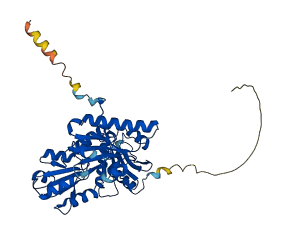
Descriptions
The autoinhibited protein was predicted that may have potential autoinhibitory elements via cis-regPred.
Autoinhibitory domains (AIDs)
Target domain |
|
Relief mechanism |
|
Assay |
cis-regPred |
Accessory elements
No accessory elements
Autoinhibited structure

Activated structure
1 structures for P51868
| Entry ID | Method | Resolution | Chain | Position | Source |
|---|---|---|---|---|---|
| AF-P51868-F1 | Predicted | AlphaFoldDB |
No variants for P51868
| Variant ID(s) | Position | Change | Description | Diseaes Association | Provenance |
|---|---|---|---|---|---|
| No variants for P51868 | |||||
No associated diseases with P51868
3 regional properties for P51868
| Type | Name | Position | InterPro Accession |
|---|---|---|---|
| conserved_site | Calreticulin/calnexin, conserved site | 101 - 116 | IPR018124-1 |
| conserved_site | Calreticulin/calnexin, conserved site | 133 - 141 | IPR018124-2 |
| conserved_site | Calreticulin/calnexin, conserved site | 246 - 258 | IPR018124-3 |
Functions
5 GO annotations of cellular component
| Name | Definition |
|---|---|
| cytoplasm | The contents of a cell excluding the plasma membrane and nucleus, but including other subcellular structures. |
| junctional membrane complex | Complex formed in muscle cells between the membrane of the sarcoplasmic reticulum and invaginations of the plasma membrane (T-tubules). |
| sarcoplasmic reticulum | A fine reticular network of membrane-limited elements that pervades the sarcoplasm of a muscle cell; continuous over large portions of the cell and with the nuclear envelope; that part of the endoplasmic reticulum specialized for calcium release, uptake and storage. |
| sarcoplasmic reticulum lumen | The volume enclosed by the membranes of the sarcoplasmic reticulum. |
| Z disc | Platelike region of a muscle sarcomere to which the plus ends of actin filaments are attached. |
5 GO annotations of molecular function
| Name | Definition |
|---|---|
| calcium ion binding | Binding to a calcium ion (Ca2+). |
| calcium ion sequestering activity | Binding to a calcium ion to prevent it from interacting with other partners or to inhibit its localization to the area of the cell or complex where it is active. |
| calcium-dependent protein binding | Binding to a protein or protein complex in the presence of calcium. |
| protein homodimerization activity | Binding to an identical protein to form a homodimer. |
| protein kinase C binding | Binding to protein kinase C. |
16 GO annotations of biological process
| Name | Definition |
|---|---|
| cardiac muscle contraction | Muscle contraction of cardiac muscle tissue. |
| cellular calcium ion homeostasis | Any process involved in the maintenance of an internal steady state of calcium ions at the level of a cell. |
| cellular response to caffeine | Any process that results in a change in state or activity of a cell (in terms of movement, secretion, enzyme production, gene expression, etc.) as a result of a caffeine stimulus. Caffeine is an alkaloid found in numerous plant species, where it acts as a natural pesticide that paralyzes and kills certain insects feeding upon them. |
| negative regulation of potassium ion transmembrane transporter activity | Any process that stops, prevents or reduces the frequency, rate or extent of potassium ion transmembrane transporter activity. |
| negative regulation of potassium ion transport | Any process that stops, prevents, or reduces the frequency, rate or extent of the directed movement of potassium ions (K+) into, out of or within a cell, or between cells, by means of some agent such as a transporter or pore. |
| negative regulation of ryanodine-sensitive calcium-release channel activity | Any process that decreases the activity of a ryanodine-sensitive calcium-release channel. The ryanodine-sensitive calcium-release channel catalyzes the transmembrane transfer of a calcium ion by a channel that opens when a ryanodine class ligand has been bound by the channel complex or one of its constituent parts. |
| protein polymerization | The process of creating protein polymers, compounds composed of a large number of component monomers; polymeric proteins may be made up of different or identical monomers. Polymerization occurs by the addition of extra monomers to an existing poly- or oligomeric protein. |
| regulation of cardiac muscle cell contraction | Any process that modulates the frequency, rate or extent of cardiac muscle cell contraction. |
| regulation of cardiac muscle contraction by regulation of the release of sequestered calcium ion | Any process that modulates the frequency, rate or extent of cardiac muscle contraction via the regulation of the release of sequestered calcium ion by sarcoplasmic reticulum into cytosol. The sarcoplasmic reticulum is the endoplasmic reticulum of striated muscle, specialised for the sequestration of calcium ions that are released upon receipt of a signal relayed by the T tubules from the neuromuscular junction. |
| regulation of cell communication by electrical coupling | Any process that modulates the frequency, rate or extent of cell communication via electrical coupling. Cell communication via electrical coupling is the process that mediates signaling interactions between one cell and another cell by transfer of current between their adjacent cytoplasms via intercellular protein channels. |
| regulation of heart rate | Any process that modulates the frequency or rate of heart contraction. |
| regulation of membrane repolarization | Any process that modulates the establishment or extent of a membrane potential in the polarizing direction towards the resting potential, usually from positive to negative. |
| regulation of release of sequestered calcium ion into cytosol | Any process that modulates the frequency, rate or extent of the release into the cytosolic compartment of calcium ions sequestered in the endoplasmic reticulum or mitochondria. |
| regulation of release of sequestered calcium ion into cytosol by sarcoplasmic reticulum | Any process that modulates the rate, frequency or extent of release of sequestered calcium ion into cytosol by the sarcoplasmic reticulum, the process in which the release of sequestered calcium ion by sarcoplasmic reticulum into cytosol occurs via calcium release channels. |
| sarcomere organization | The myofibril assembly process that results in the organization of muscle actomyosin into sarcomeres. The sarcomere is the repeating unit of a myofibril in a muscle cell, composed of an array of overlapping thick and thin filaments between two adjacent Z discs. |
| sequestering of calcium ion | The process of binding or confining calcium ions such that they are separated from other components of a biological system. |
| 10 | 20 | 30 | 40 | 50 | 60 |
| MKRIYLLVVG | LYLLSFSRAE | EGLNFPTYDG | KDRVVSLSEK | NLKQVLKRYD | LLCLYYHEPV |
| 70 | 80 | 90 | 100 | 110 | 120 |
| SSDKVAQKQF | QLKEIVLELV | AQVLEHKNIG | FVMVDSRKEA | KLAKRLGFSE | EGSLYVLKGG |
| 130 | 140 | 150 | 160 | 170 | 180 |
| RTIEFDGEFA | ADVLVEFLLD | LIEDPVEIVN | NKLEVQAFER | IEDQIKLLGF | FKNEDSEYYK |
| 190 | 200 | 210 | 220 | 230 | 240 |
| AFQEAAEHFQ | PYIKFFATFD | KGVAKKLSLK | MNEVGFYEPF | MDEPSVIPNK | PYTEEELVEF |
| 250 | 260 | 270 | 280 | 290 | 300 |
| VKEHQRPTLR | PLRPEDMFET | WEDDLNGIHI | VAFAEKSDPD | GYEFLEILKQ | VARDNTDNPD |
| 310 | 320 | 330 | 340 | 350 | 360 |
| LSILWIDPDD | FPLLVAYWEK | TFKIDLFKPQ | IGVVNVTDAD | SVWMEIPDDD | DLPTAEELED |
| 370 | 380 | 390 | 400 | 410 | |
| WIEDVLSGKI | NTEDDDNEDE | DDDGDNDNDD | DDDDDDNSDE | DNDDSDDDDD | DDE |