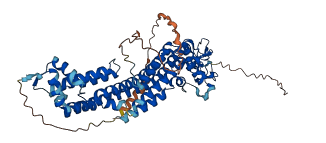
Descriptions
The autoinhibited protein was predicted that may have potential autoinhibitory elements via cis-regPred.
Autoinhibitory domains (AIDs)
Target domain |
|
Relief mechanism |
|
Assay |
cis-regPred |
Accessory elements
No accessory elements
Autoinhibited structure

Activated structure
1 structures for P50593
| Entry ID | Method | Resolution | Chain | Position | Source |
|---|---|---|---|---|---|
| AF-P50593-F1 | Predicted | AlphaFoldDB |
No variants for P50593
| Variant ID(s) | Position | Change | Description | Diseaes Association | Provenance |
|---|---|---|---|---|---|
| No variants for P50593 | |||||
No associated diseases with P50593
1 regional properties for P50593
| Type | Name | Position | InterPro Accession |
|---|---|---|---|
| conserved_site | Glypican, conserved site | 253 - 276 | IPR019803 |
6 GO annotations of cellular component
| Name | Definition |
|---|---|
| anchored component of plasma membrane | The component of the plasma membrane consisting of the gene products that are tethered to the membrane only by a covalently attached anchor, such as a lipid group, that is embedded in the membrane. Gene products with peptide sequences that are embedded in the membrane are excluded from this grouping. |
| cell surface | The external part of the cell wall and/or plasma membrane. |
| collagen-containing extracellular matrix | An extracellular matrix consisting mainly of proteins (especially collagen) and glycosaminoglycans (mostly as proteoglycans) that provides not only essential physical scaffolding for the cellular constituents but can also initiate crucial biochemical and biomechanical cues required for tissue morphogenesis, differentiation and homeostasis. The components are secreted by cells in the vicinity and form a sheet underlying or overlying cells such as endothelial and epithelial cells. |
| endosome | A vacuole to which materials ingested by endocytosis are delivered. |
| extracellular space | That part of a multicellular organism outside the cells proper, usually taken to be outside the plasma membranes, and occupied by fluid. |
| synapse | The junction between an axon of one neuron and a dendrite of another neuron, a muscle fiber or a glial cell. As the axon approaches the synapse it enlarges into a specialized structure, the presynaptic terminal bouton, which contains mitochondria and synaptic vesicles. At the tip of the terminal bouton is the presynaptic membrane; facing it, and separated from it by a minute cleft (the synaptic cleft) is a specialized area of membrane on the receiving cell, known as the postsynaptic membrane. In response to the arrival of nerve impulses, the presynaptic terminal bouton secretes molecules of neurotransmitters into the synaptic cleft. These diffuse across the cleft and transmit the signal to the postsynaptic membrane. |
1 GO annotations of molecular function
| Name | Definition |
|---|---|
| fibroblast growth factor binding | Binding to a fibroblast growth factor. |
7 GO annotations of biological process
| Name | Definition |
|---|---|
| cell migration | The controlled self-propelled movement of a cell from one site to a destination guided by molecular cues. Cell migration is a central process in the development and maintenance of multicellular organisms. |
| negative regulation of fibroblast growth factor receptor signaling pathway | Any process that stops, prevents, or reduces the frequency, rate or extent of fibroblast growth factor receptor signaling pathway activity. |
| negative regulation of satellite cell differentiation | Any process that stops, prevents or reduces the frequency, rate or extent of satellite cell differentiation. |
| negative regulation of skeletal muscle satellite cell proliferation | Any process that stops, prevents or reduces the frequency, rate or extent of satellite cell proliferation. |
| positive regulation of skeletal muscle satellite cell differentiation | Any process that activates or increases the frequency, rate or extent of satellite cell differentiation. |
| positive regulation of skeletal muscle satellite cell proliferation | Any process that activates or increases the frequency, rate or extent of skeletal muscle satellite cell proliferation. |
| regulation of protein localization to membrane | Any process that modulates the frequency, rate or extent of protein localization to membrane. |
| 10 | 20 | 30 | 40 | 50 | 60 |
| MRFFPWGFWL | LCVASAPARG | DSGSKARSCA | EVRQLYGAKG | FSLNGVPQAE | ISGEHLRICP |
| 70 | 80 | 90 | 100 | 110 | 120 |
| QGYTCCTSEM | EENFANKSRS | EFEAMMKEAG | RSVQTILTAQ | YKSFDNYFQD | LLNKSEKALY |
| 130 | 140 | 150 | 160 | 170 | 180 |
| DTFPSLYGDL | YTQNMKVFKD | LYSELRRYYR | GSNINLEEAL | NEFWTRLLER | LFKLMNAQYH |
| 190 | 200 | 210 | 220 | 230 | 240 |
| ITDEYLDCMV | KHAEQHKPFG | EVPRDLKVKA | TRAFIVARSY | AQGFLVGSDV | VKKVSQVSLS |
| 250 | 260 | 270 | 280 | 290 | 300 |
| HECTRAVMKL | MYCPHCRGMA | SVKPCSNYCL | NVVKGCLANQ | ADLNTEWKYL | MDALVAVADR |
| 310 | 320 | 330 | 340 | 350 | 360 |
| IDGPYNVDTV | IGTIHMRISE | AISNLQENKV | SITAKVFQGC | GNPKVSMKGS | SSEDKKRRGK |
| 370 | 380 | 390 | 400 | 410 | 420 |
| VTLEAKSSAV | ALEMLVLDAK | GNLTALKSYW | VTLPGVLCSK | KIMASPAEDD | KCWNGMTKGS |
| 430 | 440 | 450 | 460 | 470 | 480 |
| YLPEVMGGGL | ANQINNPEVE | VDITKPDMTI | RQQIMQLKIM | TNRLGNANIG | NDVDFQDASD |
| 490 | 500 | 510 | 520 | 530 | 540 |
| DMSGSGSGDS | CPDDVCVKRL | SKSPSTRQPE | THAIPKQSGH | GVIGASSRSL | PSAFLLFLSG |
| ASIVVQHLWR |